

338
7 Wave Functions in the Vicinity of Particle-Emission Threshold
will be shown to be particularly visible in spectroscopic factors. It will be directly
quantified through the calculation of the expectation value of the isospin operator,
denoted as ˆ
T 2 .
7.4.1 Two-Particle Reaction Cross Sections and Wigner Cusps
In a closed quantum system framework, the cross section is often modelled by the
product of the cross sections coming from a one-body potential and the associated
spectroscopic factors:
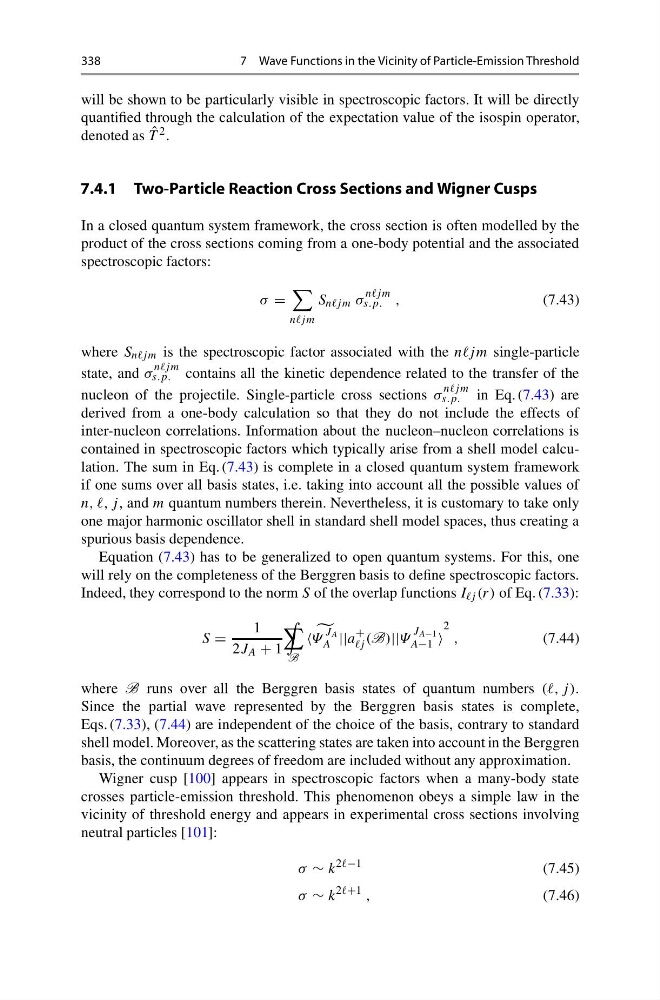
σ =
nnj m
S nnj m σ
nnj m
s.p. ,
(7.43)
where S nnj m is the spectroscopic factor associated with the nnj m single-particle
state, and σ
nnj m
s.p. contains all the kinetic dependence related to the transfer of the
nucleon of the projectile. Single-particle cross sections σ
nnj m
s.p. in Eq. (7.43) are
derived from a one-body calculation so that they do not include the effects of
inter-nucleon correlations. Information about the nucleon–nucleon correlations is
contained in spectroscopic factors which typically arise from a shell model calculation. The sum in Eq. (7.43) is complete in a closed quantum system framework
if one sums over all basis states, i.e. taking into account all the possible values of
n, ,, j , and m quantum numbers therein. Nevertheless, it is customary to take only
one major harmonic oscillator shell in standard shell model spaces, thus creating a
spurious basis dependence.
Equation (7.43) has to be generalized to open quantum systems. For this, one
will rely on the completeness of the Berggren basis to define spectroscopic factors.
Indeed, they correspond to the norm S of the overlap functions I j (r) of Eq. (7.33):
S =
1
2J A + 1
B
Ψ
J A
A ||a
+
(B)||Ψ
J A−1
A−1
2
,
(7.44)
where B runs over all the Berggren basis states of quantum numbers ((, j ).
Since the partial wave represented by the Berggren basis states is complete,
Eqs. (7.33), (7.44) are independent of the choice of the basis, contrary to standard
shell model. Moreover, as the scattering states are taken into account in the Berggren
basis, the continuum degrees of freedom are included without any approximation.
Wigner cusp [100] appears in spectroscopic factors when a many-body state
crosses particle-emission threshold. This phenomenon obeys a simple law in the
vicinity of threshold energy and appears in experimental cross sections involving
neutral particles [101]:
σ ∼ k
2
(7.45)
σ ∼ k
2 ,
(7.46)
7 Wave Functions in the Vicinity of Particle-Emission Threshold
will be shown to be particularly visible in spectroscopic factors. It will be directly
quantified through the calculation of the expectation value of the isospin operator,
denoted as ˆ
T 2 .
7.4.1 Two-Particle Reaction Cross Sections and Wigner Cusps
In a closed quantum system framework, the cross section is often modelled by the
product of the cross sections coming from a one-body potential and the associated
spectroscopic factors:
σ =
nnj m
S nnj m σ
nnj m
s.p. ,
(7.43)
where S nnj m is the spectroscopic factor associated with the nnj m single-particle
state, and σ
nnj m
s.p. contains all the kinetic dependence related to the transfer of the
nucleon of the projectile. Single-particle cross sections σ
nnj m
s.p. in Eq. (7.43) are
derived from a one-body calculation so that they do not include the effects of
inter-nucleon correlations. Information about the nucleon–nucleon correlations is
contained in spectroscopic factors which typically arise from a shell model calculation. The sum in Eq. (7.43) is complete in a closed quantum system framework
if one sums over all basis states, i.e. taking into account all the possible values of
n, ,, j , and m quantum numbers therein. Nevertheless, it is customary to take only
one major harmonic oscillator shell in standard shell model spaces, thus creating a
spurious basis dependence.
Equation (7.43) has to be generalized to open quantum systems. For this, one
will rely on the completeness of the Berggren basis to define spectroscopic factors.
Indeed, they correspond to the norm S of the overlap functions I j (r) of Eq. (7.33):
S =
1
2J A + 1
B
Ψ
J A
A ||a
+
(B)||Ψ
J A−1
A−1
2
,
(7.44)
where B runs over all the Berggren basis states of quantum numbers ((, j ).
Since the partial wave represented by the Berggren basis states is complete,
Eqs. (7.33), (7.44) are independent of the choice of the basis, contrary to standard
shell model. Moreover, as the scattering states are taken into account in the Berggren
basis, the continuum degrees of freedom are included without any approximation.
Wigner cusp [100] appears in spectroscopic factors when a many-body state
crosses particle-emission threshold. This phenomenon obeys a simple law in the
vicinity of threshold energy and appears in experimental cross sections involving
neutral particles [101]:
σ ∼ k
2
(7.45)
σ ∼ k
2 ,
(7.46)