

334
7 Wave Functions in the Vicinity of Particle-Emission Threshold
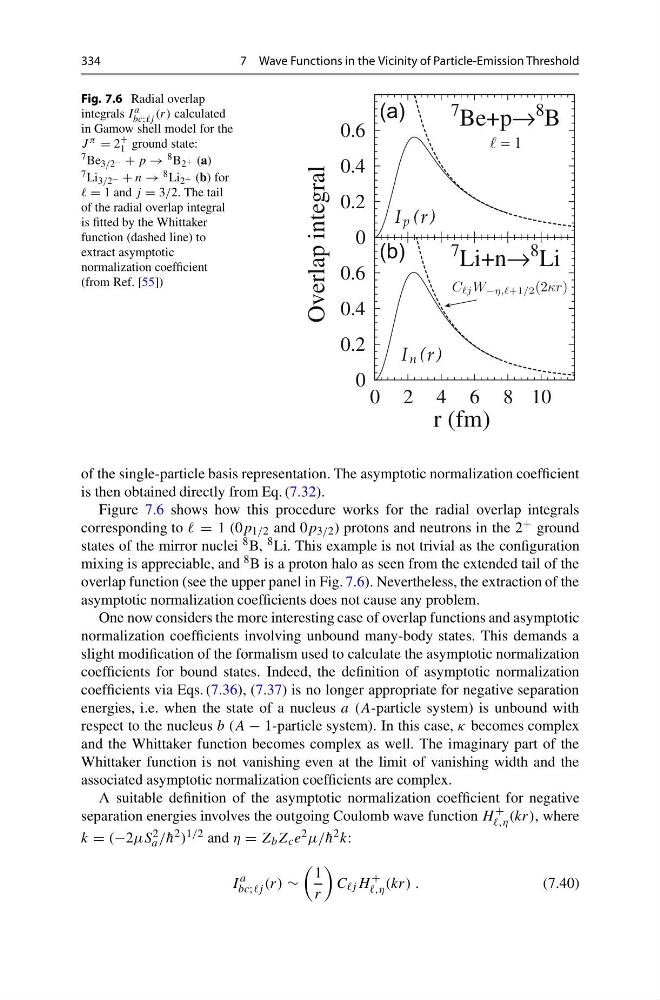
Fig. 7.6 Radial overlap
integrals I
a
bc;j (r) calculated
in Gamow shell model for the
J π = 2
+
1 ground state:
7 Be 3/2 − + p → 8 B 2 + (a)
7 Li 3/2 − + n → 8 Li 2 + (b) for
= 1 and j = 3/2. The tail
of the radial overlap integral
is fitted by the Whittaker
function (dashed line) to
extract asymptotic
normalization coefficient
(from Ref. [55])
0 2 4 6 8 10
0
0.2
0.4
0.6
r (fm)
0
0.2
0.4
0.6
Overlap integral
7
Li+n→
8
Li
I n (r)
I p (r)
= 1
7
Be+p→
8
B
(a)
(b)
of the single-particle basis representation. The asymptotic normalization coefficient
is then obtained directly from Eq. (7.32).
Figure 7.6 shows how this procedure works for the radial overlap integrals
corresponding to = 1 (0p 1/2 and 0p 3/2 ) protons and neutrons in the 2 + ground
states of the mirror nuclei 8 B, 8 Li. This example is not trivial as the configuration
mixing is appreciable, and 8 B is a proton halo as seen from the extended tail of the
overlap function (see the upper panel in Fig. 7.6). Nevertheless, the extraction of the
asymptotic normalization coefficients does not cause any problem.
One now considers the more interesting case of overlap functions and asymptotic
normalization coefficients involving unbound many-body states. This demands a
slight modification of the formalism used to calculate the asymptotic normalization
coefficients for bound states. Indeed, the definition of asymptotic normalization
coefficients via Eqs. (7.36), (7.37) is no longer appropriate for negative separation
energies, i.e. when the state of a nucleus a (A-particle system) is unbound with
respect to the nucleus b (A − 1-particle system). In this case, κ becomes complex
and the Whittaker function becomes complex as well. The imaginary part of the
Whittaker function is not vanishing even at the limit of vanishing width and the
associated asymptotic normalization coefficients are complex.
A suitable definition of the asymptotic normalization coefficient for negative
separation energies involves the outgoing Coulomb wave function H
+
,η (kr), where
k = (−2μS 2
a / ¯
h 2 ) 1/2 and η = Z b Z c e 2 μ/ ¯
h 2 k:
I
a
bc;j (r) ∼
1
r
C H
+
,η (kr) .
(7.40)
7 Wave Functions in the Vicinity of Particle-Emission Threshold
Fig. 7.6 Radial overlap
integrals I
a
bc;j (r) calculated
in Gamow shell model for the
J π = 2
+
1 ground state:
7 Be 3/2 − + p → 8 B 2 + (a)
7 Li 3/2 − + n → 8 Li 2 + (b) for
= 1 and j = 3/2. The tail
of the radial overlap integral
is fitted by the Whittaker
function (dashed line) to
extract asymptotic
normalization coefficient
(from Ref. [55])
0 2 4 6 8 10
0
0.2
0.4
0.6
r (fm)
0
0.2
0.4
0.6
Overlap integral
7
Li+n→
8
Li
I n (r)
I p (r)
= 1
7
Be+p→
8
B
(a)
(b)
of the single-particle basis representation. The asymptotic normalization coefficient
is then obtained directly from Eq. (7.32).
Figure 7.6 shows how this procedure works for the radial overlap integrals
corresponding to = 1 (0p 1/2 and 0p 3/2 ) protons and neutrons in the 2 + ground
states of the mirror nuclei 8 B, 8 Li. This example is not trivial as the configuration
mixing is appreciable, and 8 B is a proton halo as seen from the extended tail of the
overlap function (see the upper panel in Fig. 7.6). Nevertheless, the extraction of the
asymptotic normalization coefficients does not cause any problem.
One now considers the more interesting case of overlap functions and asymptotic
normalization coefficients involving unbound many-body states. This demands a
slight modification of the formalism used to calculate the asymptotic normalization
coefficients for bound states. Indeed, the definition of asymptotic normalization
coefficients via Eqs. (7.36), (7.37) is no longer appropriate for negative separation
energies, i.e. when the state of a nucleus a (A-particle system) is unbound with
respect to the nucleus b (A − 1-particle system). In this case, κ becomes complex
and the Whittaker function becomes complex as well. The imaginary part of the
Whittaker function is not vanishing even at the limit of vanishing width and the
associated asymptotic normalization coefficients are complex.
A suitable definition of the asymptotic normalization coefficient for negative
separation energies involves the outgoing Coulomb wave function H
+
,η (kr), where
k = (−2μS 2
a / ¯
h 2 ) 1/2 and η = Z b Z c e 2 μ/ ¯
h 2 k:
I
a
bc;j (r) ∼
1
r
C H
+
,η (kr) .
(7.40)