

332
7 Wave Functions in the Vicinity of Particle-Emission Threshold
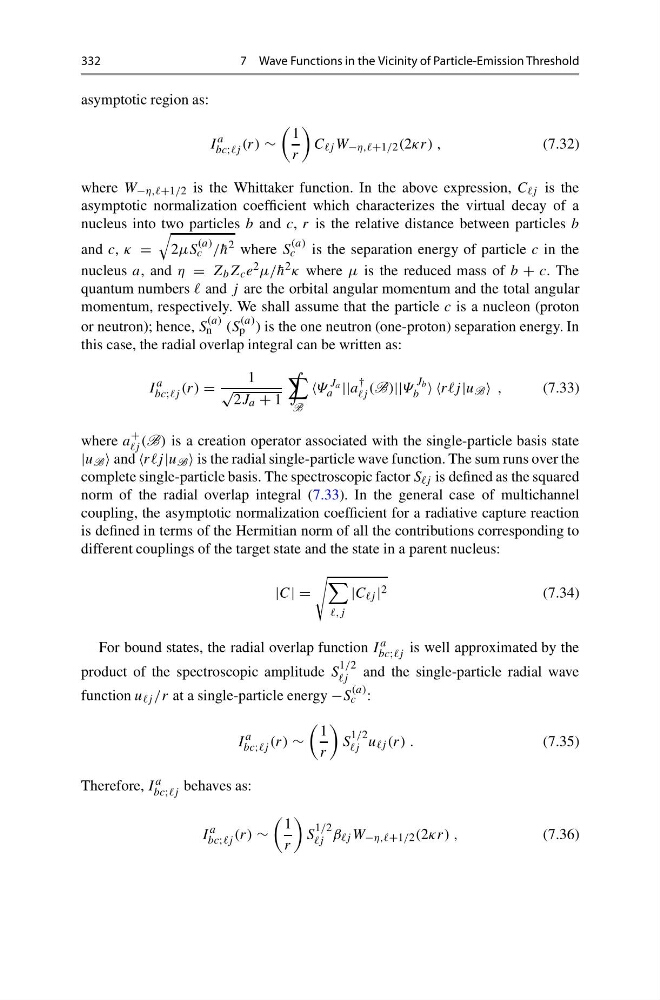
asymptotic region as:
I
a
bc;j (r) ∼
1
r
C W −η,,+1/2 (2κr) ,
(7.32)
where W −η,,+1/2 is the Whittaker function. In the above expression, C j is the
asymptotic normalization coefficient which characterizes the virtual decay of a
nucleus into two particles b and c, r is the relative distance between particles b
and c, κ =
2μS
(a)
c / ¯
h 2 where S
(a)
c is the separation energy of particle c in the
nucleus a, and η = Z b Z c e 2 μ/ ¯
h 2 κ where μ is the reduced mass of b + c. The
quantum numbers and j are the orbital angular momentum and the total angular
momentum, respectively. We shall assume that the particle c is a nucleon (proton
or neutron); hence, S
(a)
n (S
(a)
p ) is the one neutron (one-proton) separation energy. In
this case, the radial overlap integral can be written as:
I
a
bc;j (r) =
1
√
2J a + 1
B
J a
a ||a
†
(B)||Ψ
J b
b rrj |u B ,
(7.33)
where a
+
(B) is a creation operator associated with the single-particle basis state
|u B and rrj |u B is the radial single-particle wave function. The sum runs over the
complete single-particle basis. The spectroscopic factor S j is defined as the squared
norm of the radial overlap integral (7.33). In the general case of multichannel
coupling, the asymptotic normalization coefficient for a radiative capture reaction
is defined in terms of the Hermitian norm of all the contributions corresponding to
different couplings of the target state and the state in a parent nucleus:
|C| =
|C | 2
(7.34)
For bound states, the radial overlap function I a
bc;j is well approximated by the
product of the spectroscopic amplitude S
1/2
j and the single-particle radial wave
function u j /r at a single-particle energy −S
(a)
c :
I
a
bc;j (r) ∼
1
r
S
1/2
u j (r) .
(7.35)
Therefore, I
a
bc;j behaves as:
I
a
bc;j (r) ∼
1
r
S
1/2
β W −η,,+1/2 (2κr) ,
(7.36)
7 Wave Functions in the Vicinity of Particle-Emission Threshold
asymptotic region as:
I
a
bc;j (r) ∼
1
r
C W −η,,+1/2 (2κr) ,
(7.32)
where W −η,,+1/2 is the Whittaker function. In the above expression, C j is the
asymptotic normalization coefficient which characterizes the virtual decay of a
nucleus into two particles b and c, r is the relative distance between particles b
and c, κ =
2μS
(a)
c / ¯
h 2 where S
(a)
c is the separation energy of particle c in the
nucleus a, and η = Z b Z c e 2 μ/ ¯
h 2 κ where μ is the reduced mass of b + c. The
quantum numbers and j are the orbital angular momentum and the total angular
momentum, respectively. We shall assume that the particle c is a nucleon (proton
or neutron); hence, S
(a)
n (S
(a)
p ) is the one neutron (one-proton) separation energy. In
this case, the radial overlap integral can be written as:
I
a
bc;j (r) =
1
√
2J a + 1
B
J a
a ||a
†
(B)||Ψ
J b
b rrj |u B ,
(7.33)
where a
+
(B) is a creation operator associated with the single-particle basis state
|u B and rrj |u B is the radial single-particle wave function. The sum runs over the
complete single-particle basis. The spectroscopic factor S j is defined as the squared
norm of the radial overlap integral (7.33). In the general case of multichannel
coupling, the asymptotic normalization coefficient for a radiative capture reaction
is defined in terms of the Hermitian norm of all the contributions corresponding to
different couplings of the target state and the state in a parent nucleus:
|C| =
|C | 2
(7.34)
For bound states, the radial overlap function I a
bc;j is well approximated by the
product of the spectroscopic amplitude S
1/2
j and the single-particle radial wave
function u j /r at a single-particle energy −S
(a)
c :
I
a
bc;j (r) ∼
1
r
S
1/2
u j (r) .
(7.35)
Therefore, I
a
bc;j behaves as:
I
a
bc;j (r) ∼
1
r
S
1/2
β W −η,,+1/2 (2κr) ,
(7.36)