

330
7 Wave Functions in the Vicinity of Particle-Emission Threshold
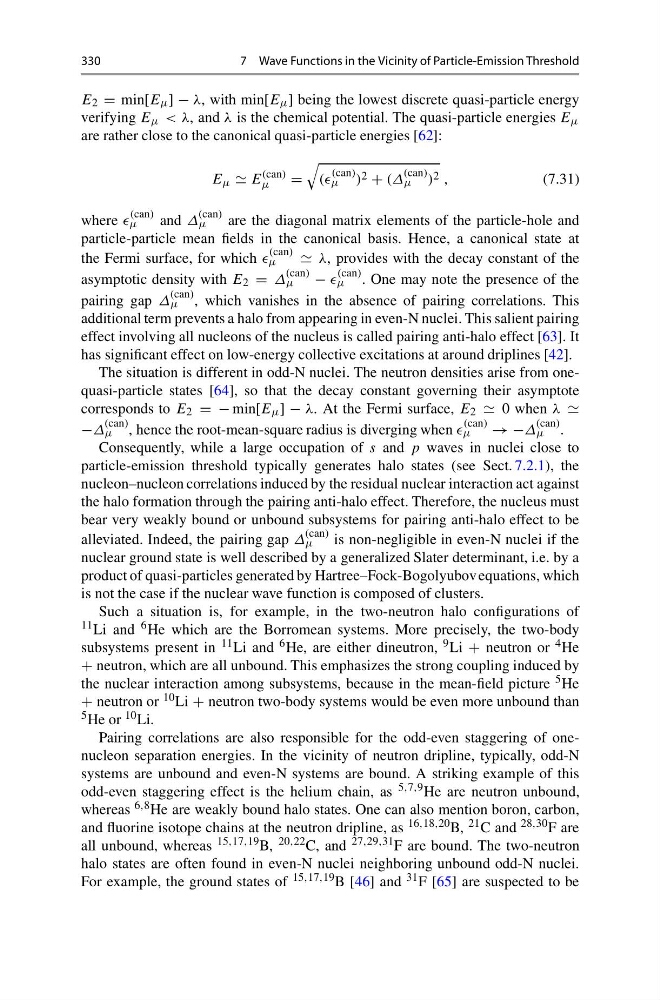
E 2 = min[E μ ] − λ, with min[E μ ] being the lowest discrete quasi-particle energy
verifying E μ < λ, and λ is the chemical potential. The quasi-particle energies E μ
are rather close to the canonical quasi-particle energies [62]:
E μ E
(can)
μ
=
((
(can)
μ
) 2 + (Δ
(can)
μ ) 2 ,
(7.31)
where
(can)
μ
and Δ
(can)
μ
are the diagonal matrix elements of the particle-hole and
particle-particle mean fields in the canonical basis. Hence, a canonical state at
the Fermi surface, for which
(can)
μ
λ, provides with the decay constant of the
asymptotic density with E 2 = Δ
(can)
μ
−
(can)
μ
. One may note the presence of the
pairing gap Δ
(can)
μ , which vanishes in the absence of pairing correlations. This
additional term prevents a halo from appearing in even-N nuclei. This salient pairing
effect involving all nucleons of the nucleus is called pairing anti-halo effect [63]. It
has significant effect on low-energy collective excitations at around driplines [42].
The situation is different in odd-N nuclei. The neutron densities arise from onequasi-particle states [64], so that the decay constant governing their asymptote
corresponds to E 2 = − min[E μ ] − λ. At the Fermi surface, E 2 0 when λ
−Δ
(can)
μ , hence the root-mean-square radius is diverging when
(can)
μ
→ −Δ
(can)
μ .
Consequently, while a large occupation of s and p waves in nuclei close to
particle-emission threshold typically generates halo states (see Sect. 7.2.1), the
nucleon–nucleon correlations induced by the residual nuclear interaction act against
the halo formation through the pairing anti-halo effect. Therefore, the nucleus must
bear very weakly bound or unbound subsystems for pairing anti-halo effect to be
alleviated. Indeed, the pairing gap Δ
(can)
μ
is non-negligible in even-N nuclei if the
nuclear ground state is well described by a generalized Slater determinant, i.e. by a
product of quasi-particles generated by Hartree–Fock-Bogolyubov equations, which
is not the case if the nuclear wave function is composed of clusters.
Such a situation is, for example, in the two-neutron halo configurations of
11 Li and 6 He which are the Borromean systems. More precisely, the two-body
subsystems present in 11 Li and 6 He, are either dineutron, 9 Li + neutron or 4 He
+ neutron, which are all unbound. This emphasizes the strong coupling induced by
the nuclear interaction among subsystems, because in the mean-field picture 5 He
+ neutron or 10 Li + neutron two-body systems would be even more unbound than
5 He or 10 Li.
Pairing correlations are also responsible for the odd-even staggering of onenucleon separation energies. In the vicinity of neutron dripline, typically, odd-N
systems are unbound and even-N systems are bound. A striking example of this
odd-even staggering effect is the helium chain, as 5,7,9 He are neutron unbound,
whereas 6,8 He are weakly bound halo states. One can also mention boron, carbon,
and fluorine isotope chains at the neutron dripline, as 16,18,20 B, 21 C and 28,30 F are
all unbound, whereas 15,17,19 B, 20,22 C, and 27,29,31 F are bound. The two-neutron
halo states are often found in even-N nuclei neighboring unbound odd-N nuclei.
For example, the ground states of 15,17,19 B [46] and 31 F [65] are suspected to be
7 Wave Functions in the Vicinity of Particle-Emission Threshold
E 2 = min[E μ ] − λ, with min[E μ ] being the lowest discrete quasi-particle energy
verifying E μ < λ, and λ is the chemical potential. The quasi-particle energies E μ
are rather close to the canonical quasi-particle energies [62]:
E μ E
(can)
μ
=
((
(can)
μ
) 2 + (Δ
(can)
μ ) 2 ,
(7.31)
where
(can)
μ
and Δ
(can)
μ
are the diagonal matrix elements of the particle-hole and
particle-particle mean fields in the canonical basis. Hence, a canonical state at
the Fermi surface, for which
(can)
μ
λ, provides with the decay constant of the
asymptotic density with E 2 = Δ
(can)
μ
−
(can)
μ
. One may note the presence of the
pairing gap Δ
(can)
μ , which vanishes in the absence of pairing correlations. This
additional term prevents a halo from appearing in even-N nuclei. This salient pairing
effect involving all nucleons of the nucleus is called pairing anti-halo effect [63]. It
has significant effect on low-energy collective excitations at around driplines [42].
The situation is different in odd-N nuclei. The neutron densities arise from onequasi-particle states [64], so that the decay constant governing their asymptote
corresponds to E 2 = − min[E μ ] − λ. At the Fermi surface, E 2 0 when λ
−Δ
(can)
μ , hence the root-mean-square radius is diverging when
(can)
μ
→ −Δ
(can)
μ .
Consequently, while a large occupation of s and p waves in nuclei close to
particle-emission threshold typically generates halo states (see Sect. 7.2.1), the
nucleon–nucleon correlations induced by the residual nuclear interaction act against
the halo formation through the pairing anti-halo effect. Therefore, the nucleus must
bear very weakly bound or unbound subsystems for pairing anti-halo effect to be
alleviated. Indeed, the pairing gap Δ
(can)
μ
is non-negligible in even-N nuclei if the
nuclear ground state is well described by a generalized Slater determinant, i.e. by a
product of quasi-particles generated by Hartree–Fock-Bogolyubov equations, which
is not the case if the nuclear wave function is composed of clusters.
Such a situation is, for example, in the two-neutron halo configurations of
11 Li and 6 He which are the Borromean systems. More precisely, the two-body
subsystems present in 11 Li and 6 He, are either dineutron, 9 Li + neutron or 4 He
+ neutron, which are all unbound. This emphasizes the strong coupling induced by
the nuclear interaction among subsystems, because in the mean-field picture 5 He
+ neutron or 10 Li + neutron two-body systems would be even more unbound than
5 He or 10 Li.
Pairing correlations are also responsible for the odd-even staggering of onenucleon separation energies. In the vicinity of neutron dripline, typically, odd-N
systems are unbound and even-N systems are bound. A striking example of this
odd-even staggering effect is the helium chain, as 5,7,9 He are neutron unbound,
whereas 6,8 He are weakly bound halo states. One can also mention boron, carbon,
and fluorine isotope chains at the neutron dripline, as 16,18,20 B, 21 C and 28,30 F are
all unbound, whereas 15,17,19 B, 20,22 C, and 27,29,31 F are bound. The two-neutron
halo states are often found in even-N nuclei neighboring unbound odd-N nuclei.
For example, the ground states of 15,17,19 B [46] and 31 F [65] are suspected to be