

2.2 The Harmonic Oscillator Potential
19
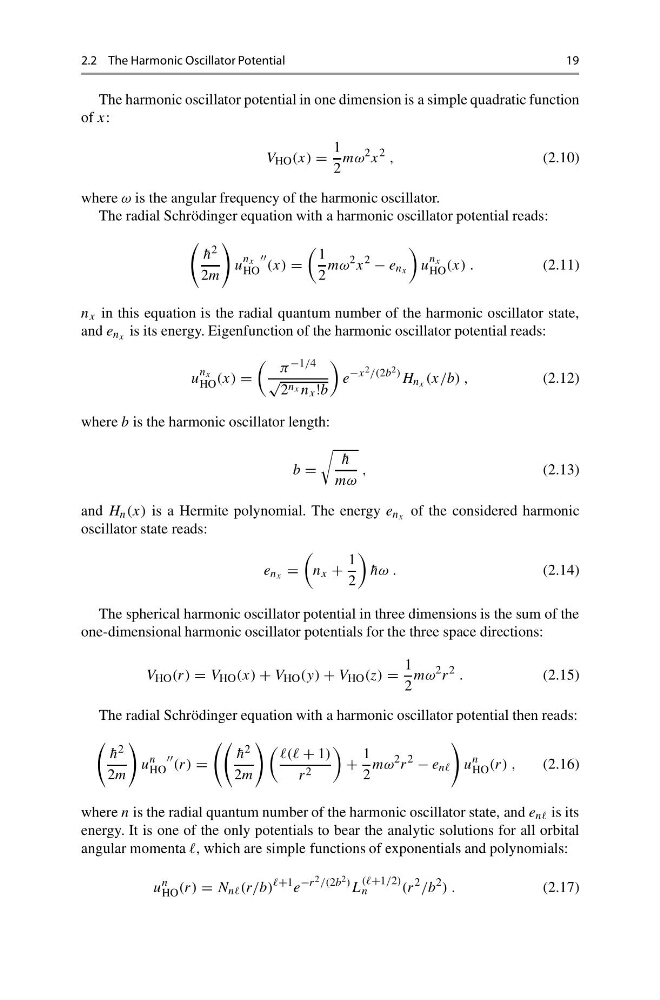
The harmonic oscillator potential in one dimension is a simple quadratic function
of x:
V HO (x) =
1
2
mω
2 x
2 ,
(2.10)
where ω is the angular frequency of the harmonic oscillator.
The radial Schrödinger equation with a harmonic oscillator potential reads:
¯
h 2
2m
u
n x
HO
(x) =
1
2
mω
2 x
2
− e n x
u
n x
HO (x) .
(2.11)
n x in this equation is the radial quantum number of the harmonic oscillator state,
and e n x is its energy. Eigenfunction of the harmonic oscillator potential reads:
u
n x
HO (x) =
π −1/4
√
2 n x n x !b
e
−x 2 /(2b 2 ) H n x (x/b) ,
(2.12)
where b is the harmonic oscillator length:
b =
¯
h
mω
,
(2.13)
and H n (x) is a Hermite polynomial. The energy e n x of the considered harmonic
oscillator state reads:
e n x =
n x +
1
2
¯
hω .
(2.14)
The spherical harmonic oscillator potential in three dimensions is the sum of the
one-dimensional harmonic oscillator potentials for the three space directions:
V HO (r) = V HO (x) + V HO (y) + V HO (z) =
1
2
mω
2 r
2 .
(2.15)
The radial Schrödinger equation with a harmonic oscillator potential then reads:
¯
h 2
2m
u
n
HO
(r) =
¯
h 2
2m
+ 1)
r 2
+
1
2
mω
2 r
2
− e nn
u
n
HO (r) ,
(2.16)
where n is the radial quantum number of the harmonic oscillator state, and e nn is its
energy. It is one of the only potentials to bear the analytic solutions for all orbital
angular momenta , which are simple functions of exponentials and polynomials:
u
n
HO (r) = N nn (r/b)
e
−r 2 /(2b 2 ) L
((+1/2)
n
(r
2 /b
2 ) .
(2.17)
19
The harmonic oscillator potential in one dimension is a simple quadratic function
of x:
V HO (x) =
1
2
mω
2 x
2 ,
(2.10)
where ω is the angular frequency of the harmonic oscillator.
The radial Schrödinger equation with a harmonic oscillator potential reads:
¯
h 2
2m
u
n x
HO
(x) =
1
2
mω
2 x
2
− e n x
u
n x
HO (x) .
(2.11)
n x in this equation is the radial quantum number of the harmonic oscillator state,
and e n x is its energy. Eigenfunction of the harmonic oscillator potential reads:
u
n x
HO (x) =
π −1/4
√
2 n x n x !b
e
−x 2 /(2b 2 ) H n x (x/b) ,
(2.12)
where b is the harmonic oscillator length:
b =
¯
h
mω
,
(2.13)
and H n (x) is a Hermite polynomial. The energy e n x of the considered harmonic
oscillator state reads:
e n x =
n x +
1
2
¯
hω .
(2.14)
The spherical harmonic oscillator potential in three dimensions is the sum of the
one-dimensional harmonic oscillator potentials for the three space directions:
V HO (r) = V HO (x) + V HO (y) + V HO (z) =
1
2
mω
2 r
2 .
(2.15)
The radial Schrödinger equation with a harmonic oscillator potential then reads:
¯
h 2
2m
u
n
HO
(r) =
¯
h 2
2m
+ 1)
r 2
+
1
2
mω
2 r
2
− e nn
u
n
HO (r) ,
(2.16)
where n is the radial quantum number of the harmonic oscillator state, and e nn is its
energy. It is one of the only potentials to bear the analytic solutions for all orbital
angular momenta , which are simple functions of exponentials and polynomials:
u
n
HO (r) = N nn (r/b)
e
−r 2 /(2b 2 ) L
((+1/2)
n
(r
2 /b
2 ) .
(2.17)