

6.6 Comparison of Gamow Shell Model and Hamiltonian Complex Scaling. . .
295
Re E (MeV)
Im E (MeV)
3-body threshold
2-body resonance
3-body resonance
Bound state
2θ
2θ
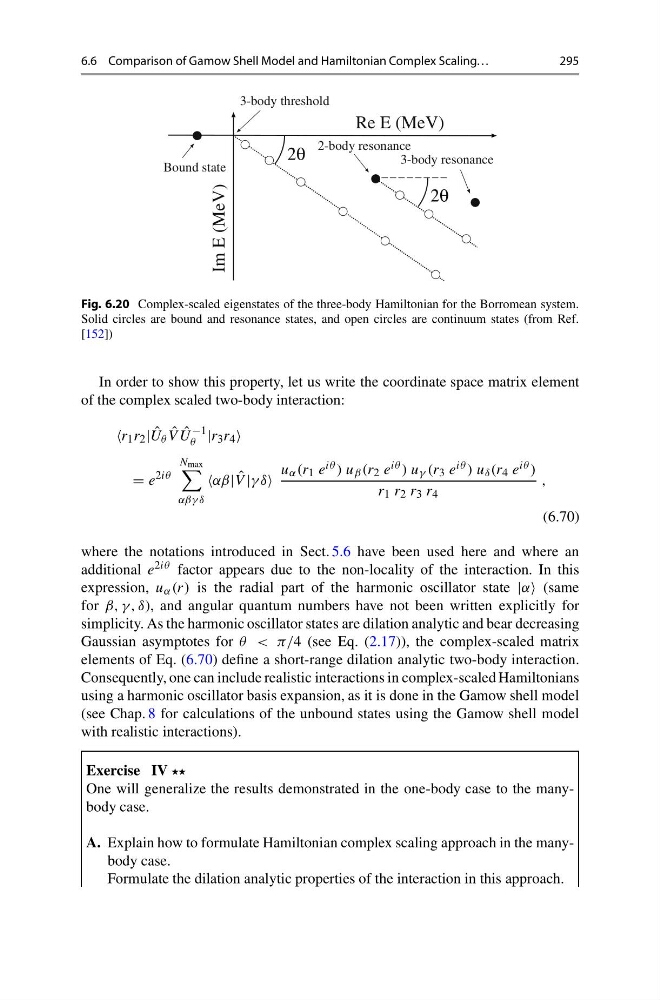
Fig. 6.20 Complex-scaled eigenstates of the three-body Hamiltonian for the Borromean system.
Solid circles are bound and resonance states, and open circles are continuum states (from Ref.
[152])
In order to show this property, let us write the coordinate space matrix element
of the complex scaled two-body interaction:
1 r 2 | ˆ
U θ ˆ
V ˆ
U
−1
θ |r 3 r 4
= e
2iθ
N max
αβγ δ
αβ| ˆ
V |γ δ
u α (r 1 e iθ ) u β (r 2 e iθ ) u γ (r 3 e iθ ) u δ (r 4 e iθ )
r 1 r 2 r 3 r 4
,
(6.70)
where the notations introduced in Sect. 5.6 have been used here and where an
additional e 2iθ factor appears due to the non-locality of the interaction. In this
expression, u α (r) is the radial part of the harmonic oscillator state |α (same
for β, γ , δ), and angular quantum numbers have not been written explicitly for
simplicity. As the harmonic oscillator states are dilation analytic and bear decreasing
Gaussian asymptotes for θ < π/4 (see Eq. (2.17)), the complex-scaled matrix
elements of Eq. (6.70) define a short-range dilation analytic two-body interaction.
Consequently, one can include realistic interactions in complex-scaled Hamiltonians
using a harmonic oscillator basis expansion, as it is done in the Gamow shell model
(see Chap. 8 for calculations of the unbound states using the Gamow shell model
with realistic interactions).
Exercise IV
One will generalize the results demonstrated in the one-body case to the manybody case.
A. Explain how to formulate Hamiltonian complex scaling approach in the manybody case.
Formulate the dilation analytic properties of the interaction in this approach.
295
Re E (MeV)
Im E (MeV)
3-body threshold
2-body resonance
3-body resonance
Bound state
2θ
2θ
Fig. 6.20 Complex-scaled eigenstates of the three-body Hamiltonian for the Borromean system.
Solid circles are bound and resonance states, and open circles are continuum states (from Ref.
[152])
In order to show this property, let us write the coordinate space matrix element
of the complex scaled two-body interaction:
1 r 2 | ˆ
U θ ˆ
V ˆ
U
−1
θ |r 3 r 4
= e
2iθ
N max
αβγ δ
αβ| ˆ
V |γ δ
u α (r 1 e iθ ) u β (r 2 e iθ ) u γ (r 3 e iθ ) u δ (r 4 e iθ )
r 1 r 2 r 3 r 4
,
(6.70)
where the notations introduced in Sect. 5.6 have been used here and where an
additional e 2iθ factor appears due to the non-locality of the interaction. In this
expression, u α (r) is the radial part of the harmonic oscillator state |α (same
for β, γ , δ), and angular quantum numbers have not been written explicitly for
simplicity. As the harmonic oscillator states are dilation analytic and bear decreasing
Gaussian asymptotes for θ < π/4 (see Eq. (2.17)), the complex-scaled matrix
elements of Eq. (6.70) define a short-range dilation analytic two-body interaction.
Consequently, one can include realistic interactions in complex-scaled Hamiltonians
using a harmonic oscillator basis expansion, as it is done in the Gamow shell model
(see Chap. 8 for calculations of the unbound states using the Gamow shell model
with realistic interactions).
Exercise IV
One will generalize the results demonstrated in the one-body case to the manybody case.
A. Explain how to formulate Hamiltonian complex scaling approach in the manybody case.
Formulate the dilation analytic properties of the interaction in this approach.