

286
6 Physical Applications of the Gamow Shell Model
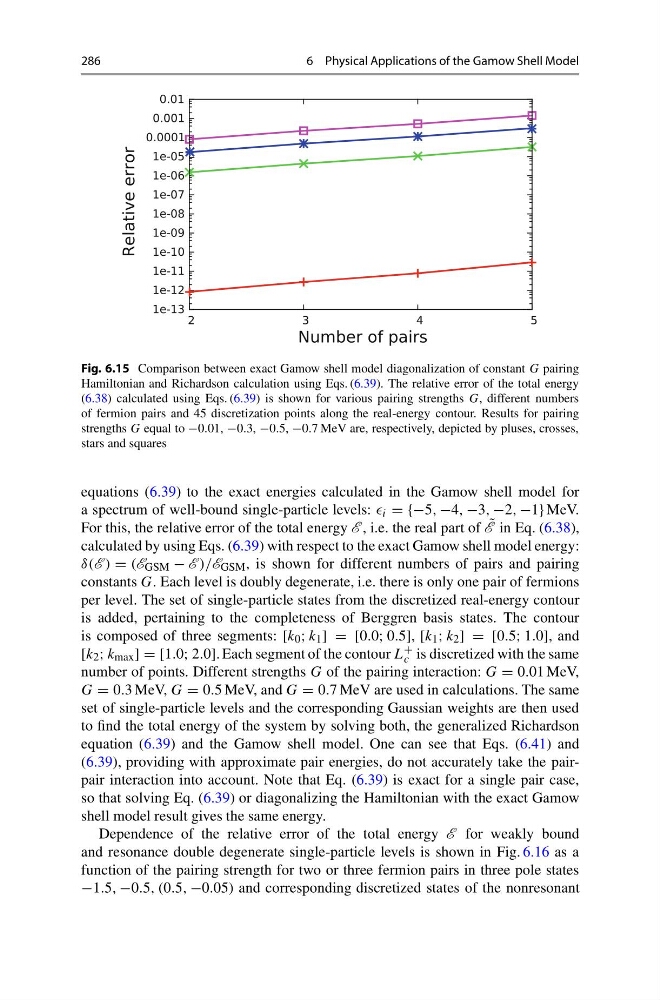
Fig. 6.15 Comparison between exact Gamow shell model diagonalization of constant G pairing
Hamiltonian and Richardson calculation using Eqs. (6.39). The relative error of the total energy
(6.38) calculated using Eqs. (6.39) is shown for various pairing strengths G, different numbers
of fermion pairs and 45 discretization points along the real-energy contour. Results for pairing
strengths G equal to −0.01, −0.3, −0.5, −0.7 MeV are, respectively, depicted by pluses, crosses,
stars and squares
equations (6.39) to the exact energies calculated in the Gamow shell model for
a spectrum of well-bound single-particle levels: i = {−5, −4, −3, −2, −1} MeV.
For this, the relative error of the total energy E , i.e. the real part of ˜
E in Eq. (6.38),
calculated by using Eqs. (6.39) with respect to the exact Gamow shell model energy:
δ(E ) = (E GSM − E )/E GSM , is shown for different numbers of pairs and pairing
constants G. Each level is doubly degenerate, i.e. there is only one pair of fermions
per level. The set of single-particle states from the discretized real-energy contour
is added, pertaining to the completeness of Berggren basis states. The contour
is composed of three segments: [k 0 ; k 1 ] = [0.0; 0.5], [k 1 ; k 2 ] = [0.5; 1.0], and
[k 2 ; k max ] = [1.0; 2.0]. Each segment of the contour L +
c is discretized with the same
number of points. Different strengths G of the pairing interaction: G = 0.01 MeV,
G = 0.3 MeV, G = 0.5 MeV, and G = 0.7 MeV are used in calculations. The same
set of single-particle levels and the corresponding Gaussian weights are then used
to find the total energy of the system by solving both, the generalized Richardson
equation (6.39) and the Gamow shell model. One can see that Eqs. (6.41) and
(6.39), providing with approximate pair energies, do not accurately take the pairpair interaction into account. Note that Eq. (6.39) is exact for a single pair case,
so that solving Eq. (6.39) or diagonalizing the Hamiltonian with the exact Gamow
shell model result gives the same energy.
Dependence of the relative error of the total energy E for weakly bound
and resonance double degenerate single-particle levels is shown in Fig. 6.16 as a
function of the pairing strength for two or three fermion pairs in three pole states
−1.5, −0.5, (0.5, −0.05) and corresponding discretized states of the nonresonant
6 Physical Applications of the Gamow Shell Model
Fig. 6.15 Comparison between exact Gamow shell model diagonalization of constant G pairing
Hamiltonian and Richardson calculation using Eqs. (6.39). The relative error of the total energy
(6.38) calculated using Eqs. (6.39) is shown for various pairing strengths G, different numbers
of fermion pairs and 45 discretization points along the real-energy contour. Results for pairing
strengths G equal to −0.01, −0.3, −0.5, −0.7 MeV are, respectively, depicted by pluses, crosses,
stars and squares
equations (6.39) to the exact energies calculated in the Gamow shell model for
a spectrum of well-bound single-particle levels: i = {−5, −4, −3, −2, −1} MeV.
For this, the relative error of the total energy E , i.e. the real part of ˜
E in Eq. (6.38),
calculated by using Eqs. (6.39) with respect to the exact Gamow shell model energy:
δ(E ) = (E GSM − E )/E GSM , is shown for different numbers of pairs and pairing
constants G. Each level is doubly degenerate, i.e. there is only one pair of fermions
per level. The set of single-particle states from the discretized real-energy contour
is added, pertaining to the completeness of Berggren basis states. The contour
is composed of three segments: [k 0 ; k 1 ] = [0.0; 0.5], [k 1 ; k 2 ] = [0.5; 1.0], and
[k 2 ; k max ] = [1.0; 2.0]. Each segment of the contour L +
c is discretized with the same
number of points. Different strengths G of the pairing interaction: G = 0.01 MeV,
G = 0.3 MeV, G = 0.5 MeV, and G = 0.7 MeV are used in calculations. The same
set of single-particle levels and the corresponding Gaussian weights are then used
to find the total energy of the system by solving both, the generalized Richardson
equation (6.39) and the Gamow shell model. One can see that Eqs. (6.41) and
(6.39), providing with approximate pair energies, do not accurately take the pairpair interaction into account. Note that Eq. (6.39) is exact for a single pair case,
so that solving Eq. (6.39) or diagonalizing the Hamiltonian with the exact Gamow
shell model result gives the same energy.
Dependence of the relative error of the total energy E for weakly bound
and resonance double degenerate single-particle levels is shown in Fig. 6.16 as a
function of the pairing strength for two or three fermion pairs in three pole states
−1.5, −0.5, (0.5, −0.05) and corresponding discretized states of the nonresonant