

6.5 Inclusion of Continuum Couplings in the Pairing Model
277
T = 1 isovector pairing models [121] and the SO(8) for T = 0, 1 spin-isospin
pairing models [122], where proton–neutron pairing is treated exactly. The exercises
proposed in this section are technical and can be omitted in the first reading.
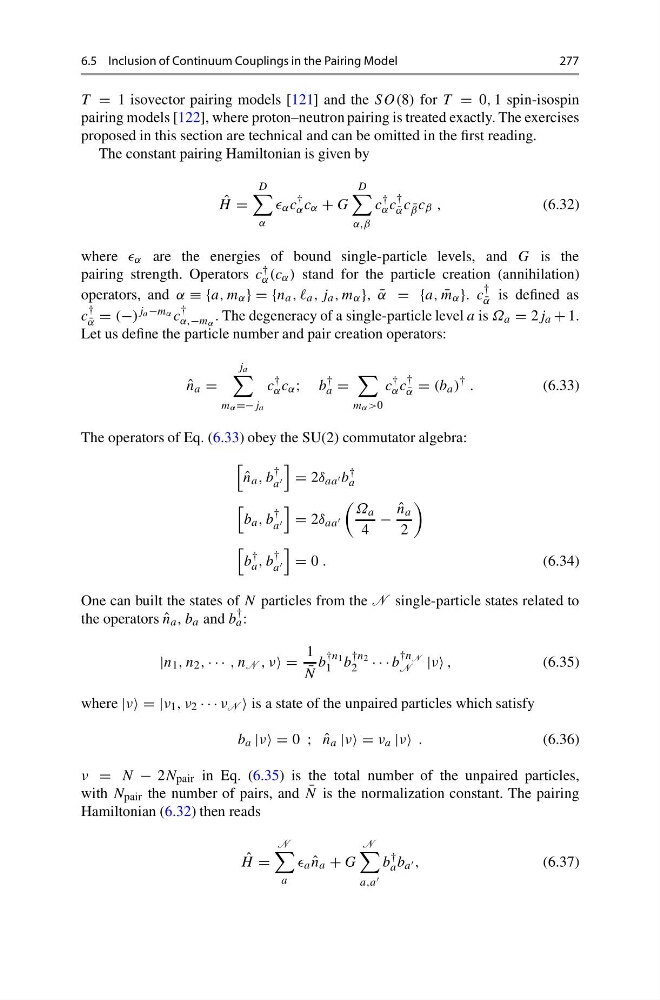
The constant pairing Hamiltonian is given by
ˆ
H =
D
α
α c
†
α c α + G
D
α,β
c
†
α c
†
¯
α c ¯
β c β ,
(6.32)
where α are the energies of bound single-particle levels, and G is the
pairing strength. Operators c †
α (c α ) stand for the particle creation (annihilation)
operators, and α ≡ {a, m α } = {n a , , a , j a , m α }, ¯
α = {a, ¯
m α }. c
†
¯
α is defined as
c
†
¯
α = (−)
j a −m α c
†
α,−m α . The degeneracy of a single-particle level a is Ω a = 2j a + 1.
Let us define the particle number and pair creation operators:
ˆ
n a =
j a
m α =−j a
c
†
α c α ; b
†
a =
m α >0
c
†
α c
†
¯
α = (b a )
† .
(6.33)
The operators of Eq. (6.33) obey the SU(2) commutator algebra:
ˆ
n a , b
†
a
= 2δ aa b
†
a
b a , b
†
a
= 2δ aa
Ω a
4
−
ˆ
n a
2
b
†
a , b
†
a
= 0 .
(6.34)
One can built the states of N particles from the N single-particle states related to
the operators ˆ
n a , b a and b
†
a :
|n 1 , n 2 , · · · , n N , ν =
1
¯
N
b
†n 1
1 b
†n 2
2 · · · b
†n N
N |ν ,
(6.35)
where |ν = |ν 1 , ν 2 · · · ν N is a state of the unpaired particles which satisfy
b a |ν = 0 ; ˆ
n a |ν = ν a |ν .
(6.36)
ν = N − 2N pair in Eq. (6.35) is the total number of the unpaired particles,
with N pair the number of pairs, and ¯
N is the normalization constant. The pairing
Hamiltonian (6.32) then reads
ˆ
H =
N
a
a ˆ
n a + G
N
a,a
b
†
a b a ,
(6.37)
277
T = 1 isovector pairing models [121] and the SO(8) for T = 0, 1 spin-isospin
pairing models [122], where proton–neutron pairing is treated exactly. The exercises
proposed in this section are technical and can be omitted in the first reading.
The constant pairing Hamiltonian is given by
ˆ
H =
D
α
α c
†
α c α + G
D
α,β
c
†
α c
†
¯
α c ¯
β c β ,
(6.32)
where α are the energies of bound single-particle levels, and G is the
pairing strength. Operators c †
α (c α ) stand for the particle creation (annihilation)
operators, and α ≡ {a, m α } = {n a , , a , j a , m α }, ¯
α = {a, ¯
m α }. c
†
¯
α is defined as
c
†
¯
α = (−)
j a −m α c
†
α,−m α . The degeneracy of a single-particle level a is Ω a = 2j a + 1.
Let us define the particle number and pair creation operators:
ˆ
n a =
j a
m α =−j a
c
†
α c α ; b
†
a =
m α >0
c
†
α c
†
¯
α = (b a )
† .
(6.33)
The operators of Eq. (6.33) obey the SU(2) commutator algebra:
ˆ
n a , b
†
a
= 2δ aa b
†
a
b a , b
†
a
= 2δ aa
Ω a
4
−
ˆ
n a
2
b
†
a , b
†
a
= 0 .
(6.34)
One can built the states of N particles from the N single-particle states related to
the operators ˆ
n a , b a and b
†
a :
|n 1 , n 2 , · · · , n N , ν =
1
¯
N
b
†n 1
1 b
†n 2
2 · · · b
†n N
N |ν ,
(6.35)
where |ν = |ν 1 , ν 2 · · · ν N is a state of the unpaired particles which satisfy
b a |ν = 0 ; ˆ
n a |ν = ν a |ν .
(6.36)
ν = N − 2N pair in Eq. (6.35) is the total number of the unpaired particles,
with N pair the number of pairs, and ¯
N is the normalization constant. The pairing
Hamiltonian (6.32) then reads
ˆ
H =
N
a
a ˆ
n a + G
N
a,a
b
†
a b a ,
(6.37)