

268
6 Physical Applications of the Gamow Shell Model
x
y
θ
T-type
r 1
r 2
12
core
n 1
n 2
(a)
x
y
Y-type
(b)
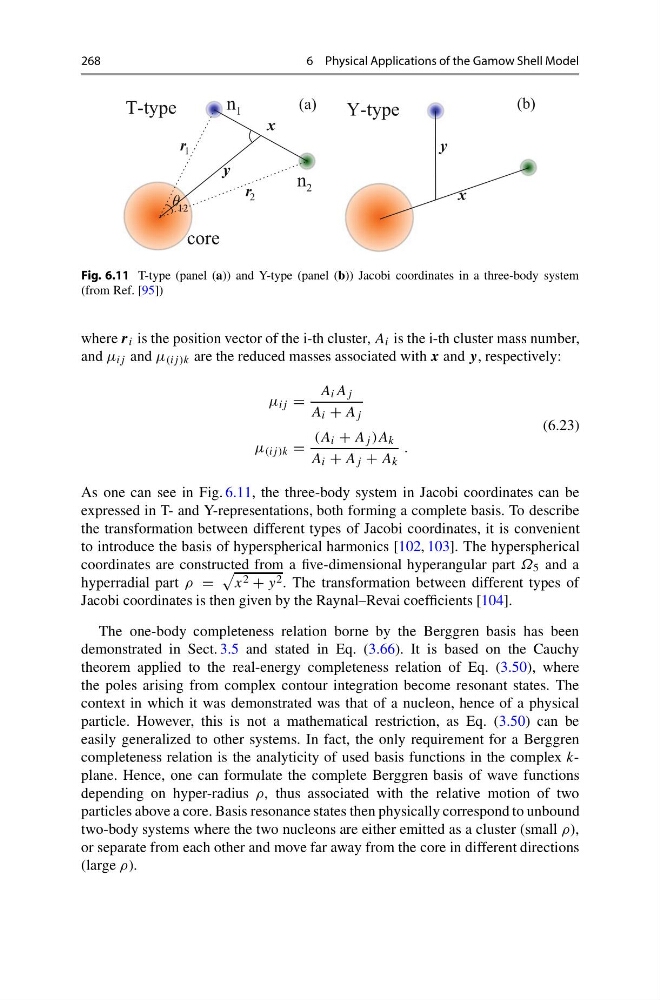
Fig. 6.11 T-type (panel (a)) and Y-type (panel (b)) Jacobi coordinates in a three-body system
(from Ref. [95])
where r i is the position vector of the i-th cluster, A i is the i-th cluster mass number,
and μ ij and μ (ij )k are the reduced masses associated with x and y, respectively:
μ ij =
A i A j
A i + A j
μ (ij )k =
(A i + A j )A k
A i + A j + A k
.
(6.23)
As one can see in Fig. 6.11, the three-body system in Jacobi coordinates can be
expressed in T- and Y-representations, both forming a complete basis. To describe
the transformation between different types of Jacobi coordinates, it is convenient
to introduce the basis of hyperspherical harmonics [102, 103]. The hyperspherical
coordinates are constructed from a five-dimensional hyperangular part Ω 5 and a
hyperradial part ρ =
x 2 + y 2 . The transformation between different types of
Jacobi coordinates is then given by the Raynal–Revai coefficients [104].
The one-body completeness relation borne by the Berggren basis has been
demonstrated in Sect. 3.5 and stated in Eq. (3.66). It is based on the Cauchy
theorem applied to the real-energy completeness relation of Eq. (3.50), where
the poles arising from complex contour integration become resonant states. The
context in which it was demonstrated was that of a nucleon, hence of a physical
particle. However, this is not a mathematical restriction, as Eq. (3.50) can be
easily generalized to other systems. In fact, the only requirement for a Berggren
completeness relation is the analyticity of used basis functions in the complex kplane. Hence, one can formulate the complete Berggren basis of wave functions
depending on hyper-radius ρ, thus associated with the relative motion of two
particles above a core. Basis resonance states then physically correspond to unbound
two-body systems where the two nucleons are either emitted as a cluster (small ρ),
or separate from each other and move far away from the core in different directions
(large ρ).
6 Physical Applications of the Gamow Shell Model
x
y
θ
T-type
r 1
r 2
12
core
n 1
n 2
(a)
x
y
Y-type
(b)
Fig. 6.11 T-type (panel (a)) and Y-type (panel (b)) Jacobi coordinates in a three-body system
(from Ref. [95])
where r i is the position vector of the i-th cluster, A i is the i-th cluster mass number,
and μ ij and μ (ij )k are the reduced masses associated with x and y, respectively:
μ ij =
A i A j
A i + A j
μ (ij )k =
(A i + A j )A k
A i + A j + A k
.
(6.23)
As one can see in Fig. 6.11, the three-body system in Jacobi coordinates can be
expressed in T- and Y-representations, both forming a complete basis. To describe
the transformation between different types of Jacobi coordinates, it is convenient
to introduce the basis of hyperspherical harmonics [102, 103]. The hyperspherical
coordinates are constructed from a five-dimensional hyperangular part Ω 5 and a
hyperradial part ρ =
x 2 + y 2 . The transformation between different types of
Jacobi coordinates is then given by the Raynal–Revai coefficients [104].
The one-body completeness relation borne by the Berggren basis has been
demonstrated in Sect. 3.5 and stated in Eq. (3.66). It is based on the Cauchy
theorem applied to the real-energy completeness relation of Eq. (3.50), where
the poles arising from complex contour integration become resonant states. The
context in which it was demonstrated was that of a nucleon, hence of a physical
particle. However, this is not a mathematical restriction, as Eq. (3.50) can be
easily generalized to other systems. In fact, the only requirement for a Berggren
completeness relation is the analyticity of used basis functions in the complex kplane. Hence, one can formulate the complete Berggren basis of wave functions
depending on hyper-radius ρ, thus associated with the relative motion of two
particles above a core. Basis resonance states then physically correspond to unbound
two-body systems where the two nucleons are either emitted as a cluster (small ρ),
or separate from each other and move far away from the core in different directions
(large ρ).