

266
6 Physical Applications of the Gamow Shell Model
6.3.1.3 Pairing Correlations and Correlation Density in 6 He and 6 Li
Pairing correlations are important in nuclei close to the neutron dripline as they can
stabilize weakly bound nuclei through the coupling to continuum states [87–91].
Two-nucleon correlations can be evaluated using correlation density [92–95]:
ρ NN (r, θ ) = 8π
2 r
2
1 r
2
2 sin(θ )ρ(r 1 , r 2 ) = =Ψ |δ(r − r 1 )δ(r
− r 2 )δ(θ − θ 12 )|Ψ ,
(6.19)
in which r 1 and r 2 are the positions of nucleons and θ 12 is the opening angle between
the two nucleons. One follows the normalization convention of Ref. [94] in which
the Jacobian 8π 2 r 2 r sin θ is implicitly included in ρ NN .
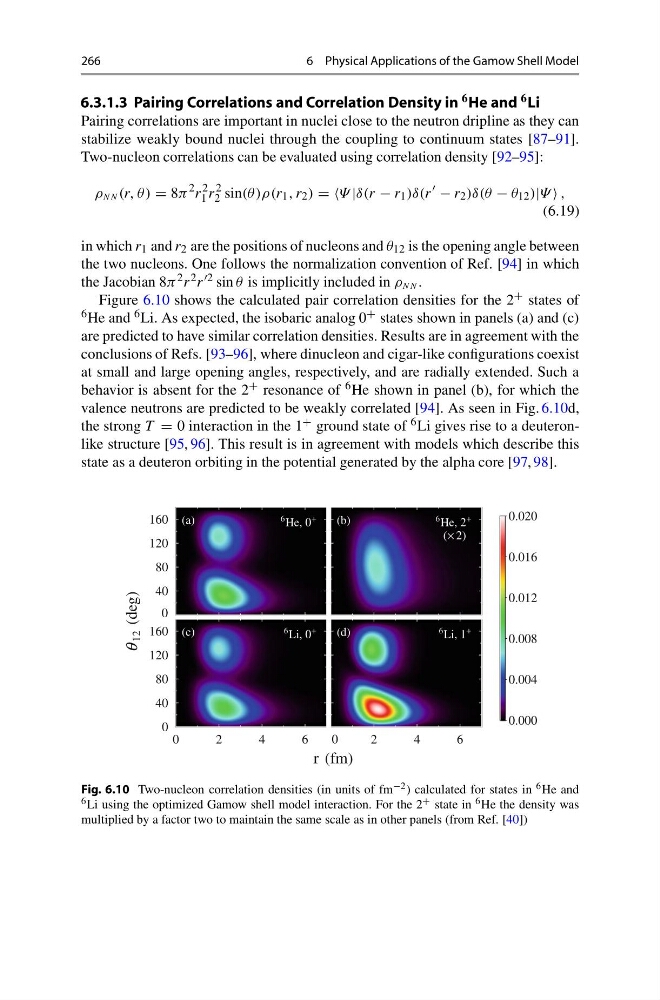
Figure 6.10 shows the calculated pair correlation densities for the 2 + states of
6 He and 6 Li. As expected, the isobaric analog 0 + states shown in panels (a) and (c)
are predicted to have similar correlation densities. Results are in agreement with the
conclusions of Refs. [93–96], where dinucleon and cigar-like configurations coexist
at small and large opening angles, respectively, and are radially extended. Such a
behavior is absent for the 2 + resonance of 6 He shown in panel (b), for which the
valence neutrons are predicted to be weakly correlated [94]. As seen in Fig. 6.10d,
the strong T = 0 interaction in the 1 + ground state of 6 Li gives rise to a deuteronlike structure [95, 96]. This result is in agreement with models which describe this
state as a deuteron orbiting in the potential generated by the alpha core [97, 98].
40
80
120
160 (a)
He,
(b)
He,
0
40
80
120
160
0
2
4
6
(c)
Li,
2
4
6
(d)
Li,
r (fm)
θ 12 (deg)
0
0
0.000
0.004
0.008
0.012
0.016
0.020
6
0
+
6
2
+
(× 2)
6
0
+
6
1
+
Fig. 6.10 Two-nucleon correlation densities (in units of fm −2 ) calculated for states in 6 He and
6 Li using the optimized Gamow shell model interaction. For the 2 + state in 6 He the density was
multiplied by a factor two to maintain the same scale as in other panels (from Ref. [40])
6 Physical Applications of the Gamow Shell Model
6.3.1.3 Pairing Correlations and Correlation Density in 6 He and 6 Li
Pairing correlations are important in nuclei close to the neutron dripline as they can
stabilize weakly bound nuclei through the coupling to continuum states [87–91].
Two-nucleon correlations can be evaluated using correlation density [92–95]:
ρ NN (r, θ ) = 8π
2 r
2
1 r
2
2 sin(θ )ρ(r 1 , r 2 ) = =Ψ |δ(r − r 1 )δ(r
− r 2 )δ(θ − θ 12 )|Ψ ,
(6.19)
in which r 1 and r 2 are the positions of nucleons and θ 12 is the opening angle between
the two nucleons. One follows the normalization convention of Ref. [94] in which
the Jacobian 8π 2 r 2 r sin θ is implicitly included in ρ NN .
Figure 6.10 shows the calculated pair correlation densities for the 2 + states of
6 He and 6 Li. As expected, the isobaric analog 0 + states shown in panels (a) and (c)
are predicted to have similar correlation densities. Results are in agreement with the
conclusions of Refs. [93–96], where dinucleon and cigar-like configurations coexist
at small and large opening angles, respectively, and are radially extended. Such a
behavior is absent for the 2 + resonance of 6 He shown in panel (b), for which the
valence neutrons are predicted to be weakly correlated [94]. As seen in Fig. 6.10d,
the strong T = 0 interaction in the 1 + ground state of 6 Li gives rise to a deuteronlike structure [95, 96]. This result is in agreement with models which describe this
state as a deuteron orbiting in the potential generated by the alpha core [97, 98].
40
80
120
160 (a)
He,
(b)
He,
0
40
80
120
160
0
2
4
6
(c)
Li,
2
4
6
(d)
Li,
r (fm)
θ 12 (deg)
0
0
0.000
0.004
0.008
0.012
0.016
0.020
6
0
+
6
2
+
(× 2)
6
0
+
6
1
+
Fig. 6.10 Two-nucleon correlation densities (in units of fm −2 ) calculated for states in 6 He and
6 Li using the optimized Gamow shell model interaction. For the 2 + state in 6 He the density was
multiplied by a factor two to maintain the same scale as in other panels (from Ref. [40])