

264
6 Physical Applications of the Gamow Shell Model
0.2
0.4
0.6
0.8
7
Be
8
B
9
C
10
N
11
O
3/2
−
1/2
−
7/2
−
5/2
−
-4.47
-2.3
-4.73
-2.57
2
+
1
+
3
+ -7.11 -7.12
-7.12 -7.14
1
−
2
−
-8.93
-8.46
-8.12
-7.9
-8.84
-7.94
5/2+
-6.0
-5.82
-6.58
-6.09
Energy(MeV)
-2
-4
-6
-8
-10
2
+
1
+
3/2
−
3/2
−
1/2
−
5/2
−
GSM exp
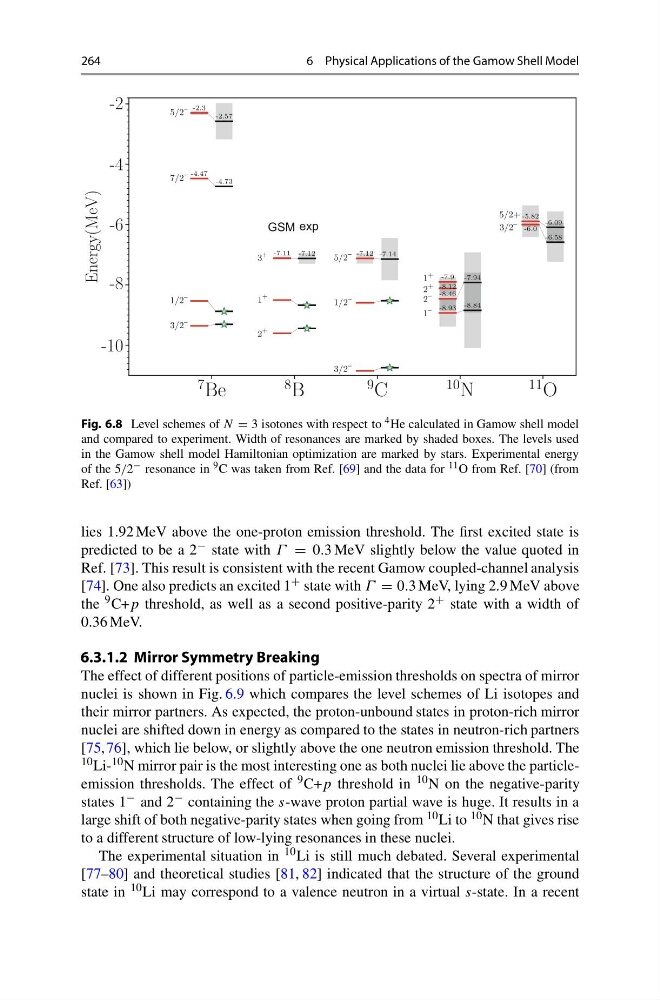
Fig. 6.8 Level schemes of N = 3 isotones with respect to 4 He calculated in Gamow shell model
and compared to experiment. Width of resonances are marked by shaded boxes. The levels used
in the Gamow shell model Hamiltonian optimization are marked by stars. Experimental energy
of the 5/2 − resonance in 9 C was taken from Ref. [69] and the data for 11 O from Ref. [70] (from
Ref. [63])
lies 1.92 MeV above the one-proton emission threshold. The first excited state is
predicted to be a 2 − state with Γ = 0.3 MeV slightly below the value quoted in
Ref. [73]. This result is consistent with the recent Gamow coupled-channel analysis
[74]. One also predicts an excited 1 + state with Γ = 0.3 MeV, lying 2.9 MeV above
the 9 C+p threshold, as well as a second positive-parity 2 + state with a width of
0.36 MeV.
6.3.1.2 Mirror Symmetry Breaking
The effect of different positions of particle-emission thresholds on spectra of mirror
nuclei is shown in Fig. 6.9 which compares the level schemes of Li isotopes and
their mirror partners. As expected, the proton-unbound states in proton-rich mirror
nuclei are shifted down in energy as compared to the states in neutron-rich partners
[75, 76], which lie below, or slightly above the one neutron emission threshold. The
10 Li- 10 N mirror pair is the most interesting one as both nuclei lie above the particleemission thresholds. The effect of 9 C+p threshold in 10 N on the negative-parity
states 1 − and 2 − containing the s-wave proton partial wave is huge. It results in a
large shift of both negative-parity states when going from 10 Li to 10 N that gives rise
to a different structure of low-lying resonances in these nuclei.
The experimental situation in 10 Li is still much debated. Several experimental
[77–80] and theoretical studies [81, 82] indicated that the structure of the ground
state in 10 Li may correspond to a valence neutron in a virtual s-state. In a recent
6 Physical Applications of the Gamow Shell Model
0.2
0.4
0.6
0.8
7
Be
8
B
9
C
10
N
11
O
3/2
−
1/2
−
7/2
−
5/2
−
-4.47
-2.3
-4.73
-2.57
2
+
1
+
3
+ -7.11 -7.12
-7.12 -7.14
1
−
2
−
-8.93
-8.46
-8.12
-7.9
-8.84
-7.94
5/2+
-6.0
-5.82
-6.58
-6.09
Energy(MeV)
-2
-4
-6
-8
-10
2
+
1
+
3/2
−
3/2
−
1/2
−
5/2
−
GSM exp
Fig. 6.8 Level schemes of N = 3 isotones with respect to 4 He calculated in Gamow shell model
and compared to experiment. Width of resonances are marked by shaded boxes. The levels used
in the Gamow shell model Hamiltonian optimization are marked by stars. Experimental energy
of the 5/2 − resonance in 9 C was taken from Ref. [69] and the data for 11 O from Ref. [70] (from
Ref. [63])
lies 1.92 MeV above the one-proton emission threshold. The first excited state is
predicted to be a 2 − state with Γ = 0.3 MeV slightly below the value quoted in
Ref. [73]. This result is consistent with the recent Gamow coupled-channel analysis
[74]. One also predicts an excited 1 + state with Γ = 0.3 MeV, lying 2.9 MeV above
the 9 C+p threshold, as well as a second positive-parity 2 + state with a width of
0.36 MeV.
6.3.1.2 Mirror Symmetry Breaking
The effect of different positions of particle-emission thresholds on spectra of mirror
nuclei is shown in Fig. 6.9 which compares the level schemes of Li isotopes and
their mirror partners. As expected, the proton-unbound states in proton-rich mirror
nuclei are shifted down in energy as compared to the states in neutron-rich partners
[75, 76], which lie below, or slightly above the one neutron emission threshold. The
10 Li- 10 N mirror pair is the most interesting one as both nuclei lie above the particleemission thresholds. The effect of 9 C+p threshold in 10 N on the negative-parity
states 1 − and 2 − containing the s-wave proton partial wave is huge. It results in a
large shift of both negative-parity states when going from 10 Li to 10 N that gives rise
to a different structure of low-lying resonances in these nuclei.
The experimental situation in 10 Li is still much debated. Several experimental
[77–80] and theoretical studies [81, 82] indicated that the structure of the ground
state in 10 Li may correspond to a valence neutron in a virtual s-state. In a recent