

252
6 Physical Applications of the Gamow Shell Model
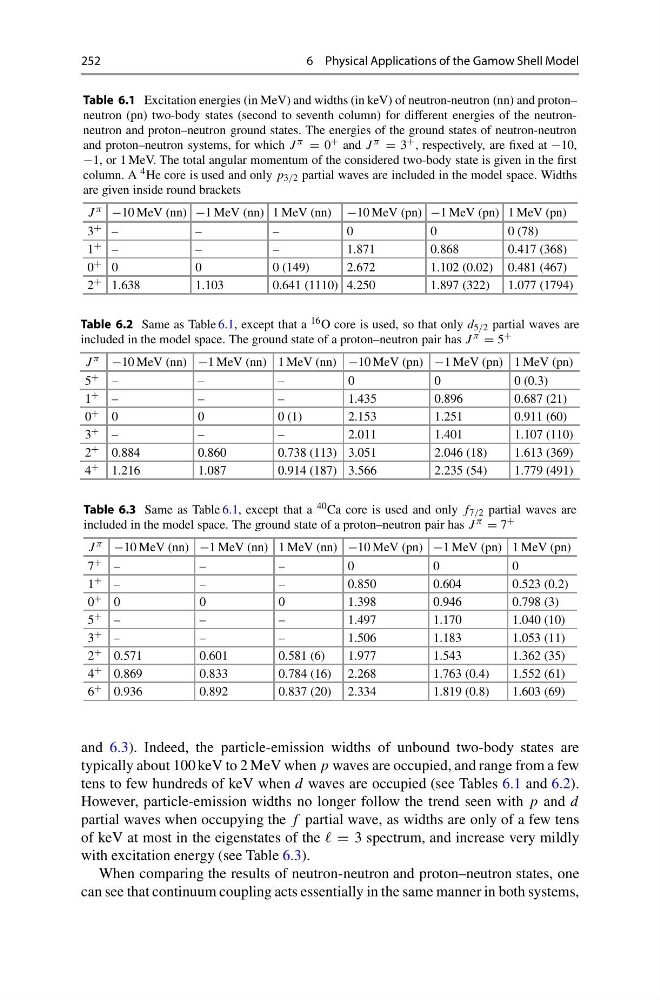
Table 6.1 Excitation energies (in MeV) and widths (in keV) of neutron-neutron (nn) and proton–
neutron (pn) two-body states (second to seventh column) for different energies of the neutronneutron and proton–neutron ground states. The energies of the ground states of neutron-neutron
and proton–neutron systems, for which J π = 0 + and J π = 3 + , respectively, are fixed at −10,
−1, or 1 MeV. The total angular momentum of the considered two-body state is given in the first
column. A 4 He core is used and only p 3/2 partial waves are included in the model space. Widths
are given inside round brackets
J π −10 MeV (nn) −1 MeV (nn) 1 MeV (nn) −10 MeV (pn) −1 MeV (pn) 1 MeV (pn)
3 + –
–
–
0
0
0 (78)
1 + –
–
–
1.871
0.868
0.417 (368)
0 + 0
0
0 (149)
2.672
1.102 (0.02) 0.481 (467)
2 + 1.638
1.103
0.641 (1110) 4.250
1.897 (322) 1.077 (1794)
Table 6.2 Same as Table 6.1, except that a 16 O core is used, so that only d 5/2 partial waves are
included in the model space. The ground state of a proton–neutron pair has J π = 5 +
J π −10 MeV (nn) −1 MeV (nn) 1 MeV (nn) −10 MeV (pn) −1 MeV (pn) 1 MeV (pn)
5 + –
–
–
0
0
0 (0.3)
1 + –
–
–
1.435
0.896
0.687 (21)
0 + 0
0
0 (1)
2.153
1.251
0.911 (60)
3 + –
–
–
2.011
1.401
1.107 (110)
2 + 0.884
0.860
0.738 (113) 3.051
2.046 (18)
1.613 (369)
4 + 1.216
1.087
0.914 (187) 3.566
2.235 (54)
1.779 (491)
Table 6.3 Same as Table 6.1, except that a 40 Ca core is used and only f 7/2 partial waves are
included in the model space. The ground state of a proton–neutron pair has J π = 7 +
J π −10 MeV (nn) −1 MeV (nn) 1 MeV (nn) −10 MeV (pn) −1 MeV (pn) 1 MeV (pn)
7 + –
–
–
0
0
0
1 + –
–
–
0.850
0.604
0.523 (0.2)
0 + 0
0
0
1.398
0.946
0.798 (3)
5 + –
–
–
1.497
1.170
1.040 (10)
3 + –
–
–
1.506
1.183
1.053 (11)
2 + 0.571
0.601
0.581 (6)
1.977
1.543
1.362 (35)
4 + 0.869
0.833
0.784 (16) 2.268
1.763 (0.4)
1.552 (61)
6 + 0.936
0.892
0.837 (20) 2.334
1.819 (0.8)
1.603 (69)
and 6.3). Indeed, the particle-emission widths of unbound two-body states are
typically about 100 keV to 2 MeV when p waves are occupied, and range from a few
tens to few hundreds of keV when d waves are occupied (see Tables 6.1 and 6.2).
However, particle-emission widths no longer follow the trend seen with p and d
partial waves when occupying the f partial wave, as widths are only of a few tens
of keV at most in the eigenstates of the = 3 spectrum, and increase very mildly
with excitation energy (see Table 6.3).
When comparing the results of neutron-neutron and proton–neutron states, one
can see that continuum coupling acts essentially in the same manner in both systems,
6 Physical Applications of the Gamow Shell Model
Table 6.1 Excitation energies (in MeV) and widths (in keV) of neutron-neutron (nn) and proton–
neutron (pn) two-body states (second to seventh column) for different energies of the neutronneutron and proton–neutron ground states. The energies of the ground states of neutron-neutron
and proton–neutron systems, for which J π = 0 + and J π = 3 + , respectively, are fixed at −10,
−1, or 1 MeV. The total angular momentum of the considered two-body state is given in the first
column. A 4 He core is used and only p 3/2 partial waves are included in the model space. Widths
are given inside round brackets
J π −10 MeV (nn) −1 MeV (nn) 1 MeV (nn) −10 MeV (pn) −1 MeV (pn) 1 MeV (pn)
3 + –
–
–
0
0
0 (78)
1 + –
–
–
1.871
0.868
0.417 (368)
0 + 0
0
0 (149)
2.672
1.102 (0.02) 0.481 (467)
2 + 1.638
1.103
0.641 (1110) 4.250
1.897 (322) 1.077 (1794)
Table 6.2 Same as Table 6.1, except that a 16 O core is used, so that only d 5/2 partial waves are
included in the model space. The ground state of a proton–neutron pair has J π = 5 +
J π −10 MeV (nn) −1 MeV (nn) 1 MeV (nn) −10 MeV (pn) −1 MeV (pn) 1 MeV (pn)
5 + –
–
–
0
0
0 (0.3)
1 + –
–
–
1.435
0.896
0.687 (21)
0 + 0
0
0 (1)
2.153
1.251
0.911 (60)
3 + –
–
–
2.011
1.401
1.107 (110)
2 + 0.884
0.860
0.738 (113) 3.051
2.046 (18)
1.613 (369)
4 + 1.216
1.087
0.914 (187) 3.566
2.235 (54)
1.779 (491)
Table 6.3 Same as Table 6.1, except that a 40 Ca core is used and only f 7/2 partial waves are
included in the model space. The ground state of a proton–neutron pair has J π = 7 +
J π −10 MeV (nn) −1 MeV (nn) 1 MeV (nn) −10 MeV (pn) −1 MeV (pn) 1 MeV (pn)
7 + –
–
–
0
0
0
1 + –
–
–
0.850
0.604
0.523 (0.2)
0 + 0
0
0
1.398
0.946
0.798 (3)
5 + –
–
–
1.497
1.170
1.040 (10)
3 + –
–
–
1.506
1.183
1.053 (11)
2 + 0.571
0.601
0.581 (6)
1.977
1.543
1.362 (35)
4 + 0.869
0.833
0.784 (16) 2.268
1.763 (0.4)
1.552 (61)
6 + 0.936
0.892
0.837 (20) 2.334
1.819 (0.8)
1.603 (69)
and 6.3). Indeed, the particle-emission widths of unbound two-body states are
typically about 100 keV to 2 MeV when p waves are occupied, and range from a few
tens to few hundreds of keV when d waves are occupied (see Tables 6.1 and 6.2).
However, particle-emission widths no longer follow the trend seen with p and d
partial waves when occupying the f partial wave, as widths are only of a few tens
of keV at most in the eigenstates of the = 3 spectrum, and increase very mildly
with excitation energy (see Table 6.3).
When comparing the results of neutron-neutron and proton–neutron states, one
can see that continuum coupling acts essentially in the same manner in both systems,