

5.10 Statistical Evaluation of Modeling Errors and Quality of Predictions in. . .
231
is the identity matrix. For this, one may use the following identity, valid for
p ∼ p 0 in linear regression: ˆ ¯
H (p − p 0 ) = ˆ ¯
J
T ¯
O .
B. Explain why this assumption is consistent with the renormalization introduced
in Eq. (5.76) when an overall scaling factor is used.
5.10.2 Bayesian Inference of Parameters
The probability distribution associated to the fitted parameters as in Eq. (5.79) has
not yet been quantitatively assessed, even though it is of the undeniable interest.
The standard procedure to calculate statistical errors in that framework is by
using Bayesian inference. For this, a prior probability distribution of parameters
is postulated, from which a posterior probability distribution is calculated, which
can then confirm or infirm the hypothesis borne by the prior.
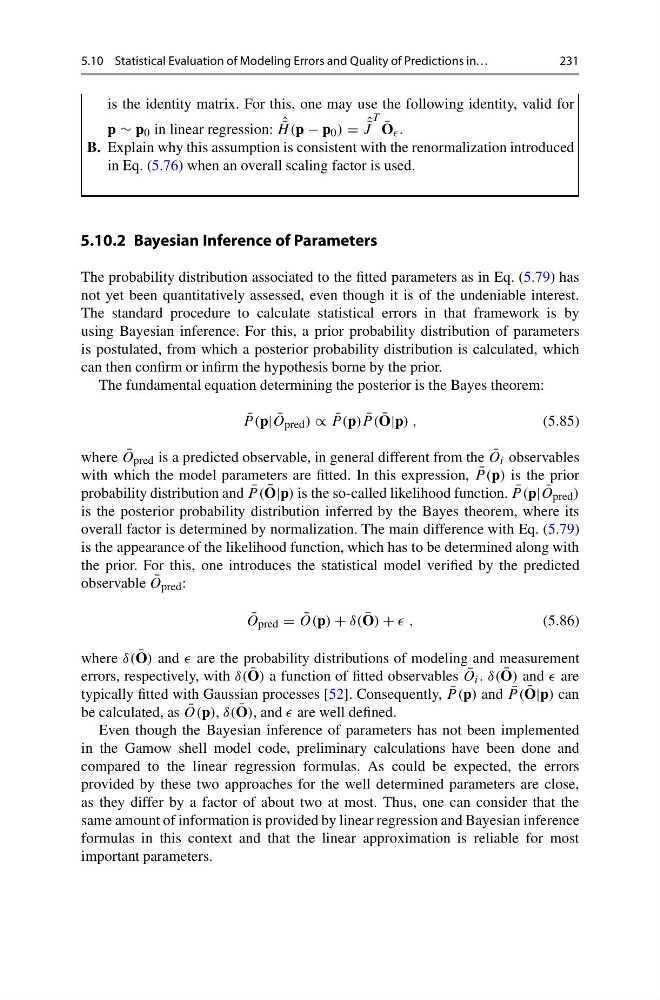
The fundamental equation determining the posterior is the Bayes theorem:
¯
P (p| ¯
O pred ) ∝ ¯
P (p) ¯
P ( ¯
O|p) ,
(5.85)
where ¯
O pred is a predicted observable, in general different from the ¯
O i observables
with which the model parameters are fitted. In this expression, ¯
P (p) is the prior
probability distribution and ¯
P ( ¯
O|p) is the so-called likelihood function. ¯
P (p| ¯
O pred )
is the posterior probability distribution inferred by the Bayes theorem, where its
overall factor is determined by normalization. The main difference with Eq. (5.79)
is the appearance of the likelihood function, which has to be determined along with
the prior. For this, one introduces the statistical model verified by the predicted
observable ¯
O pred :
¯
O pred = ¯
O(p) + δ( ¯
O) + ,
(5.86)
where δ( ¯
O) and are the probability distributions of modeling and measurement
errors, respectively, with δ( ¯
O) a function of fitted observables ¯
O i . δ( ¯
O) and are
typically fitted with Gaussian processes [52]. Consequently, ¯
P (p) and ¯
P ( ¯
O|p) can
be calculated, as ¯
O(p), δ( ¯
O), and are well defined.
Even though the Bayesian inference of parameters has not been implemented
in the Gamow shell model code, preliminary calculations have been done and
compared to the linear regression formulas. As could be expected, the errors
provided by these two approaches for the well determined parameters are close,
as they differ by a factor of about two at most. Thus, one can consider that the
same amount of information is provided by linear regression and Bayesian inference
formulas in this context and that the linear approximation is reliable for most
important parameters.
231
is the identity matrix. For this, one may use the following identity, valid for
p ∼ p 0 in linear regression: ˆ ¯
H (p − p 0 ) = ˆ ¯
J
T ¯
O .
B. Explain why this assumption is consistent with the renormalization introduced
in Eq. (5.76) when an overall scaling factor is used.
5.10.2 Bayesian Inference of Parameters
The probability distribution associated to the fitted parameters as in Eq. (5.79) has
not yet been quantitatively assessed, even though it is of the undeniable interest.
The standard procedure to calculate statistical errors in that framework is by
using Bayesian inference. For this, a prior probability distribution of parameters
is postulated, from which a posterior probability distribution is calculated, which
can then confirm or infirm the hypothesis borne by the prior.
The fundamental equation determining the posterior is the Bayes theorem:
¯
P (p| ¯
O pred ) ∝ ¯
P (p) ¯
P ( ¯
O|p) ,
(5.85)
where ¯
O pred is a predicted observable, in general different from the ¯
O i observables
with which the model parameters are fitted. In this expression, ¯
P (p) is the prior
probability distribution and ¯
P ( ¯
O|p) is the so-called likelihood function. ¯
P (p| ¯
O pred )
is the posterior probability distribution inferred by the Bayes theorem, where its
overall factor is determined by normalization. The main difference with Eq. (5.79)
is the appearance of the likelihood function, which has to be determined along with
the prior. For this, one introduces the statistical model verified by the predicted
observable ¯
O pred :
¯
O pred = ¯
O(p) + δ( ¯
O) + ,
(5.86)
where δ( ¯
O) and are the probability distributions of modeling and measurement
errors, respectively, with δ( ¯
O) a function of fitted observables ¯
O i . δ( ¯
O) and are
typically fitted with Gaussian processes [52]. Consequently, ¯
P (p) and ¯
P ( ¯
O|p) can
be calculated, as ¯
O(p), δ( ¯
O), and are well defined.
Even though the Bayesian inference of parameters has not been implemented
in the Gamow shell model code, preliminary calculations have been done and
compared to the linear regression formulas. As could be expected, the errors
provided by these two approaches for the well determined parameters are close,
as they differ by a factor of about two at most. Thus, one can consider that the
same amount of information is provided by linear regression and Bayesian inference
formulas in this context and that the linear approximation is reliable for most
important parameters.