

5.10 Statistical Evaluation of Modeling Errors and Quality of Predictions in. . .
227
-0.527
-0.526
30
60
90
N step
-0.071
-0.070
Energy (MeV)
Re(E)
Im(E)
24
20
22
N opt
7 He (J π =3/2 - )
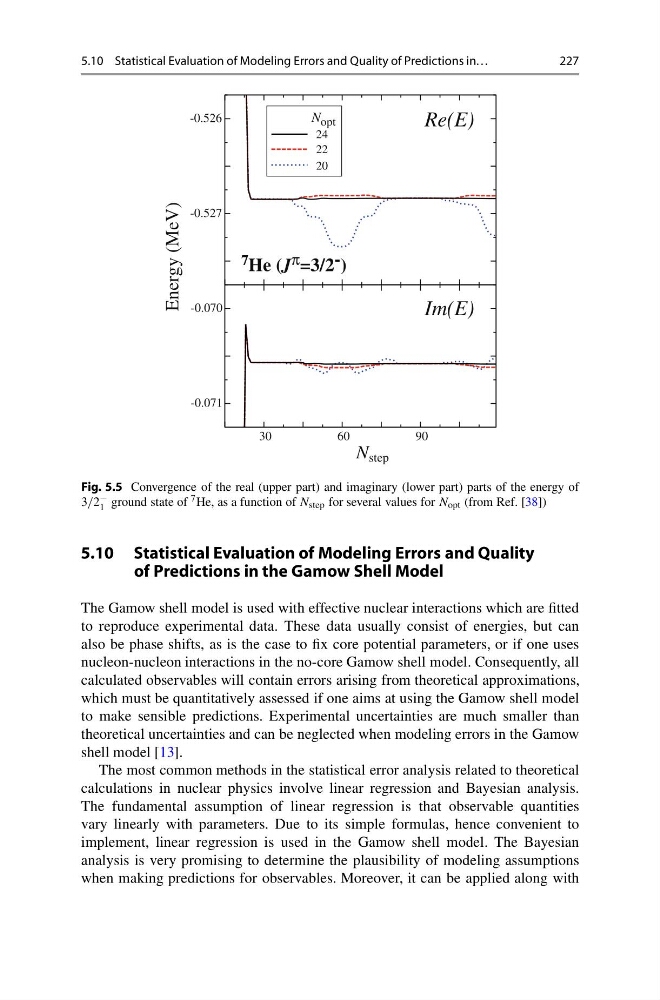
Fig. 5.5 Convergence of the real (upper part) and imaginary (lower part) parts of the energy of
3/2
−
1 ground state of 7 He, as a function of N step for several values for N opt (from Ref. [38])
5.10 Statistical Evaluation of Modeling Errors and Quality
of Predictions in the Gamow Shell Model
The Gamow shell model is used with effective nuclear interactions which are fitted
to reproduce experimental data. These data usually consist of energies, but can
also be phase shifts, as is the case to fix core potential parameters, or if one uses
nucleon-nucleon interactions in the no-core Gamow shell model. Consequently, all
calculated observables will contain errors arising from theoretical approximations,
which must be quantitatively assessed if one aims at using the Gamow shell model
to make sensible predictions. Experimental uncertainties are much smaller than
theoretical uncertainties and can be neglected when modeling errors in the Gamow
shell model [13].
The most common methods in the statistical error analysis related to theoretical
calculations in nuclear physics involve linear regression and Bayesian analysis.
The fundamental assumption of linear regression is that observable quantities
vary linearly with parameters. Due to its simple formulas, hence convenient to
implement, linear regression is used in the Gamow shell model. The Bayesian
analysis is very promising to determine the plausibility of modeling assumptions
when making predictions for observables. Moreover, it can be applied along with
227
-0.527
-0.526
30
60
90
N step
-0.071
-0.070
Energy (MeV)
Re(E)
Im(E)
24
20
22
N opt
7 He (J π =3/2 - )
Fig. 5.5 Convergence of the real (upper part) and imaginary (lower part) parts of the energy of
3/2
−
1 ground state of 7 He, as a function of N step for several values for N opt (from Ref. [38])
5.10 Statistical Evaluation of Modeling Errors and Quality
of Predictions in the Gamow Shell Model
The Gamow shell model is used with effective nuclear interactions which are fitted
to reproduce experimental data. These data usually consist of energies, but can
also be phase shifts, as is the case to fix core potential parameters, or if one uses
nucleon-nucleon interactions in the no-core Gamow shell model. Consequently, all
calculated observables will contain errors arising from theoretical approximations,
which must be quantitatively assessed if one aims at using the Gamow shell model
to make sensible predictions. Experimental uncertainties are much smaller than
theoretical uncertainties and can be neglected when modeling errors in the Gamow
shell model [13].
The most common methods in the statistical error analysis related to theoretical
calculations in nuclear physics involve linear regression and Bayesian analysis.
The fundamental assumption of linear regression is that observable quantities
vary linearly with parameters. Due to its simple formulas, hence convenient to
implement, linear regression is used in the Gamow shell model. The Bayesian
analysis is very promising to determine the plausibility of modeling assumptions
when making predictions for observables. Moreover, it can be applied along with