

5.5 Optimization of the Gamow Shell Model One-Body Basis
209
If one considers a Slater determinant of a configuration whose one-body states
of maximal angular momentum projections are occupied, it is possible to build
a Gamow-Hartree-Fock scheme, also called the M-potential, as the optimized
Slater determinant is coupled to J = M (see Ref. [22]). However, unless one
considers single-particle or single-hole many-body states, the considered Slater
determinant corresponds in general to an excited state, so that the basis-generating
potential is not optimal. Moreover, partial averaging has to be done over the angular
momentum projections of occupied one-body states. This procedure is called the
fill-in approximation, as one considers therein that the single-particle states of the
occupied shell are equally occupied.
While sphericity in the basis potential arises by construction in the fill-in
approximation, the main drawback of this scheme is that it is not variational, so
that its ability to provide with a well optimized basis potential is doubtful. Thus, it
would be convenient to have a potential directly optimized at the ground state level,
on the one hand, and which suppresses the most important 1p-1h excitations from
the trial ground state, on the other hand. The optimized wave function can no longer
be a Slater determinant, but it can be a linear combination of Slater determinants
belonging to a given configuration and coupled to a given angular momentum J .
Hence, the procedure just described will be called the multi-Slater determinant
coupled Hartree-Fock method. We will see that the multi-Slater determinant coupled
Hartree-Fock equations are very similar to Hartree-Fock equations, and that any
nucleus can be treated therein.
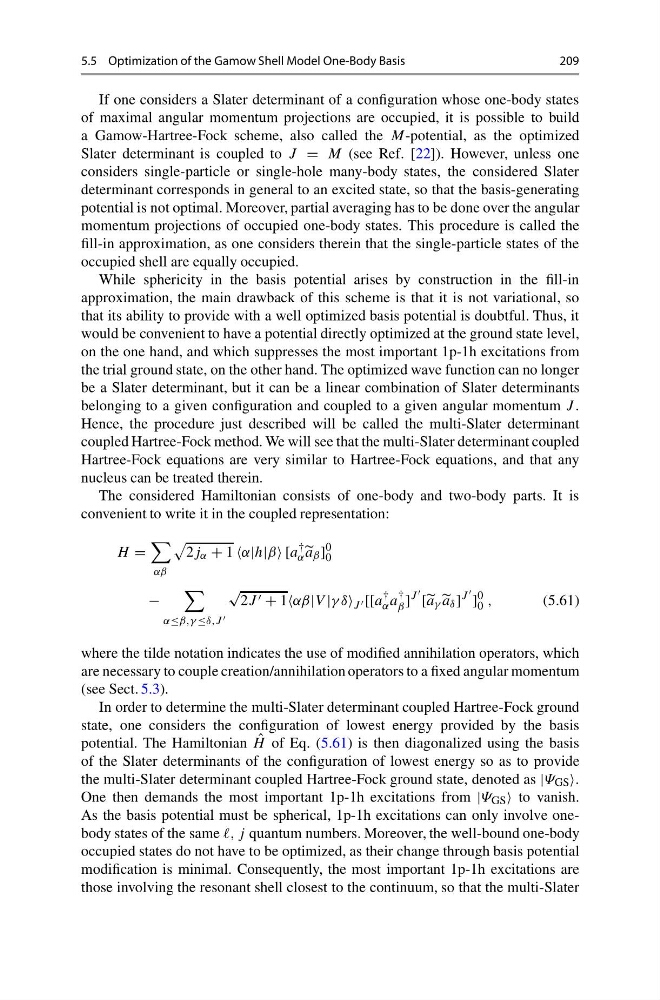
The considered Hamiltonian consists of one-body and two-body parts. It is
convenient to write it in the coupled representation:
H =
αβ
2j α + 1 [a
†
α a β ]
0
0
−
α≤β,γ ≤δ,J
√
2J + 1αβ|V |γ δ J [[a
†
α a
†
β ]
J [ a γ a δ ]
J ]
0
0 ,
(5.61)
where the tilde notation indicates the use of modified annihilation operators, which
are necessary to couple creation/annihilation operators to a fixed angular momentum
(see Sect. 5.3).
In order to determine the multi-Slater determinant coupled Hartree-Fock ground
state, one considers the configuration of lowest energy provided by the basis
potential. The Hamiltonian ˆ
H of Eq. (5.61) is then diagonalized using the basis
of the Slater determinants of the configuration of lowest energy so as to provide
the multi-Slater determinant coupled Hartree-Fock ground state, denoted as |Ψ GS
One then demands the most important 1p-1h excitations from |Ψ GS to vanish.
As the basis potential must be spherical, 1p-1h excitations can only involve onebody states of the same , j quantum numbers. Moreover, the well-bound one-body
occupied states do not have to be optimized, as their change through basis potential
modification is minimal. Consequently, the most important 1p-1h excitations are
those involving the resonant shell closest to the continuum, so that the multi-Slater
209
If one considers a Slater determinant of a configuration whose one-body states
of maximal angular momentum projections are occupied, it is possible to build
a Gamow-Hartree-Fock scheme, also called the M-potential, as the optimized
Slater determinant is coupled to J = M (see Ref. [22]). However, unless one
considers single-particle or single-hole many-body states, the considered Slater
determinant corresponds in general to an excited state, so that the basis-generating
potential is not optimal. Moreover, partial averaging has to be done over the angular
momentum projections of occupied one-body states. This procedure is called the
fill-in approximation, as one considers therein that the single-particle states of the
occupied shell are equally occupied.
While sphericity in the basis potential arises by construction in the fill-in
approximation, the main drawback of this scheme is that it is not variational, so
that its ability to provide with a well optimized basis potential is doubtful. Thus, it
would be convenient to have a potential directly optimized at the ground state level,
on the one hand, and which suppresses the most important 1p-1h excitations from
the trial ground state, on the other hand. The optimized wave function can no longer
be a Slater determinant, but it can be a linear combination of Slater determinants
belonging to a given configuration and coupled to a given angular momentum J .
Hence, the procedure just described will be called the multi-Slater determinant
coupled Hartree-Fock method. We will see that the multi-Slater determinant coupled
Hartree-Fock equations are very similar to Hartree-Fock equations, and that any
nucleus can be treated therein.
The considered Hamiltonian consists of one-body and two-body parts. It is
convenient to write it in the coupled representation:
H =
αβ
2j α + 1 [a
†
α a β ]
0
0
−
α≤β,γ ≤δ,J
√
2J + 1αβ|V |γ δ J [[a
†
α a
†
β ]
J [ a γ a δ ]
J ]
0
0 ,
(5.61)
where the tilde notation indicates the use of modified annihilation operators, which
are necessary to couple creation/annihilation operators to a fixed angular momentum
(see Sect. 5.3).
In order to determine the multi-Slater determinant coupled Hartree-Fock ground
state, one considers the configuration of lowest energy provided by the basis
potential. The Hamiltonian ˆ
H of Eq. (5.61) is then diagonalized using the basis
of the Slater determinants of the configuration of lowest energy so as to provide
the multi-Slater determinant coupled Hartree-Fock ground state, denoted as |Ψ GS
One then demands the most important 1p-1h excitations from |Ψ GS to vanish.
As the basis potential must be spherical, 1p-1h excitations can only involve onebody states of the same , j quantum numbers. Moreover, the well-bound one-body
occupied states do not have to be optimized, as their change through basis potential
modification is minimal. Consequently, the most important 1p-1h excitations are
those involving the resonant shell closest to the continuum, so that the multi-Slater