

206
5 Formulation and Implementation of the Gamow Shell Model
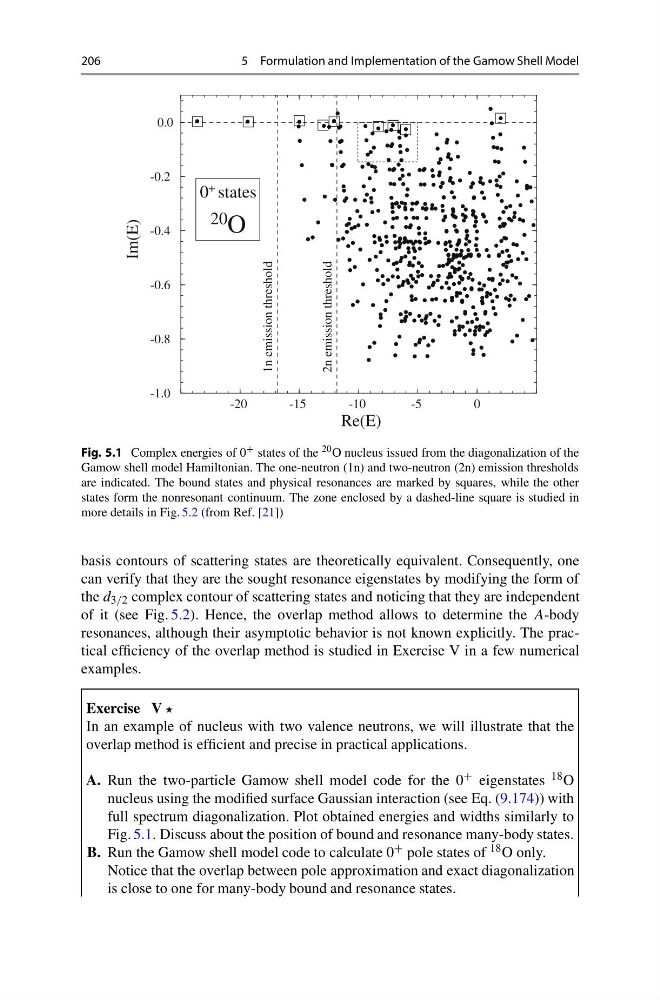
Fig. 5.1 Complex energies of 0 + states of the 20 O nucleus issued from the diagonalization of the
Gamow shell model Hamiltonian. The one-neutron (1n) and two-neutron (2n) emission thresholds
are indicated. The bound states and physical resonances are marked by squares, while the other
states form the nonresonant continuum. The zone enclosed by a dashed-line square is studied in
more details in Fig. 5.2 (from Ref. [21])
basis contours of scattering states are theoretically equivalent. Consequently, one
can verify that they are the sought resonance eigenstates by modifying the form of
the d 3/2 complex contour of scattering states and noticing that they are independent
of it (see Fig. 5.2). Hence, the overlap method allows to determine the A-body
resonances, although their asymptotic behavior is not known explicitly. The practical efficiency of the overlap method is studied in Exercise V in a few numerical
examples.
Exercise V
In an example of nucleus with two valence neutrons, we will illustrate that the
overlap method is efficient and precise in practical applications.
A. Run the two-particle Gamow shell model code for the 0 + eigenstates 18 O
nucleus using the modified surface Gaussian interaction (see Eq. (9.174)) with
full spectrum diagonalization. Plot obtained energies and widths similarly to
Fig. 5.1. Discuss about the position of bound and resonance many-body states.
B. Run the Gamow shell model code to calculate 0 + pole states of 18 O only.
Notice that the overlap between pole approximation and exact diagonalization
is close to one for many-body bound and resonance states.
5 Formulation and Implementation of the Gamow Shell Model
Fig. 5.1 Complex energies of 0 + states of the 20 O nucleus issued from the diagonalization of the
Gamow shell model Hamiltonian. The one-neutron (1n) and two-neutron (2n) emission thresholds
are indicated. The bound states and physical resonances are marked by squares, while the other
states form the nonresonant continuum. The zone enclosed by a dashed-line square is studied in
more details in Fig. 5.2 (from Ref. [21])
basis contours of scattering states are theoretically equivalent. Consequently, one
can verify that they are the sought resonance eigenstates by modifying the form of
the d 3/2 complex contour of scattering states and noticing that they are independent
of it (see Fig. 5.2). Hence, the overlap method allows to determine the A-body
resonances, although their asymptotic behavior is not known explicitly. The practical efficiency of the overlap method is studied in Exercise V in a few numerical
examples.
Exercise V
In an example of nucleus with two valence neutrons, we will illustrate that the
overlap method is efficient and precise in practical applications.
A. Run the two-particle Gamow shell model code for the 0 + eigenstates 18 O
nucleus using the modified surface Gaussian interaction (see Eq. (9.174)) with
full spectrum diagonalization. Plot obtained energies and widths similarly to
Fig. 5.1. Discuss about the position of bound and resonance many-body states.
B. Run the Gamow shell model code to calculate 0 + pole states of 18 O only.
Notice that the overlap between pole approximation and exact diagonalization
is close to one for many-body bound and resonance states.