

1 Introduction: From Bound States to the Continuum
7
was motivated by the necessity to accommodate Dirac’s formalism of bras and kets
[5, 6]. Soon it was realized that the rigged Hilbert space is also a natural setting for
Gamow states [10, 49], and therefore provides a rigorous mathematical framework
for extending the domain of quantum mechanics into the time-asymmetric processes
like decays or captures. The resonance amplitude associated with the Gamow states
is proportional to the complex δ-function and such amplitude can be approximated
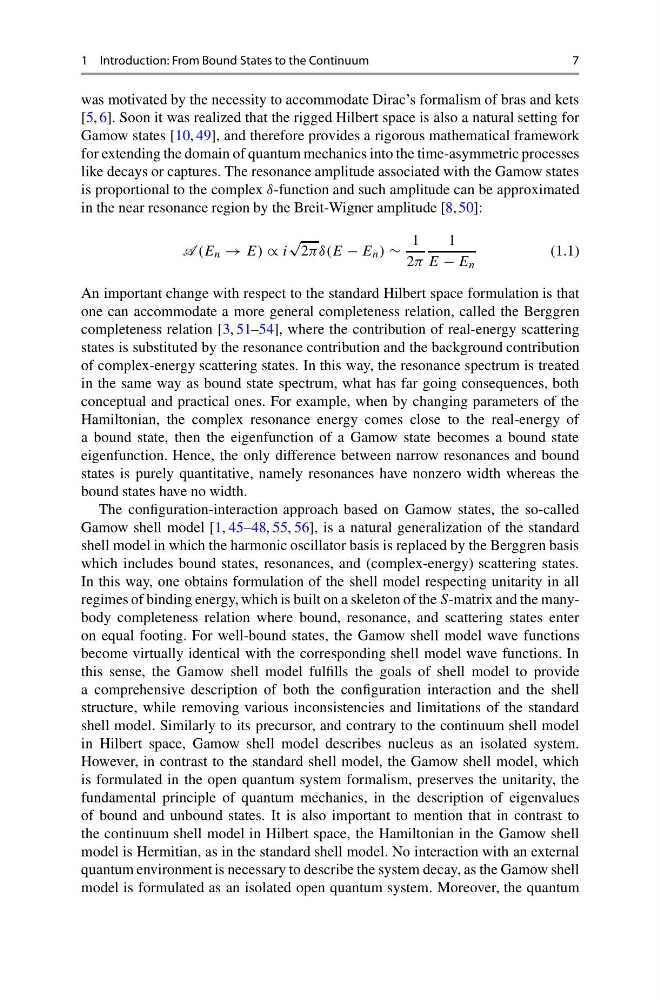
in the near resonance region by the Breit-Wigner amplitude [8, 50]:
A (E n → E) ∝ i
√
2πδ(E − E n ) ∼
1
2π
1
E − E n
(1.1)
An important change with respect to the standard Hilbert space formulation is that
one can accommodate a more general completeness relation, called the Berggren
completeness relation [3, 51–54], where the contribution of real-energy scattering
states is substituted by the resonance contribution and the background contribution
of complex-energy scattering states. In this way, the resonance spectrum is treated
in the same way as bound state spectrum, what has far going consequences, both
conceptual and practical ones. For example, when by changing parameters of the
Hamiltonian, the complex resonance energy comes close to the real-energy of
a bound state, then the eigenfunction of a Gamow state becomes a bound state
eigenfunction. Hence, the only difference between narrow resonances and bound
states is purely quantitative, namely resonances have nonzero width whereas the
bound states have no width.
The configuration-interaction approach based on Gamow states, the so-called
Gamow shell model [1, 45–48, 55, 56], is a natural generalization of the standard
shell model in which the harmonic oscillator basis is replaced by the Berggren basis
which includes bound states, resonances, and (complex-energy) scattering states.
In this way, one obtains formulation of the shell model respecting unitarity in all
regimes of binding energy, which is built on a skeleton of the S-matrix and the manybody completeness relation where bound, resonance, and scattering states enter
on equal footing. For well-bound states, the Gamow shell model wave functions
become virtually identical with the corresponding shell model wave functions. In
this sense, the Gamow shell model fulfills the goals of shell model to provide
a comprehensive description of both the configuration interaction and the shell
structure, while removing various inconsistencies and limitations of the standard
shell model. Similarly to its precursor, and contrary to the continuum shell model
in Hilbert space, Gamow shell model describes nucleus as an isolated system.
However, in contrast to the standard shell model, the Gamow shell model, which
is formulated in the open quantum system formalism, preserves the unitarity, the
fundamental principle of quantum mechanics, in the description of eigenvalues
of bound and unbound states. It is also important to mention that in contrast to
the continuum shell model in Hilbert space, the Hamiltonian in the Gamow shell
model is Hermitian, as in the standard shell model. No interaction with an external
quantum environment is necessary to describe the system decay, as the Gamow shell
model is formulated as an isolated open quantum system. Moreover, the quantum
7
was motivated by the necessity to accommodate Dirac’s formalism of bras and kets
[5, 6]. Soon it was realized that the rigged Hilbert space is also a natural setting for
Gamow states [10, 49], and therefore provides a rigorous mathematical framework
for extending the domain of quantum mechanics into the time-asymmetric processes
like decays or captures. The resonance amplitude associated with the Gamow states
is proportional to the complex δ-function and such amplitude can be approximated
in the near resonance region by the Breit-Wigner amplitude [8, 50]:
A (E n → E) ∝ i
√
2πδ(E − E n ) ∼
1
2π
1
E − E n
(1.1)
An important change with respect to the standard Hilbert space formulation is that
one can accommodate a more general completeness relation, called the Berggren
completeness relation [3, 51–54], where the contribution of real-energy scattering
states is substituted by the resonance contribution and the background contribution
of complex-energy scattering states. In this way, the resonance spectrum is treated
in the same way as bound state spectrum, what has far going consequences, both
conceptual and practical ones. For example, when by changing parameters of the
Hamiltonian, the complex resonance energy comes close to the real-energy of
a bound state, then the eigenfunction of a Gamow state becomes a bound state
eigenfunction. Hence, the only difference between narrow resonances and bound
states is purely quantitative, namely resonances have nonzero width whereas the
bound states have no width.
The configuration-interaction approach based on Gamow states, the so-called
Gamow shell model [1, 45–48, 55, 56], is a natural generalization of the standard
shell model in which the harmonic oscillator basis is replaced by the Berggren basis
which includes bound states, resonances, and (complex-energy) scattering states.
In this way, one obtains formulation of the shell model respecting unitarity in all
regimes of binding energy, which is built on a skeleton of the S-matrix and the manybody completeness relation where bound, resonance, and scattering states enter
on equal footing. For well-bound states, the Gamow shell model wave functions
become virtually identical with the corresponding shell model wave functions. In
this sense, the Gamow shell model fulfills the goals of shell model to provide
a comprehensive description of both the configuration interaction and the shell
structure, while removing various inconsistencies and limitations of the standard
shell model. Similarly to its precursor, and contrary to the continuum shell model
in Hilbert space, Gamow shell model describes nucleus as an isolated system.
However, in contrast to the standard shell model, the Gamow shell model, which
is formulated in the open quantum system formalism, preserves the unitarity, the
fundamental principle of quantum mechanics, in the description of eigenvalues
of bound and unbound states. It is also important to mention that in contrast to
the continuum shell model in Hilbert space, the Hamiltonian in the Gamow shell
model is Hermitian, as in the standard shell model. No interaction with an external
quantum environment is necessary to describe the system decay, as the Gamow shell
model is formulated as an isolated open quantum system. Moreover, the quantum