

192
5 Formulation and Implementation of the Gamow Shell Model
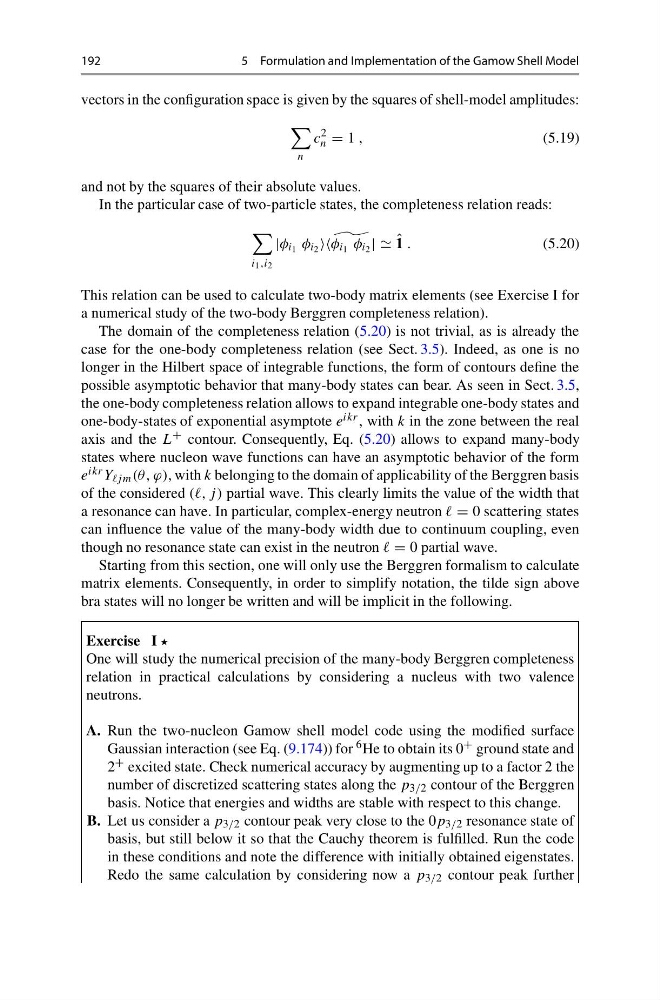
vectors in the configuration space is given by the squares of shell-model amplitudes:
n
c
2
n = 1 ,
(5.19)
and not by the squares of their absolute values.
In the particular case of two-particle states, the completeness relation reads:
i 1 ,i 2
|φ i 1 φ i 2
φ i 1 φ i 2 | | ˆ
1 .
(5.20)
This relation can be used to calculate two-body matrix elements (see Exercise I for
a numerical study of the two-body Berggren completeness relation).
The domain of the completeness relation (5.20) is not trivial, as is already the
case for the one-body completeness relation (see Sect. 3.5). Indeed, as one is no
longer in the Hilbert space of integrable functions, the form of contours define the
possible asymptotic behavior that many-body states can bear. As seen in Sect. 3.5,
the one-body completeness relation allows to expand integrable one-body states and
one-body-states of exponential asymptote e ikr , with k in the zone between the real
axis and the L + contour. Consequently, Eq. (5.20) allows to expand many-body
states where nucleon wave functions can have an asymptotic behavior of the form
e ikr Y j m (θ, ϕ), with k belonging to the domain of applicability of the Berggren basis
of the considered ((, j ) partial wave. This clearly limits the value of the width that
a resonance can have. In particular, complex-energy neutron = 0 scattering states
can influence the value of the many-body width due to continuum coupling, even
though no resonance state can exist in the neutron = 0 partial wave.
Starting from this section, one will only use the Berggren formalism to calculate
matrix elements. Consequently, in order to simplify notation, the tilde sign above
bra states will no longer be written and will be implicit in the following.
Exercise I
One will study the numerical precision of the many-body Berggren completeness
relation in practical calculations by considering a nucleus with two valence
neutrons.
A. Run the two-nucleon Gamow shell model code using the modified surface
Gaussian interaction (see Eq. (9.174)) for 6 He to obtain its 0 + ground state and
2 + excited state. Check numerical accuracy by augmenting up to a factor 2 the
number of discretized scattering states along the p 3/2 contour of the Berggren
basis. Notice that energies and widths are stable with respect to this change.
B. Let us consider a p 3/2 contour peak very close to the 0p 3/2 resonance state of
basis, but still below it so that the Cauchy theorem is fulfilled. Run the code
in these conditions and note the difference with initially obtained eigenstates.
Redo the same calculation by considering now a p 3/2 contour peak further
5 Formulation and Implementation of the Gamow Shell Model
vectors in the configuration space is given by the squares of shell-model amplitudes:
n
c
2
n = 1 ,
(5.19)
and not by the squares of their absolute values.
In the particular case of two-particle states, the completeness relation reads:
i 1 ,i 2
|φ i 1 φ i 2
φ i 1 φ i 2 | | ˆ
1 .
(5.20)
This relation can be used to calculate two-body matrix elements (see Exercise I for
a numerical study of the two-body Berggren completeness relation).
The domain of the completeness relation (5.20) is not trivial, as is already the
case for the one-body completeness relation (see Sect. 3.5). Indeed, as one is no
longer in the Hilbert space of integrable functions, the form of contours define the
possible asymptotic behavior that many-body states can bear. As seen in Sect. 3.5,
the one-body completeness relation allows to expand integrable one-body states and
one-body-states of exponential asymptote e ikr , with k in the zone between the real
axis and the L + contour. Consequently, Eq. (5.20) allows to expand many-body
states where nucleon wave functions can have an asymptotic behavior of the form
e ikr Y j m (θ, ϕ), with k belonging to the domain of applicability of the Berggren basis
of the considered ((, j ) partial wave. This clearly limits the value of the width that
a resonance can have. In particular, complex-energy neutron = 0 scattering states
can influence the value of the many-body width due to continuum coupling, even
though no resonance state can exist in the neutron = 0 partial wave.
Starting from this section, one will only use the Berggren formalism to calculate
matrix elements. Consequently, in order to simplify notation, the tilde sign above
bra states will no longer be written and will be implicit in the following.
Exercise I
One will study the numerical precision of the many-body Berggren completeness
relation in practical calculations by considering a nucleus with two valence
neutrons.
A. Run the two-nucleon Gamow shell model code using the modified surface
Gaussian interaction (see Eq. (9.174)) for 6 He to obtain its 0 + ground state and
2 + excited state. Check numerical accuracy by augmenting up to a factor 2 the
number of discretized scattering states along the p 3/2 contour of the Berggren
basis. Notice that energies and widths are stable with respect to this change.
B. Let us consider a p 3/2 contour peak very close to the 0p 3/2 resonance state of
basis, but still below it so that the Cauchy theorem is fulfilled. Run the code
in these conditions and note the difference with initially obtained eigenstates.
Redo the same calculation by considering now a p 3/2 contour peak further