

1 Introduction: From Bound States to the Continuum
5
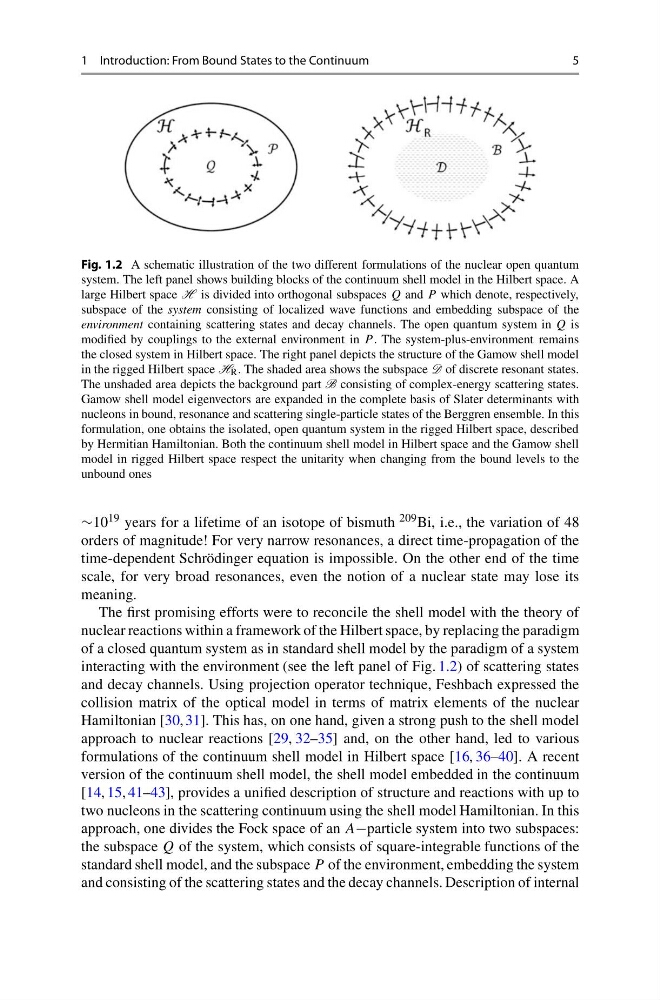
Fig. 1.2 A schematic illustration of the two different formulations of the nuclear open quantum
system. The left panel shows building blocks of the continuum shell model in the Hilbert space. A
large Hilbert space H is divided into orthogonal subspaces Q and P which denote, respectively,
subspace of the system consisting of localized wave functions and embedding subspace of the
environment containing scattering states and decay channels. The open quantum system in Q is
modified by couplings to the external environment in P . The system-plus-environment remains
the closed system in Hilbert space. The right panel depicts the structure of the Gamow shell model
in the rigged Hilbert space H R . The shaded area shows the subspace D of discrete resonant states.
The unshaded area depicts the background part B consisting of complex-energy scattering states.
Gamow shell model eigenvectors are expanded in the complete basis of Slater determinants with
nucleons in bound, resonance and scattering single-particle states of the Berggren ensemble. In this
formulation, one obtains the isolated, open quantum system in the rigged Hilbert space, described
by Hermitian Hamiltonian. Both the continuum shell model in Hilbert space and the Gamow shell
model in rigged Hilbert space respect the unitarity when changing from the bound levels to the
unbound ones
∼10 19 years for a lifetime of an isotope of bismuth 209 Bi, i.e., the variation of 48
orders of magnitude! For very narrow resonances, a direct time-propagation of the
time-dependent Schrödinger equation is impossible. On the other end of the time
scale, for very broad resonances, even the notion of a nuclear state may lose its
meaning.
The first promising efforts were to reconcile the shell model with the theory of
nuclear reactions within a framework of the Hilbert space, by replacing the paradigm
of a closed quantum system as in standard shell model by the paradigm of a system
interacting with the environment (see the left panel of Fig. 1.2) of scattering states
and decay channels. Using projection operator technique, Feshbach expressed the
collision matrix of the optical model in terms of matrix elements of the nuclear
Hamiltonian [30, 31]. This has, on one hand, given a strong push to the shell model
approach to nuclear reactions [29, 32–35] and, on the other hand, led to various
formulations of the continuum shell model in Hilbert space [16, 36–40]. A recent
version of the continuum shell model, the shell model embedded in the continuum
[14, 15, 41–43], provides a unified description of structure and reactions with up to
two nucleons in the scattering continuum using the shell model Hamiltonian. In this
approach, one divides the Fock space of an A−particle system into two subspaces:
the subspace Q of the system, which consists of square-integrable functions of the
standard shell model, and the subspace P of the environment, embedding the system
and consisting of the scattering states and the decay channels. Description of internal
5
Fig. 1.2 A schematic illustration of the two different formulations of the nuclear open quantum
system. The left panel shows building blocks of the continuum shell model in the Hilbert space. A
large Hilbert space H is divided into orthogonal subspaces Q and P which denote, respectively,
subspace of the system consisting of localized wave functions and embedding subspace of the
environment containing scattering states and decay channels. The open quantum system in Q is
modified by couplings to the external environment in P . The system-plus-environment remains
the closed system in Hilbert space. The right panel depicts the structure of the Gamow shell model
in the rigged Hilbert space H R . The shaded area shows the subspace D of discrete resonant states.
The unshaded area depicts the background part B consisting of complex-energy scattering states.
Gamow shell model eigenvectors are expanded in the complete basis of Slater determinants with
nucleons in bound, resonance and scattering single-particle states of the Berggren ensemble. In this
formulation, one obtains the isolated, open quantum system in the rigged Hilbert space, described
by Hermitian Hamiltonian. Both the continuum shell model in Hilbert space and the Gamow shell
model in rigged Hilbert space respect the unitarity when changing from the bound levels to the
unbound ones
∼10 19 years for a lifetime of an isotope of bismuth 209 Bi, i.e., the variation of 48
orders of magnitude! For very narrow resonances, a direct time-propagation of the
time-dependent Schrödinger equation is impossible. On the other end of the time
scale, for very broad resonances, even the notion of a nuclear state may lose its
meaning.
The first promising efforts were to reconcile the shell model with the theory of
nuclear reactions within a framework of the Hilbert space, by replacing the paradigm
of a closed quantum system as in standard shell model by the paradigm of a system
interacting with the environment (see the left panel of Fig. 1.2) of scattering states
and decay channels. Using projection operator technique, Feshbach expressed the
collision matrix of the optical model in terms of matrix elements of the nuclear
Hamiltonian [30, 31]. This has, on one hand, given a strong push to the shell model
approach to nuclear reactions [29, 32–35] and, on the other hand, led to various
formulations of the continuum shell model in Hilbert space [16, 36–40]. A recent
version of the continuum shell model, the shell model embedded in the continuum
[14, 15, 41–43], provides a unified description of structure and reactions with up to
two nucleons in the scattering continuum using the shell model Hamiltonian. In this
approach, one divides the Fock space of an A−particle system into two subspaces:
the subspace Q of the system, which consists of square-integrable functions of the
standard shell model, and the subspace P of the environment, embedding the system
and consisting of the scattering states and the decay channels. Description of internal