

4.3 The Particle-Rotor Model in the Berggren Basis
175
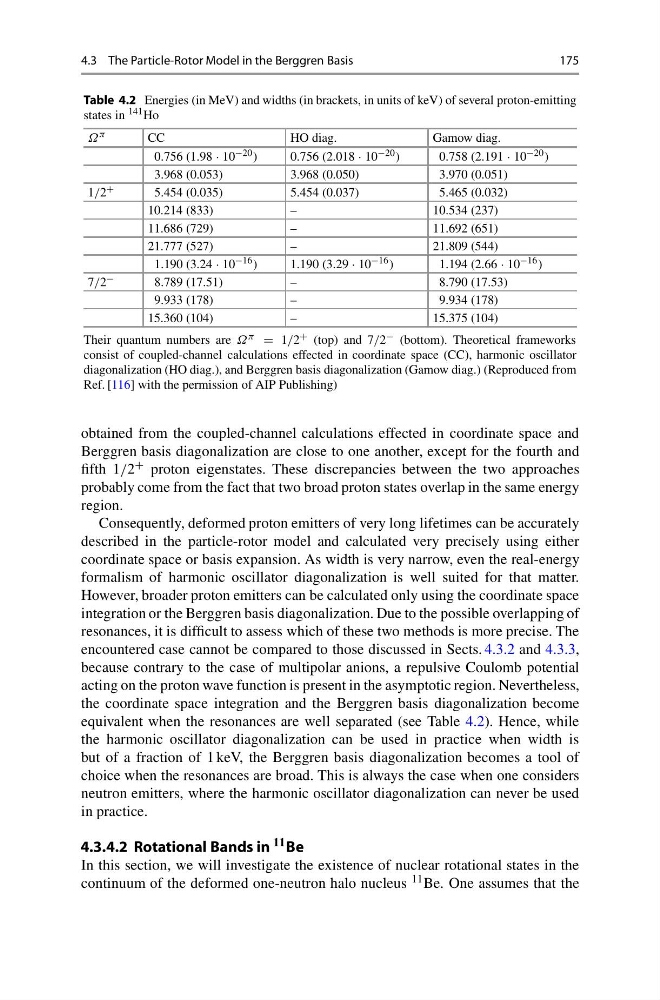
Table 4.2 Energies (in MeV) and widths (in brackets, in units of keV) of several proton-emitting
states in 141 Ho
Ω π
CC
HO diag.
Gamow diag.
0.756 (1.98 · 10 −20 )
0.756 (2.018 · 10 −20 )
0.758 (2.191 · 10 −20 )
3.968 (0.053)
3.968 (0.050)
3.970 (0.051)
1/2 +
5.454 (0.035)
5.454 (0.037)
5.465 (0.032)
10.214 (833)
–
10.534 (237)
11.686 (729)
–
11.692 (651)
21.777 (527)
–
21.809 (544)
1.190 (3.24 · 10 −16 )
1.190 (3.29 · 10 −16 )
1.194 (2.66 · 10 −16 )
7/2 −
8.789 (17.51)
–
8.790 (17.53)
9.933 (178)
–
9.934 (178)
15.360 (104)
–
15.375 (104)
Their quantum numbers are Ω π = 1/2 + (top) and 7/2 − (bottom). Theoretical frameworks
consist of coupled-channel calculations effected in coordinate space (CC), harmonic oscillator
diagonalization (HO diag.), and Berggren basis diagonalization (Gamow diag.) (Reproduced from
Ref. [116] with the permission of AIP Publishing)
obtained from the coupled-channel calculations effected in coordinate space and
Berggren basis diagonalization are close to one another, except for the fourth and
fifth 1/2 + proton eigenstates. These discrepancies between the two approaches
probably come from the fact that two broad proton states overlap in the same energy
region.
Consequently, deformed proton emitters of very long lifetimes can be accurately
described in the particle-rotor model and calculated very precisely using either
coordinate space or basis expansion. As width is very narrow, even the real-energy
formalism of harmonic oscillator diagonalization is well suited for that matter.
However, broader proton emitters can be calculated only using the coordinate space
integration or the Berggren basis diagonalization. Due to the possible overlapping of
resonances, it is difficult to assess which of these two methods is more precise. The
encountered case cannot be compared to those discussed in Sects. 4.3.2 and 4.3.3,
because contrary to the case of multipolar anions, a repulsive Coulomb potential
acting on the proton wave function is present in the asymptotic region. Nevertheless,
the coordinate space integration and the Berggren basis diagonalization become
equivalent when the resonances are well separated (see Table 4.2). Hence, while
the harmonic oscillator diagonalization can be used in practice when width is
but of a fraction of 1 keV, the Berggren basis diagonalization becomes a tool of
choice when the resonances are broad. This is always the case when one considers
neutron emitters, where the harmonic oscillator diagonalization can never be used
in practice.
4.3.4.2 Rotational Bands in 11 Be
In this section, we will investigate the existence of nuclear rotational states in the
continuum of the deformed one-neutron halo nucleus 11 Be. One assumes that the
175
Table 4.2 Energies (in MeV) and widths (in brackets, in units of keV) of several proton-emitting
states in 141 Ho
Ω π
CC
HO diag.
Gamow diag.
0.756 (1.98 · 10 −20 )
0.756 (2.018 · 10 −20 )
0.758 (2.191 · 10 −20 )
3.968 (0.053)
3.968 (0.050)
3.970 (0.051)
1/2 +
5.454 (0.035)
5.454 (0.037)
5.465 (0.032)
10.214 (833)
–
10.534 (237)
11.686 (729)
–
11.692 (651)
21.777 (527)
–
21.809 (544)
1.190 (3.24 · 10 −16 )
1.190 (3.29 · 10 −16 )
1.194 (2.66 · 10 −16 )
7/2 −
8.789 (17.51)
–
8.790 (17.53)
9.933 (178)
–
9.934 (178)
15.360 (104)
–
15.375 (104)
Their quantum numbers are Ω π = 1/2 + (top) and 7/2 − (bottom). Theoretical frameworks
consist of coupled-channel calculations effected in coordinate space (CC), harmonic oscillator
diagonalization (HO diag.), and Berggren basis diagonalization (Gamow diag.) (Reproduced from
Ref. [116] with the permission of AIP Publishing)
obtained from the coupled-channel calculations effected in coordinate space and
Berggren basis diagonalization are close to one another, except for the fourth and
fifth 1/2 + proton eigenstates. These discrepancies between the two approaches
probably come from the fact that two broad proton states overlap in the same energy
region.
Consequently, deformed proton emitters of very long lifetimes can be accurately
described in the particle-rotor model and calculated very precisely using either
coordinate space or basis expansion. As width is very narrow, even the real-energy
formalism of harmonic oscillator diagonalization is well suited for that matter.
However, broader proton emitters can be calculated only using the coordinate space
integration or the Berggren basis diagonalization. Due to the possible overlapping of
resonances, it is difficult to assess which of these two methods is more precise. The
encountered case cannot be compared to those discussed in Sects. 4.3.2 and 4.3.3,
because contrary to the case of multipolar anions, a repulsive Coulomb potential
acting on the proton wave function is present in the asymptotic region. Nevertheless,
the coordinate space integration and the Berggren basis diagonalization become
equivalent when the resonances are well separated (see Table 4.2). Hence, while
the harmonic oscillator diagonalization can be used in practice when width is
but of a fraction of 1 keV, the Berggren basis diagonalization becomes a tool of
choice when the resonances are broad. This is always the case when one considers
neutron emitters, where the harmonic oscillator diagonalization can never be used
in practice.
4.3.4.2 Rotational Bands in 11 Be
In this section, we will investigate the existence of nuclear rotational states in the
continuum of the deformed one-neutron halo nucleus 11 Be. One assumes that the