

4.3 The Particle-Rotor Model in the Berggren Basis
171
The pattern of families shown in Fig. 4.8 can be understood by considering
angular momentum coupling. Since = j r for J π = 0 + states, each family
of resonances represents an electron anti-aligned with respect to the angular
momentum of a rotor. The steadily increasing energy distance between groups is
due to the centrifugal barrier that grows with . The states within each family can
be distinguished by the number of nodes in the radial wave function. For J π = 1 − ,
the angular momentum selection rule becomes: = 1 for j r = 0 and = j r ± 1
for j r = 2, 4, . . . . This yields 8 families (note that since max = 8, there is only one
channel with j r = 8). The density of resonances in the complex energy plane is high
because many resonances belonging to low- channels cluster around the rotational
states of the molecule. This result in a multiple avoided crossings which imply the
strong configuration mixing.
As demonstrated above for the supercritical quadrupolar molecules with
|Q ±
zz | > |Q ±
zz,c | (see Fig. 4.8), many resonances can exist in the vicinity of the
rotor energies. Also the subcritical quadrupolar molecules with |Q ±
zz | < |Q ±
zz,c |
may accommodate resonances in spite of their weaker quadrupolar field [94].
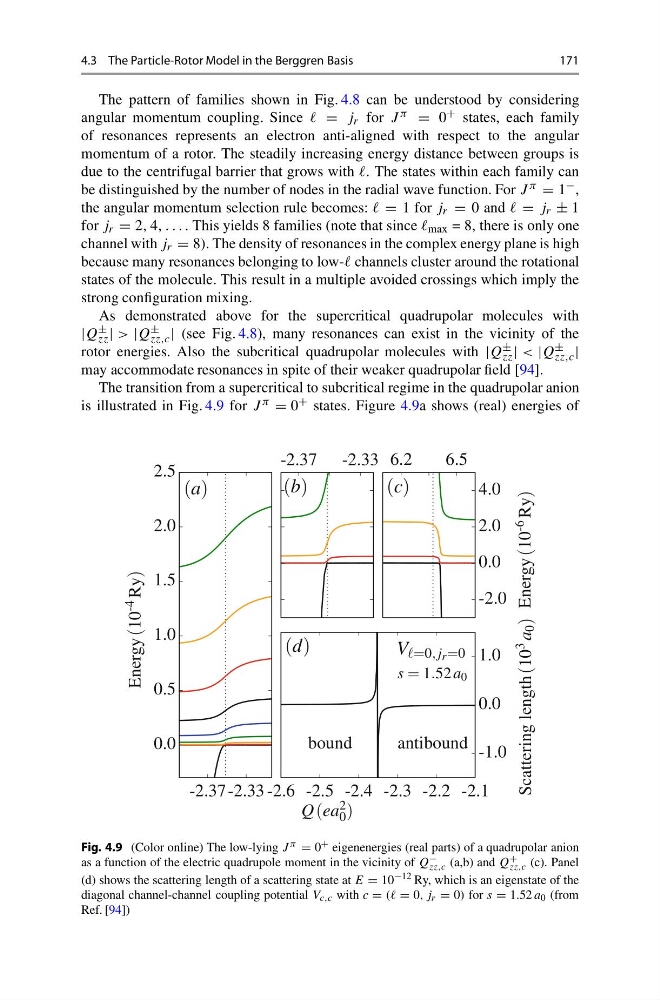
The transition from a supercritical to subcritical regime in the quadrupolar anion
is illustrated in Fig. 4.9 for J π = 0 + states. Figure 4.9a shows (real) energies of
0.0
0.2
0.4
0.6
0.8
1.0
Q (ea 2
0 )
0.0
0.2
0.4
0.6
0.8
1.0
-2.37 -2.33
(b)
6.2
6.5
-2.0
0.0
2.0
4.0
Energy
(10
-6
Ry)
(c)
-2.6 -2.5 -2.4 -2.3 -2.2 -2.1
-1.0
0.0
1.0
Scattering length
(10
3
a
0
)
(d)
V j r =0
s = 1.52 a 0
bound
antibound
-2.37 -2.33
0.0
0.5
1.0
1.5
2.0
2.5
Energy
(10
-4
Ry)
(a)
Fig. 4.9 (Color online) The low-lying J π = 0 + eigenenergies (real parts) of a quadrupolar anion
as a function of the electric quadrupole moment in the vicinity of Q −
zz,c (a,b) and Q +
zz,c (c). Panel
(d) shows the scattering length of a scattering state at E = 10
−12 Ry, which is an eigenstate of the
diagonal channel-channel coupling potential V c,c with c = (( = 0, j r = 0) for s = 1.52 a 0 (from
Ref. [94])
171
The pattern of families shown in Fig. 4.8 can be understood by considering
angular momentum coupling. Since = j r for J π = 0 + states, each family
of resonances represents an electron anti-aligned with respect to the angular
momentum of a rotor. The steadily increasing energy distance between groups is
due to the centrifugal barrier that grows with . The states within each family can
be distinguished by the number of nodes in the radial wave function. For J π = 1 − ,
the angular momentum selection rule becomes: = 1 for j r = 0 and = j r ± 1
for j r = 2, 4, . . . . This yields 8 families (note that since max = 8, there is only one
channel with j r = 8). The density of resonances in the complex energy plane is high
because many resonances belonging to low- channels cluster around the rotational
states of the molecule. This result in a multiple avoided crossings which imply the
strong configuration mixing.
As demonstrated above for the supercritical quadrupolar molecules with
|Q ±
zz | > |Q ±
zz,c | (see Fig. 4.8), many resonances can exist in the vicinity of the
rotor energies. Also the subcritical quadrupolar molecules with |Q ±
zz | < |Q ±
zz,c |
may accommodate resonances in spite of their weaker quadrupolar field [94].
The transition from a supercritical to subcritical regime in the quadrupolar anion
is illustrated in Fig. 4.9 for J π = 0 + states. Figure 4.9a shows (real) energies of
0.0
0.2
0.4
0.6
0.8
1.0
Q (ea 2
0 )
0.0
0.2
0.4
0.6
0.8
1.0
-2.37 -2.33
(b)
6.2
6.5
-2.0
0.0
2.0
4.0
Energy
(10
-6
Ry)
(c)
-2.6 -2.5 -2.4 -2.3 -2.2 -2.1
-1.0
0.0
1.0
Scattering length
(10
3
a
0
)
(d)
V j r =0
s = 1.52 a 0
bound
antibound
-2.37 -2.33
0.0
0.5
1.0
1.5
2.0
2.5
Energy
(10
-4
Ry)
(a)
Fig. 4.9 (Color online) The low-lying J π = 0 + eigenenergies (real parts) of a quadrupolar anion
as a function of the electric quadrupole moment in the vicinity of Q −
zz,c (a,b) and Q +
zz,c (c). Panel
(d) shows the scattering length of a scattering state at E = 10
−12 Ry, which is an eigenstate of the
diagonal channel-channel coupling potential V c,c with c = (( = 0, j r = 0) for s = 1.52 a 0 (from
Ref. [94])