

4.3 The Particle-Rotor Model in the Berggren Basis
163
In this section, we will address the nature of the unbound part of the spectrum
of dipolar anions. In particular, we will be interested in elucidating the transition
from the rotational motion of weakly bound subthreshold states to the rotationallike behavior exhibited by resonances. The competition between continuum effects,
collective rotation, and nonadiabatic aspects of the problem makes the description
of threshold states in dipolar anions both interesting and challenging.
As an example, we will now discuss calculations for a rotational spectrum of the
hydrogen cyanide HCN − , which has long served as a prototype of the dipole-bound
anions [44, 78, 79] and was a subject of experimental and theoretical studies [34, 80,
81]. Here, one extends these previous studies of bound states of dipolar molecules
to the unbound part of the spectrum. The parameters of the pseudo-potential for
the HCN − anion are taken from Ref. [82]. One will also note that, since V cc (r)
decreases at least as fast as r −2 , all off-diagonal matrix elements of the coupling
potential can be computed by means of the complex scaling.
To achieve stability of bound-state energies, the Berggren expansion method
calculations were carried out by including all partial waves with ≤ max = 9
and taking the optimized number of points (N = 165) on the complex contour with
k max = 6 a
−1
0 for each J π . Detailed discussion can be found in Ref. [83].
The diagonalization of a complex-symmetric Hamiltonian matrix of the particlerotor model in Berggren representation yields a set of eigenenergies which are
the physical states (S-matrix poles of the Hamiltonian) and a large number of
complex-energy scattering states. The resonances are thus embedded in a discretized
continuum of scattering states and their identification is not trivial [84, 85]. The
eigenstates associated with resonances should be stable with respect to changes
of the contour [84, 85]. Moreover, their dominant channel wave functions should
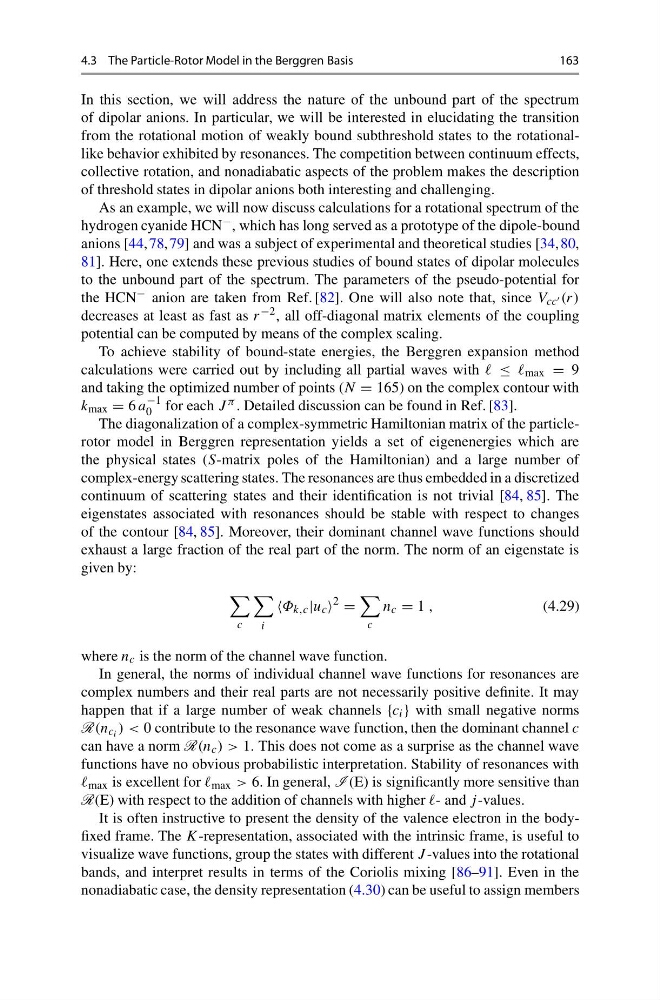
exhaust a large fraction of the real part of the norm. The norm of an eigenstate is
given by:
c
i
k,c |u c
2
=
c
n c = 1 ,
(4.29)
where n c is the norm of the channel wave function.
In general, the norms of individual channel wave functions for resonances are
complex numbers and their real parts are not necessarily positive definite. It may
happen that if a large number of weak channels {c i } with small negative norms
R(n c i ) < 0 contribute to the resonance wave function, then the dominant channel c
can have a norm R(n c ) > 1. This does not come as a surprise as the channel wave
functions have no obvious probabilistic interpretation. Stability of resonances with
max is excellent for max > 6. In general, I (E) is significantly more sensitive than
R(E) with respect to the addition of channels with higher - and j -values.
It is often instructive to present the density of the valence electron in the bodyfixed frame. The K-representation, associated with the intrinsic frame, is useful to
visualize wave functions, group the states with different J -values into the rotational
bands, and interpret results in terms of the Coriolis mixing [86–91]. Even in the
nonadiabatic case, the density representation (4.30) can be useful to assign members
163
In this section, we will address the nature of the unbound part of the spectrum
of dipolar anions. In particular, we will be interested in elucidating the transition
from the rotational motion of weakly bound subthreshold states to the rotationallike behavior exhibited by resonances. The competition between continuum effects,
collective rotation, and nonadiabatic aspects of the problem makes the description
of threshold states in dipolar anions both interesting and challenging.
As an example, we will now discuss calculations for a rotational spectrum of the
hydrogen cyanide HCN − , which has long served as a prototype of the dipole-bound
anions [44, 78, 79] and was a subject of experimental and theoretical studies [34, 80,
81]. Here, one extends these previous studies of bound states of dipolar molecules
to the unbound part of the spectrum. The parameters of the pseudo-potential for
the HCN − anion are taken from Ref. [82]. One will also note that, since V cc (r)
decreases at least as fast as r −2 , all off-diagonal matrix elements of the coupling
potential can be computed by means of the complex scaling.
To achieve stability of bound-state energies, the Berggren expansion method
calculations were carried out by including all partial waves with ≤ max = 9
and taking the optimized number of points (N = 165) on the complex contour with
k max = 6 a
−1
0 for each J π . Detailed discussion can be found in Ref. [83].
The diagonalization of a complex-symmetric Hamiltonian matrix of the particlerotor model in Berggren representation yields a set of eigenenergies which are
the physical states (S-matrix poles of the Hamiltonian) and a large number of
complex-energy scattering states. The resonances are thus embedded in a discretized
continuum of scattering states and their identification is not trivial [84, 85]. The
eigenstates associated with resonances should be stable with respect to changes
of the contour [84, 85]. Moreover, their dominant channel wave functions should
exhaust a large fraction of the real part of the norm. The norm of an eigenstate is
given by:
c
i
k,c |u c
2
=
c
n c = 1 ,
(4.29)
where n c is the norm of the channel wave function.
In general, the norms of individual channel wave functions for resonances are
complex numbers and their real parts are not necessarily positive definite. It may
happen that if a large number of weak channels {c i } with small negative norms
R(n c i ) < 0 contribute to the resonance wave function, then the dominant channel c
can have a norm R(n c ) > 1. This does not come as a surprise as the channel wave
functions have no obvious probabilistic interpretation. Stability of resonances with
max is excellent for max > 6. In general, I (E) is significantly more sensitive than
R(E) with respect to the addition of channels with higher - and j -values.
It is often instructive to present the density of the valence electron in the bodyfixed frame. The K-representation, associated with the intrinsic frame, is useful to
visualize wave functions, group the states with different J -values into the rotational
bands, and interpret results in terms of the Coriolis mixing [86–91]. Even in the
nonadiabatic case, the density representation (4.30) can be useful to assign members