

4.3 The Particle-Rotor Model in the Berggren Basis
161
completeness relation in a coupled-channel formulation reads:
N
i=1
|Φ i,c i,c | | 1 ,
(4.21)
where the N basis states include bound, resonance, and discretized scattering states
for each considered channel c.
4.3.1.1 Use of Pseudo-Potentials in Weakly Bound Anions
The main drawback of the particle-rotor model is that the Pauli principle is not
exactly satisfied, as angular momentum coupling generates a partial occupation of
one-body states in the core. To restore partially the Pauli principle, a short-range
potential can be added to the Hamiltonian.
The interaction between the valence electron and the molecular core is modeled
by a pseudo-potential, which is suppose to reproduce the main effects of the
interactions between the valence electron and the electrons of the molecular core. It
reads:
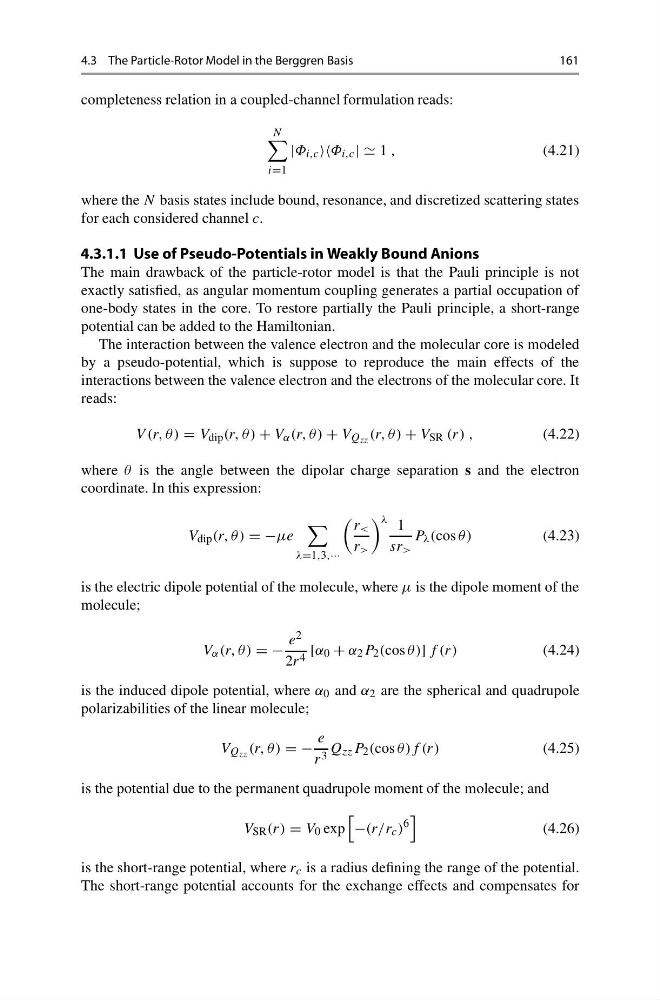
V (r, θ) = V dip (r, θ ) + V α (r, θ ) + V Q zz (r, θ ) + V SR (r) ,
(4.22)
where θ is the angle between the dipolar charge separation s and the electron
coordinate. In this expression:
V dip (r, θ ) = −μe
λ=1,3,···
r <
r >
λ 1
sr >
P λ (cos θ)
(4.23)
is the electric dipole potential of the molecule, where μ is the dipole moment of the
molecule;
V α (r, θ ) = −
e 2
2r 4 [α 0 + α 2 P 2 (cos θ)] f (r)
(4.24)
is the induced dipole potential, where α 0 and α 2 are the spherical and quadrupole
polarizabilities of the linear molecule;
V Q zz (r, θ ) = −
e
r 3 Q zz P 2 (cos θ)f (r)
(4.25)
is the potential due to the permanent quadrupole moment of the molecule; and
V SR (r) = V 0 exp
−(r/r c )
6
(4.26)
is the short-range potential, where r c is a radius defining the range of the potential.
The short-range potential accounts for the exchange effects and compensates for
161
completeness relation in a coupled-channel formulation reads:
N
i=1
|Φ i,c i,c | | 1 ,
(4.21)
where the N basis states include bound, resonance, and discretized scattering states
for each considered channel c.
4.3.1.1 Use of Pseudo-Potentials in Weakly Bound Anions
The main drawback of the particle-rotor model is that the Pauli principle is not
exactly satisfied, as angular momentum coupling generates a partial occupation of
one-body states in the core. To restore partially the Pauli principle, a short-range
potential can be added to the Hamiltonian.
The interaction between the valence electron and the molecular core is modeled
by a pseudo-potential, which is suppose to reproduce the main effects of the
interactions between the valence electron and the electrons of the molecular core. It
reads:
V (r, θ) = V dip (r, θ ) + V α (r, θ ) + V Q zz (r, θ ) + V SR (r) ,
(4.22)
where θ is the angle between the dipolar charge separation s and the electron
coordinate. In this expression:
V dip (r, θ ) = −μe
λ=1,3,···
r <
r >
λ 1
sr >
P λ (cos θ)
(4.23)
is the electric dipole potential of the molecule, where μ is the dipole moment of the
molecule;
V α (r, θ ) = −
e 2
2r 4 [α 0 + α 2 P 2 (cos θ)] f (r)
(4.24)
is the induced dipole potential, where α 0 and α 2 are the spherical and quadrupole
polarizabilities of the linear molecule;
V Q zz (r, θ ) = −
e
r 3 Q zz P 2 (cos θ)f (r)
(4.25)
is the potential due to the permanent quadrupole moment of the molecule; and
V SR (r) = V 0 exp
−(r/r c )
6
(4.26)
is the short-range potential, where r c is a radius defining the range of the potential.
The short-range potential accounts for the exchange effects and compensates for