

4.3 The Particle-Rotor Model in the Berggren Basis
159
In the next subsection, we will provide the mathematical background of the
particle-rotor model, in particular its coupled-channel equations which are generated
by potentials coupling the valence particle and the core. Afterward, we will
concentrate on the theory of weakly bound anions and discuss the use of pseudopotentials, which effectively take into account the complex interactions occurring in
the many-electron wave functions. Applications related to various molecular anions
will be followed by the example of a one-neutron halo nucleus 11 Be in which
influence of continuum couplings on rotational bands will be studied.
4.3.1 Mathematical Formalism of the Particle-Rotor Model
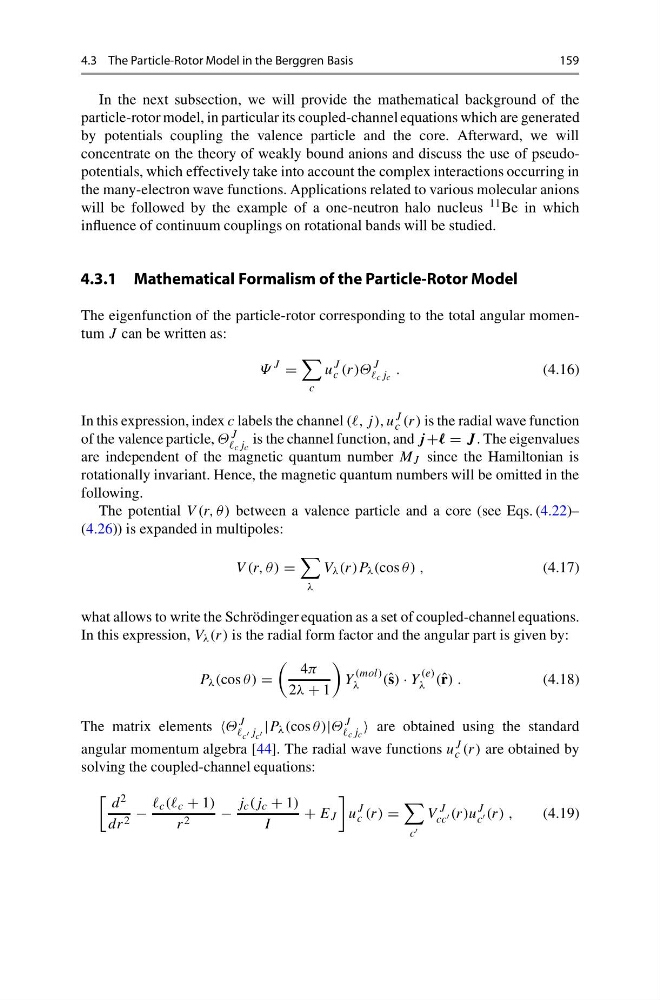
The eigenfunction of the particle-rotor corresponding to the total angular momentum J can be written as:
Ψ
J
=
c
u
J
c (r)Θ
J
c j c
.
(4.16)
In this expression, index c labels the channel ((, j ), u J
c (r) is the radial wave function
of the valence particle, Θ J
c j c
is the channel function, and j + = J . The eigenvalues
are independent of the magnetic quantum number M J since the Hamiltonian is
rotationally invariant. Hence, the magnetic quantum numbers will be omitted in the
following.
The potential V (r, θ) between a valence particle and a core (see Eqs. (4.22)–
(4.26)) is expanded in multipoles:
V (r, θ) =
λ
V λ (r)P λ (cos θ) ,
(4.17)
what allows to write the Schrödinger equation as a set of coupled-channel equations.
In this expression, V λ (r) is the radial form factor and the angular part is given by:
P λ (cos θ) =
4π
2λ + 1
Y
(mol)
λ
(ˆ s) · Y
(e)
λ (ˆ r) .
(4.18)
The matrix elements
J
c j c |P λ (cos θ)|Θ
J
c j c
are obtained using the standard
angular momentum algebra [44]. The radial wave functions u J
c (r) are obtained by
solving the coupled-channel equations:
d 2
dr 2 −
c (( c + 1)
r 2
−
j c (j c + 1)
I
+ E J
u
J
c (r) =
c
V
J
cc (r)u
J
c (r) ,
(4.19)
159
In the next subsection, we will provide the mathematical background of the
particle-rotor model, in particular its coupled-channel equations which are generated
by potentials coupling the valence particle and the core. Afterward, we will
concentrate on the theory of weakly bound anions and discuss the use of pseudopotentials, which effectively take into account the complex interactions occurring in
the many-electron wave functions. Applications related to various molecular anions
will be followed by the example of a one-neutron halo nucleus 11 Be in which
influence of continuum couplings on rotational bands will be studied.
4.3.1 Mathematical Formalism of the Particle-Rotor Model
The eigenfunction of the particle-rotor corresponding to the total angular momentum J can be written as:
Ψ
J
=
c
u
J
c (r)Θ
J
c j c
.
(4.16)
In this expression, index c labels the channel ((, j ), u J
c (r) is the radial wave function
of the valence particle, Θ J
c j c
is the channel function, and j + = J . The eigenvalues
are independent of the magnetic quantum number M J since the Hamiltonian is
rotationally invariant. Hence, the magnetic quantum numbers will be omitted in the
following.
The potential V (r, θ) between a valence particle and a core (see Eqs. (4.22)–
(4.26)) is expanded in multipoles:
V (r, θ) =
λ
V λ (r)P λ (cos θ) ,
(4.17)
what allows to write the Schrödinger equation as a set of coupled-channel equations.
In this expression, V λ (r) is the radial form factor and the angular part is given by:
P λ (cos θ) =
4π
2λ + 1
Y
(mol)
λ
(ˆ s) · Y
(e)
λ (ˆ r) .
(4.18)
The matrix elements
J
c j c |P λ (cos θ)|Θ
J
c j c
are obtained using the standard
angular momentum algebra [44]. The radial wave functions u J
c (r) are obtained by
solving the coupled-channel equations:
d 2
dr 2 −
c (( c + 1)
r 2
−
j c (j c + 1)
I
+ E J
u
J
c (r) =
c
V
J
cc (r)u
J
c (r) ,
(4.19)