

154
4 Two-Particle Systems in the Berggren Basis
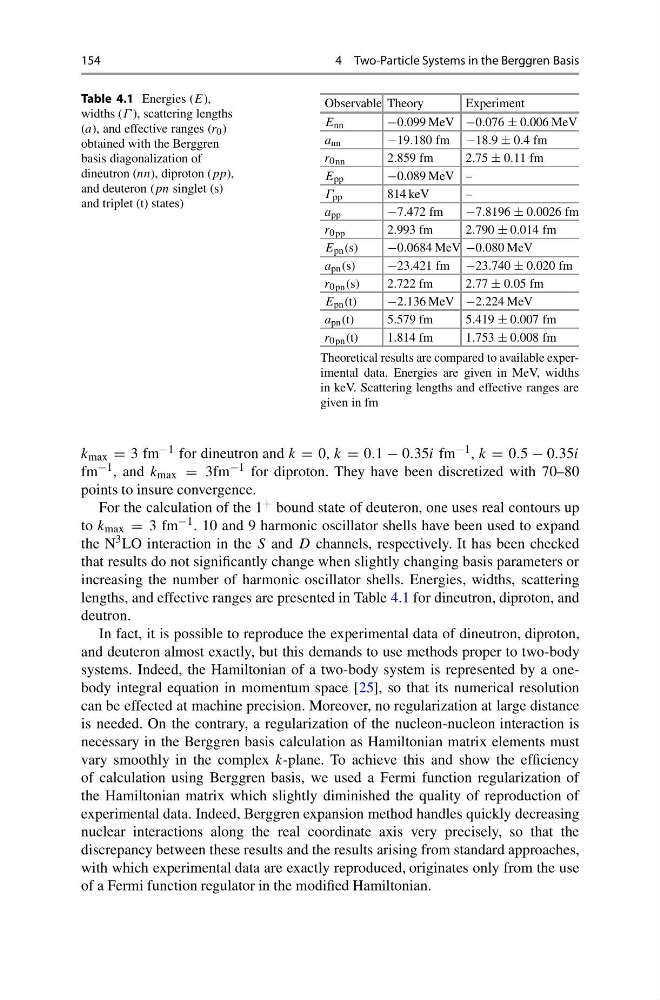
Table 4.1 Energies (E),
widths (Γ ), scattering lengths
(a), and effective ranges (r 0 )
obtained with the Berggren
basis diagonalization of
dineutron (nn), diproton (pp),
and deuteron (pn singlet (s)
and triplet (t) states)
Observable Theory
Experiment
E nn
−0.099 MeV −0.076 ± 0.006 MeV
a nn
−19.180 fm −18.9 ± 0.4 fm
r 0nn
2.859 fm
2.75 ± 0.11 fm
E pp
−0.089 MeV –
Γ pp
814 keV
–
a pp
−7.472 fm
−7.8196 ± 0.0026 fm
r 0pp
2.993 fm
2.790 ± 0.014 fm
E pn (s)
−0.0684 MeV −0.080 MeV
a pn (s)
−23.421 fm −23.740 ± 0.020 fm
r 0pn (s)
2.722 fm
2.77 ± 0.05 fm
E pn (t)
−2.136 MeV −2.224 MeV
a pn (t)
5.579 fm
5.419 ± 0.007 fm
r 0pn (t)
1.814 fm
1.753 ± 0.008 fm
Theoretical results are compared to available experimental data. Energies are given in MeV, widths
in keV. Scattering lengths and effective ranges are
given in fm
k max = 3 fm −1 for dineutron and k = 0, k = 0.1 − 0.35i fm −1 , k = 0.5 − 0.35i
fm −1 , and k max = 3fm −1 for diproton. They have been discretized with 70–80
points to insure convergence.
For the calculation of the 1 + bound state of deuteron, one uses real contours up
to k max = 3 fm −1 . 10 and 9 harmonic oscillator shells have been used to expand
the N 3 LO interaction in the S and D channels, respectively. It has been checked
that results do not significantly change when slightly changing basis parameters or
increasing the number of harmonic oscillator shells. Energies, widths, scattering
lengths, and effective ranges are presented in Table 4.1 for dineutron, diproton, and
deutron.
In fact, it is possible to reproduce the experimental data of dineutron, diproton,
and deuteron almost exactly, but this demands to use methods proper to two-body
systems. Indeed, the Hamiltonian of a two-body system is represented by a onebody integral equation in momentum space [25], so that its numerical resolution
can be effected at machine precision. Moreover, no regularization at large distance
is needed. On the contrary, a regularization of the nucleon-nucleon interaction is
necessary in the Berggren basis calculation as Hamiltonian matrix elements must
vary smoothly in the complex k-plane. To achieve this and show the efficiency
of calculation using Berggren basis, we used a Fermi function regularization of
the Hamiltonian matrix which slightly diminished the quality of reproduction of
experimental data. Indeed, Berggren expansion method handles quickly decreasing
nuclear interactions along the real coordinate axis very precisely, so that the
discrepancy between these results and the results arising from standard approaches,
with which experimental data are exactly reproduced, originates only from the use
of a Fermi function regulator in the modified Hamiltonian.
4 Two-Particle Systems in the Berggren Basis
Table 4.1 Energies (E),
widths (Γ ), scattering lengths
(a), and effective ranges (r 0 )
obtained with the Berggren
basis diagonalization of
dineutron (nn), diproton (pp),
and deuteron (pn singlet (s)
and triplet (t) states)
Observable Theory
Experiment
E nn
−0.099 MeV −0.076 ± 0.006 MeV
a nn
−19.180 fm −18.9 ± 0.4 fm
r 0nn
2.859 fm
2.75 ± 0.11 fm
E pp
−0.089 MeV –
Γ pp
814 keV
–
a pp
−7.472 fm
−7.8196 ± 0.0026 fm
r 0pp
2.993 fm
2.790 ± 0.014 fm
E pn (s)
−0.0684 MeV −0.080 MeV
a pn (s)
−23.421 fm −23.740 ± 0.020 fm
r 0pn (s)
2.722 fm
2.77 ± 0.05 fm
E pn (t)
−2.136 MeV −2.224 MeV
a pn (t)
5.579 fm
5.419 ± 0.007 fm
r 0pn (t)
1.814 fm
1.753 ± 0.008 fm
Theoretical results are compared to available experimental data. Energies are given in MeV, widths
in keV. Scattering lengths and effective ranges are
given in fm
k max = 3 fm −1 for dineutron and k = 0, k = 0.1 − 0.35i fm −1 , k = 0.5 − 0.35i
fm −1 , and k max = 3fm −1 for diproton. They have been discretized with 70–80
points to insure convergence.
For the calculation of the 1 + bound state of deuteron, one uses real contours up
to k max = 3 fm −1 . 10 and 9 harmonic oscillator shells have been used to expand
the N 3 LO interaction in the S and D channels, respectively. It has been checked
that results do not significantly change when slightly changing basis parameters or
increasing the number of harmonic oscillator shells. Energies, widths, scattering
lengths, and effective ranges are presented in Table 4.1 for dineutron, diproton, and
deutron.
In fact, it is possible to reproduce the experimental data of dineutron, diproton,
and deuteron almost exactly, but this demands to use methods proper to two-body
systems. Indeed, the Hamiltonian of a two-body system is represented by a onebody integral equation in momentum space [25], so that its numerical resolution
can be effected at machine precision. Moreover, no regularization at large distance
is needed. On the contrary, a regularization of the nucleon-nucleon interaction is
necessary in the Berggren basis calculation as Hamiltonian matrix elements must
vary smoothly in the complex k-plane. To achieve this and show the efficiency
of calculation using Berggren basis, we used a Fermi function regularization of
the Hamiltonian matrix which slightly diminished the quality of reproduction of
experimental data. Indeed, Berggren expansion method handles quickly decreasing
nuclear interactions along the real coordinate axis very precisely, so that the
discrepancy between these results and the results arising from standard approaches,
with which experimental data are exactly reproduced, originates only from the use
of a Fermi function regulator in the modified Hamiltonian.