

148
4 Two-Particle Systems in the Berggren Basis
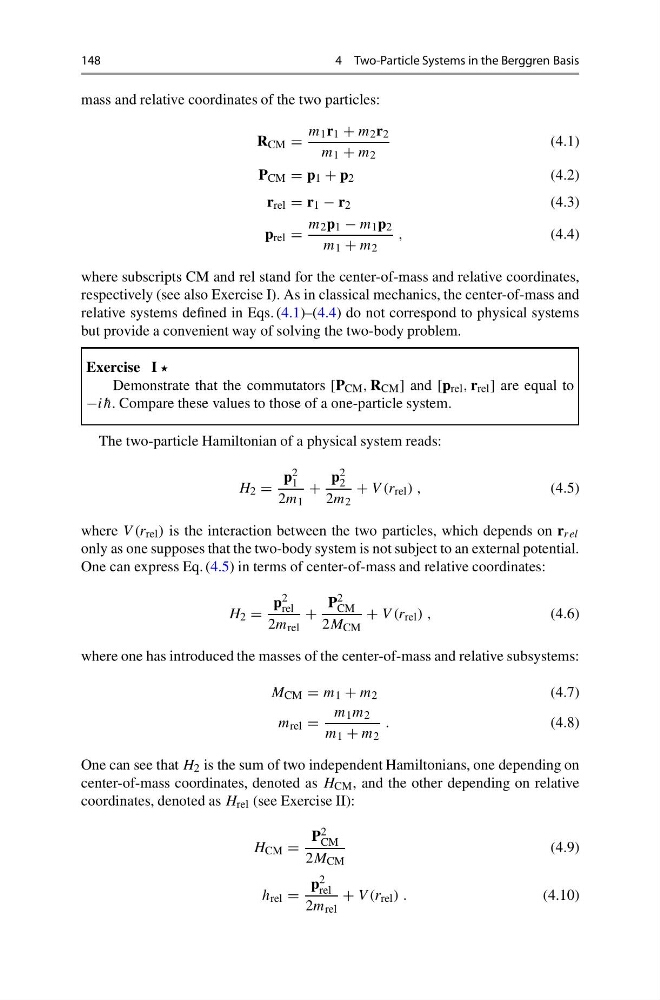
mass and relative coordinates of the two particles:
R CM =
m 1 r 1 + m 2 r 2
m 1 + m 2
(4.1)
P CM = p 1 + p 2
(4.2)
r rel = r 1 − r 2
(4.3)
p rel =
m 2 p 1 − m 1 p 2
m 1 + m 2
,
(4.4)
where subscripts CM and rel stand for the center-of-mass and relative coordinates,
respectively (see also Exercise I). As in classical mechanics, the center-of-mass and
relative systems defined in Eqs. (4.1)–(4.4) do not correspond to physical systems
but provide a convenient way of solving the two-body problem.
Exercise I
Demonstrate that the commutators [P CM , R CM ] and [p rel , r rel ] are equal to
−i ¯
h. Compare these values to those of a one-particle system.
The two-particle Hamiltonian of a physical system reads:
H 2 =
p 2
1
2m 1
+
p 2
2
2m 2
+ V (r rel ) ,
(4.5)
where V (r rel ) is the interaction between the two particles, which depends on r rel
only as one supposes that the two-body system is not subject to an external potential.
One can express Eq. (4.5) in terms of center-of-mass and relative coordinates:
H 2 =
p 2
rel
2m rel
+
P 2
CM
2M CM
+ V (r rel ) ,
(4.6)
where one has introduced the masses of the center-of-mass and relative subsystems:
M CM = m 1 + m 2
(4.7)
m rel =
m 1 m 2
m 1 + m 2
.
(4.8)
One can see that H 2 is the sum of two independent Hamiltonians, one depending on
center-of-mass coordinates, denoted as H CM , and the other depending on relative
coordinates, denoted as H rel (see Exercise II):
H CM =
P 2
CM
2M CM
(4.9)
h rel =
p 2
rel
2m rel
+ V (r rel ) .
(4.10)
4 Two-Particle Systems in the Berggren Basis
mass and relative coordinates of the two particles:
R CM =
m 1 r 1 + m 2 r 2
m 1 + m 2
(4.1)
P CM = p 1 + p 2
(4.2)
r rel = r 1 − r 2
(4.3)
p rel =
m 2 p 1 − m 1 p 2
m 1 + m 2
,
(4.4)
where subscripts CM and rel stand for the center-of-mass and relative coordinates,
respectively (see also Exercise I). As in classical mechanics, the center-of-mass and
relative systems defined in Eqs. (4.1)–(4.4) do not correspond to physical systems
but provide a convenient way of solving the two-body problem.
Exercise I
Demonstrate that the commutators [P CM , R CM ] and [p rel , r rel ] are equal to
−i ¯
h. Compare these values to those of a one-particle system.
The two-particle Hamiltonian of a physical system reads:
H 2 =
p 2
1
2m 1
+
p 2
2
2m 2
+ V (r rel ) ,
(4.5)
where V (r rel ) is the interaction between the two particles, which depends on r rel
only as one supposes that the two-body system is not subject to an external potential.
One can express Eq. (4.5) in terms of center-of-mass and relative coordinates:
H 2 =
p 2
rel
2m rel
+
P 2
CM
2M CM
+ V (r rel ) ,
(4.6)
where one has introduced the masses of the center-of-mass and relative subsystems:
M CM = m 1 + m 2
(4.7)
m rel =
m 1 m 2
m 1 + m 2
.
(4.8)
One can see that H 2 is the sum of two independent Hamiltonians, one depending on
center-of-mass coordinates, denoted as H CM , and the other depending on relative
coordinates, denoted as H rel (see Exercise II):
H CM =
P 2
CM
2M CM
(4.9)
h rel =
p 2
rel
2m rel
+ V (r rel ) .
(4.10)