

3.8 Complex-Symmetric Operators and Matrices
131
The study of exceptional points [25–30, 75] such as V 0 has practical applications
in the domain of nuclear reactions. Indeed, double poles of the S-matrix can
appear in the low-energy continuum and have an influence on phase shifts and
elastic scattering cross sections [75, 76]. Moreover they are essential features of
the configuration mixing in continuous phases in between the two successive
branch points at the particle emission thresholds [76]. Eigenstates associated to the
exceptional points can model various physical situations, such as the coalescence
in Bose-Einstein condensates and the transition to quantum chaos in quantum
billiards [77].
3.8.3 Numerical Studies of Complex-Symmetric Matrices
One will concentrate in this section on the numerical methods used to diagonalize
complex-symmetric matrices. One will focus on the numerical precision of diagonalization algorithms, as well on their eventual parallelization, as diagonalization
procedures can become very long even for matrices of moderate size.
A possible method to numerically diagonalize a complex symmetric matrix is to
extend the Householder-QL method to the complex symmetric case, as was done
in Refs. [73, 74]. The Householder method is an exact method to transform a full
matrix into a tridiagonal matrix in d − 2 steps, with d the dimension of the matrix.
For this, a rotation is effected, which zeroes all the matrix elements of a column
except its diagonal and the off-diagonal matrix element just below. As the matrix is
symmetric, this is the same for its symmetric row. By repeating this action d − 2
times, one obtains a tridiagonal matrix similar to the initial one.
The use of Householder method for tridiagonalization of real symmetric matrices
is preferred to the Lanczos method for two reasons. Firstly, the Householder
method is very stable numerically and, secondly, the Lanczos method is more time
consuming due to the reorthogonalization of Lanczos vectors. However, this is no
longer the case in the complex symmetric case, where the Lanczos method becomes
the method of choice for tridiagonalization.
While the Lanczos method had not been devised in the context of complexsymmetric matrices, it is straightforward to extend the hermitian Lanczos method to
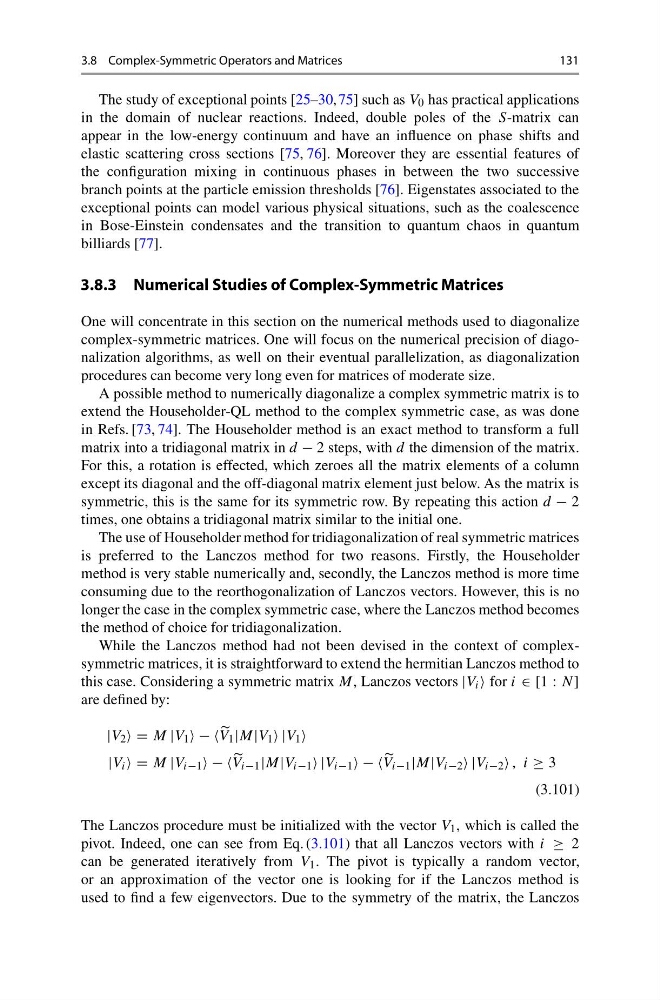
this case. Considering a symmetric matrix M, Lanczos vectors |V i for i ∈ [1 : N]
are defined by:
|V 2 = M |V 1 − −
V 1 |M|V 1 |V 1
|V i = M |V i−1 − −
V i−1 |M|V i−1 |V i−1 − −
V i−1 |M|V i−2 |V i−2 , i ≥ 3
(3.101)
The Lanczos procedure must be initialized with the vector V 1 , which is called the
pivot. Indeed, one can see from Eq. (3.101) that all Lanczos vectors with i ≥ 2
can be generated iteratively from V 1 . The pivot is typically a random vector,
or an approximation of the vector one is looking for if the Lanczos method is
used to find a few eigenvectors. Due to the symmetry of the matrix, the Lanczos
131
The study of exceptional points [25–30, 75] such as V 0 has practical applications
in the domain of nuclear reactions. Indeed, double poles of the S-matrix can
appear in the low-energy continuum and have an influence on phase shifts and
elastic scattering cross sections [75, 76]. Moreover they are essential features of
the configuration mixing in continuous phases in between the two successive
branch points at the particle emission thresholds [76]. Eigenstates associated to the
exceptional points can model various physical situations, such as the coalescence
in Bose-Einstein condensates and the transition to quantum chaos in quantum
billiards [77].
3.8.3 Numerical Studies of Complex-Symmetric Matrices
One will concentrate in this section on the numerical methods used to diagonalize
complex-symmetric matrices. One will focus on the numerical precision of diagonalization algorithms, as well on their eventual parallelization, as diagonalization
procedures can become very long even for matrices of moderate size.
A possible method to numerically diagonalize a complex symmetric matrix is to
extend the Householder-QL method to the complex symmetric case, as was done
in Refs. [73, 74]. The Householder method is an exact method to transform a full
matrix into a tridiagonal matrix in d − 2 steps, with d the dimension of the matrix.
For this, a rotation is effected, which zeroes all the matrix elements of a column
except its diagonal and the off-diagonal matrix element just below. As the matrix is
symmetric, this is the same for its symmetric row. By repeating this action d − 2
times, one obtains a tridiagonal matrix similar to the initial one.
The use of Householder method for tridiagonalization of real symmetric matrices
is preferred to the Lanczos method for two reasons. Firstly, the Householder
method is very stable numerically and, secondly, the Lanczos method is more time
consuming due to the reorthogonalization of Lanczos vectors. However, this is no
longer the case in the complex symmetric case, where the Lanczos method becomes
the method of choice for tridiagonalization.
While the Lanczos method had not been devised in the context of complexsymmetric matrices, it is straightforward to extend the hermitian Lanczos method to
this case. Considering a symmetric matrix M, Lanczos vectors |V i for i ∈ [1 : N]
are defined by:
|V 2 = M |V 1 − −
V 1 |M|V 1 |V 1
|V i = M |V i−1 − −
V i−1 |M|V i−1 |V i−1 − −
V i−1 |M|V i−2 |V i−2 , i ≥ 3
(3.101)
The Lanczos procedure must be initialized with the vector V 1 , which is called the
pivot. Indeed, one can see from Eq. (3.101) that all Lanczos vectors with i ≥ 2
can be generated iteratively from V 1 . The pivot is typically a random vector,
or an approximation of the vector one is looking for if the Lanczos method is
used to find a few eigenvectors. Due to the symmetry of the matrix, the Lanczos