

3.8 Complex-Symmetric Operators and Matrices
129
but the analytic continuation of the real symmetric scalar product. Consequently,
the Berggren norm of a Gamow shell model vector can be in principle equal to zero.
Such a vector cannot be normalized and the Lanczos method fails.
However, for this to occur, one would need matrix elements whose imaginary
parts are of the same order of magnitude as their real parts, on the one hand, and
rather large off-diagonal matrix elements, on the other hand. As the imaginary parts
of matrix elements are always much smaller than real parts, and as diagonalized
matrices are diagonally dominant, the breakdown of Lanczos method never occurs
in practice. Indeed, as one will see in this section, the Lanczos method should be
preferred to the Householder method when one diagonalizes Hamiltonian matrices.
3.8.1 Diagonalizability of Complex-Symmetric Matrices
Complex-symmetric matrices with nondegenerate eigenvalues can always be diagonalized. In Berggren basis applications, complex symmetric Hamiltonian matrices
have typically different eigenvalues, because the continuum coupling lifts as a
rule a possible degeneracy of the energies of basis states. Consequently, numerical
diagonalization of these matrices poses no practical problem. If it occurs that two
eigenvalues are equal, one can lift degeneracy by adding a small random matrix to
the initial complex symmetric matrix M. As the latter matrix can be arbitrarily small,
it cannot change the physical properties of M, known up to a given experimental
precision.
The complex symmetric matrix with nondegenerate eigenvalues possesses very
similar properties to hermitian matrices. The mathematical methods used to demonstrate this property are standard, but one has to pay attention therein that the nonhermitian norm is not positive definite. Conversely, complex-symmetric matrices
with identical eigenvalues are, in general, non-diagonalizable. One will study in the
following the case of 2 × 2 matrices to illustrate this fact.
3.8.2 The Two-Dimensional Complex Symmetric Matrix
In order to illustrate the properties of non-diagonalizable complex-symmetric
matrices, one will consider the simplest case of 2 × 2 matrices. One will show that
the general 2 × 2 complex symmetric matrix can be reduced to the study of a unique
2 × 2 complex symmetric matrix depending on one parameter.
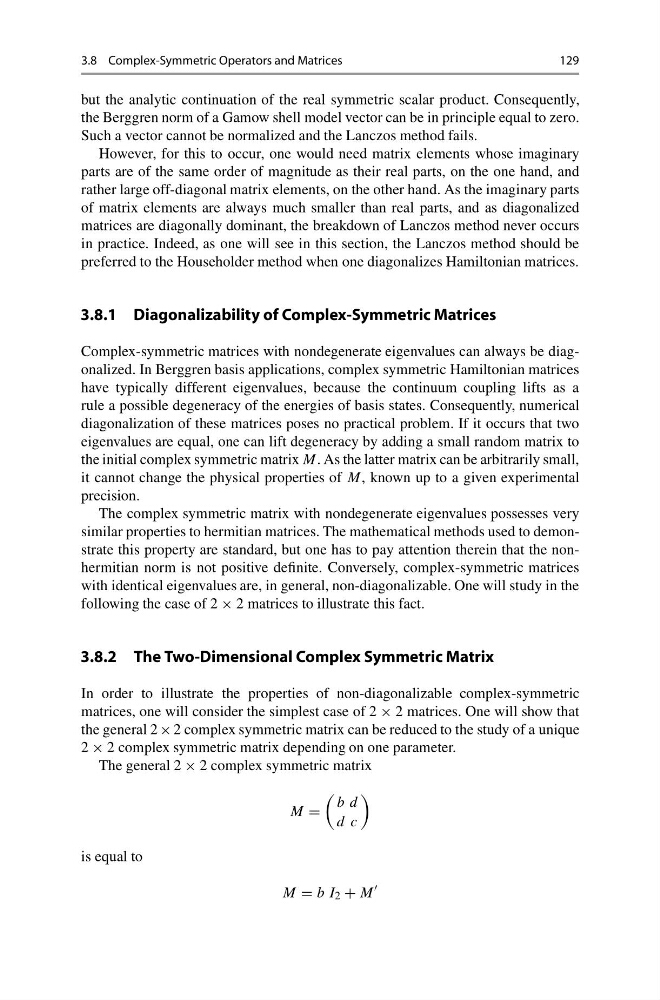
The general 2 × 2 complex symmetric matrix
M =
b d
d c
is equal to
M = b I 2 + M
129
but the analytic continuation of the real symmetric scalar product. Consequently,
the Berggren norm of a Gamow shell model vector can be in principle equal to zero.
Such a vector cannot be normalized and the Lanczos method fails.
However, for this to occur, one would need matrix elements whose imaginary
parts are of the same order of magnitude as their real parts, on the one hand, and
rather large off-diagonal matrix elements, on the other hand. As the imaginary parts
of matrix elements are always much smaller than real parts, and as diagonalized
matrices are diagonally dominant, the breakdown of Lanczos method never occurs
in practice. Indeed, as one will see in this section, the Lanczos method should be
preferred to the Householder method when one diagonalizes Hamiltonian matrices.
3.8.1 Diagonalizability of Complex-Symmetric Matrices
Complex-symmetric matrices with nondegenerate eigenvalues can always be diagonalized. In Berggren basis applications, complex symmetric Hamiltonian matrices
have typically different eigenvalues, because the continuum coupling lifts as a
rule a possible degeneracy of the energies of basis states. Consequently, numerical
diagonalization of these matrices poses no practical problem. If it occurs that two
eigenvalues are equal, one can lift degeneracy by adding a small random matrix to
the initial complex symmetric matrix M. As the latter matrix can be arbitrarily small,
it cannot change the physical properties of M, known up to a given experimental
precision.
The complex symmetric matrix with nondegenerate eigenvalues possesses very
similar properties to hermitian matrices. The mathematical methods used to demonstrate this property are standard, but one has to pay attention therein that the nonhermitian norm is not positive definite. Conversely, complex-symmetric matrices
with identical eigenvalues are, in general, non-diagonalizable. One will study in the
following the case of 2 × 2 matrices to illustrate this fact.
3.8.2 The Two-Dimensional Complex Symmetric Matrix
In order to illustrate the properties of non-diagonalizable complex-symmetric
matrices, one will consider the simplest case of 2 × 2 matrices. One will show that
the general 2 × 2 complex symmetric matrix can be reduced to the study of a unique
2 × 2 complex symmetric matrix depending on one parameter.
The general 2 × 2 complex symmetric matrix
M =
b d
d c
is equal to
M = b I 2 + M