

122
3 Berggren Basis and Completeness Relations
0 30 60 90 120
10
-7
10
-6
10
-5
10
-4
10
-3
10
-2
10
-1
1
rms (ℑ[u])
(d)
0 30 60 90 120
(e)
N GL
0 30 60 90 120
(f)
10
-7
10
-6
10
-5
10
-4
10
-3
10
-2
10
-1
1
(a)
1s 1/2
rms (ℜ[u])
(b)
0d 5/2
(c)
0d 3/2
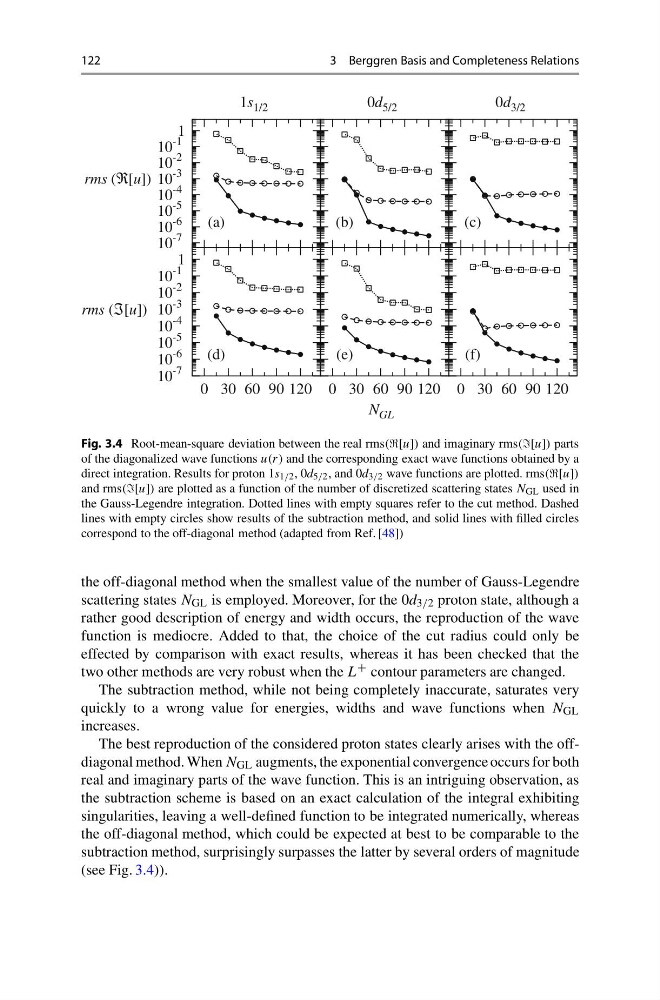
Fig. 3.4 Root-mean-square deviation between the real rms( and imaginary rms( parts
of the diagonalized wave functions u(r) and the corresponding exact wave functions obtained by a
direct integration. Results for proton 1s 1/2 , 0d 5/2 , and 0d 3/2 wave functions are plotted. rms(
and rms( are plotted as a function of the number of discretized scattering states N GL used in
the Gauss-Legendre integration. Dotted lines with empty squares refer to the cut method. Dashed
lines with empty circles show results of the subtraction method, and solid lines with filled circles
correspond to the off-diagonal method (adapted from Ref. [48])
the off-diagonal method when the smallest value of the number of Gauss-Legendre
scattering states N GL is employed. Moreover, for the 0d 3/2 proton state, although a
rather good description of energy and width occurs, the reproduction of the wave
function is mediocre. Added to that, the choice of the cut radius could only be
effected by comparison with exact results, whereas it has been checked that the
two other methods are very robust when the L + contour parameters are changed.
The subtraction method, while not being completely inaccurate, saturates very
quickly to a wrong value for energies, widths and wave functions when N GL
increases.
The best reproduction of the considered proton states clearly arises with the offdiagonal method. When N GL augments, the exponential convergence occurs for both
real and imaginary parts of the wave function. This is an intriguing observation, as
the subtraction scheme is based on an exact calculation of the integral exhibiting
singularities, leaving a well-defined function to be integrated numerically, whereas
the off-diagonal method, which could be expected at best to be comparable to the
subtraction method, surprisingly surpasses the latter by several orders of magnitude
(see Fig. 3.4)).
3 Berggren Basis and Completeness Relations
0 30 60 90 120
10
-7
10
-6
10
-5
10
-4
10
-3
10
-2
10
-1
1
rms (ℑ[u])
(d)
0 30 60 90 120
(e)
N GL
0 30 60 90 120
(f)
10
-7
10
-6
10
-5
10
-4
10
-3
10
-2
10
-1
1
(a)
1s 1/2
rms (ℜ[u])
(b)
0d 5/2
(c)
0d 3/2
Fig. 3.4 Root-mean-square deviation between the real rms( and imaginary rms( parts
of the diagonalized wave functions u(r) and the corresponding exact wave functions obtained by a
direct integration. Results for proton 1s 1/2 , 0d 5/2 , and 0d 3/2 wave functions are plotted. rms(
and rms( are plotted as a function of the number of discretized scattering states N GL used in
the Gauss-Legendre integration. Dotted lines with empty squares refer to the cut method. Dashed
lines with empty circles show results of the subtraction method, and solid lines with filled circles
correspond to the off-diagonal method (adapted from Ref. [48])
the off-diagonal method when the smallest value of the number of Gauss-Legendre
scattering states N GL is employed. Moreover, for the 0d 3/2 proton state, although a
rather good description of energy and width occurs, the reproduction of the wave
function is mediocre. Added to that, the choice of the cut radius could only be
effected by comparison with exact results, whereas it has been checked that the
two other methods are very robust when the L + contour parameters are changed.
The subtraction method, while not being completely inaccurate, saturates very
quickly to a wrong value for energies, widths and wave functions when N GL
increases.
The best reproduction of the considered proton states clearly arises with the offdiagonal method. When N GL augments, the exponential convergence occurs for both
real and imaginary parts of the wave function. This is an intriguing observation, as
the subtraction scheme is based on an exact calculation of the integral exhibiting
singularities, leaving a well-defined function to be integrated numerically, whereas
the off-diagonal method, which could be expected at best to be comparable to the
subtraction method, surprisingly surpasses the latter by several orders of magnitude
(see Fig. 3.4)).