

3.7 Numerical Implementation of the Berggren Completeness Relation
117
B. The central depth of the Woods-Saxon potential is now decreased by 10%.
Run the code to calculate the new eigenstate of the Woods-Saxon potential.
The calculated state must have its energy close to 0 MeV.
C. Explain why one cannot generate unbound states by diagonalizing the Hamiltonian using a real-energy basis generated by a Pöschl-Teller-Ginocchio
potential.
One will denote the charge of the basis generating potential as Z (b) , that of the
diagonalized potential as Z (d) , and their difference will be denominated as ΔZ =
Z (d) −Z (b) . The eigenstate u eig (r) of the diagonalized Hamiltonian will be expanded
using Eq. (3.66):
u eig (r) =
i
c k i u(k i , r) +
L +
c k u(k, r) dk ,
(3.89)
where the coefficients c k i and c k will be determined by diagonalization.
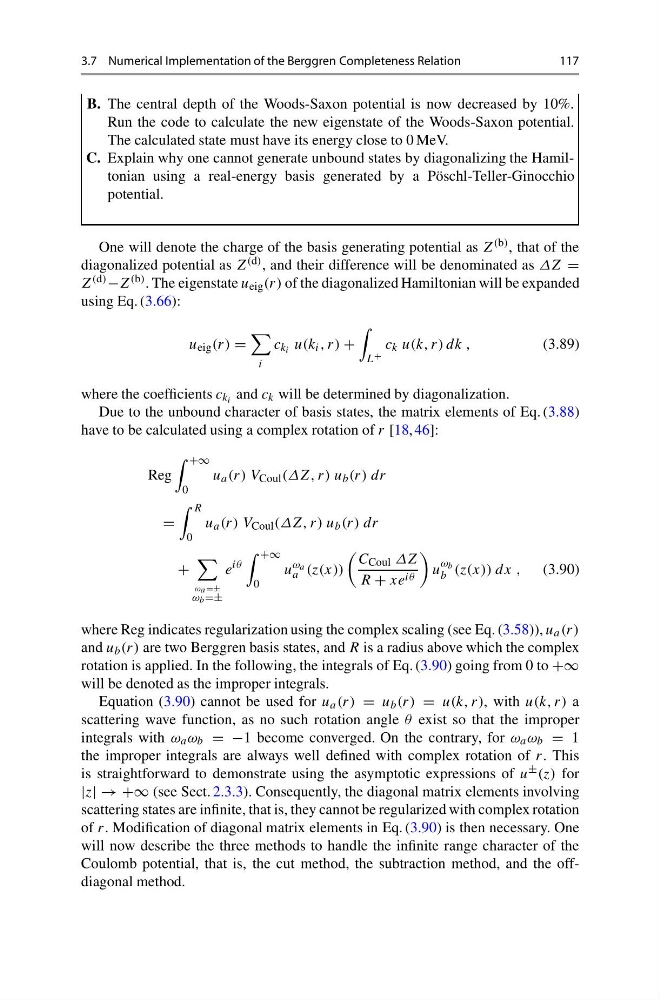
Due to the unbound character of basis states, the matrix elements of Eq. (3.88)
have to be calculated using a complex rotation of r [18, 46]:
Reg
+∞
0
u a (r) V Coul (ΔZ, r) u b (r) dr
=
R
0
u a (r) V Coul (ΔZ, r) u b (r) dr
+
ωa =±
ω b =±
e
iθ
+∞
0
u
ω a
a (z(x))
C Coul ΔZ
R + xe iθ
u
ω b
b (z(x)) dx , (3.90)
where Reg indicates regularization using the complex scaling (see Eq. (3.58)), u a (r)
and u b (r) are two Berggren basis states, and R is a radius above which the complex
rotation is applied. In the following, the integrals of Eq. (3.90) going from 0 to +∞
will be denoted as the improper integrals.
Equation (3.90) cannot be used for u a (r) = u b (r) = u(k, r), with u(k, r) a
scattering wave function, as no such rotation angle θ exist so that the improper
integrals with ω a ω b = −1 become converged. On the contrary, for ω a ω b = 1
the improper integrals are always well defined with complex rotation of r. This
is straightforward to demonstrate using the asymptotic expressions of u ± (z) for
|z| → +∞ (see Sect. 2.3.3). Consequently, the diagonal matrix elements involving
scattering states are infinite, that is, they cannot be regularized with complex rotation
of r. Modification of diagonal matrix elements in Eq. (3.90) is then necessary. One
will now describe the three methods to handle the infinite range character of the
Coulomb potential, that is, the cut method, the subtraction method, and the offdiagonal method.
117
B. The central depth of the Woods-Saxon potential is now decreased by 10%.
Run the code to calculate the new eigenstate of the Woods-Saxon potential.
The calculated state must have its energy close to 0 MeV.
C. Explain why one cannot generate unbound states by diagonalizing the Hamiltonian using a real-energy basis generated by a Pöschl-Teller-Ginocchio
potential.
One will denote the charge of the basis generating potential as Z (b) , that of the
diagonalized potential as Z (d) , and their difference will be denominated as ΔZ =
Z (d) −Z (b) . The eigenstate u eig (r) of the diagonalized Hamiltonian will be expanded
using Eq. (3.66):
u eig (r) =
i
c k i u(k i , r) +
L +
c k u(k, r) dk ,
(3.89)
where the coefficients c k i and c k will be determined by diagonalization.
Due to the unbound character of basis states, the matrix elements of Eq. (3.88)
have to be calculated using a complex rotation of r [18, 46]:
Reg
+∞
0
u a (r) V Coul (ΔZ, r) u b (r) dr
=
R
0
u a (r) V Coul (ΔZ, r) u b (r) dr
+
ωa =±
ω b =±
e
iθ
+∞
0
u
ω a
a (z(x))
C Coul ΔZ
R + xe iθ
u
ω b
b (z(x)) dx , (3.90)
where Reg indicates regularization using the complex scaling (see Eq. (3.58)), u a (r)
and u b (r) are two Berggren basis states, and R is a radius above which the complex
rotation is applied. In the following, the integrals of Eq. (3.90) going from 0 to +∞
will be denoted as the improper integrals.
Equation (3.90) cannot be used for u a (r) = u b (r) = u(k, r), with u(k, r) a
scattering wave function, as no such rotation angle θ exist so that the improper
integrals with ω a ω b = −1 become converged. On the contrary, for ω a ω b = 1
the improper integrals are always well defined with complex rotation of r. This
is straightforward to demonstrate using the asymptotic expressions of u ± (z) for
|z| → +∞ (see Sect. 2.3.3). Consequently, the diagonal matrix elements involving
scattering states are infinite, that is, they cannot be regularized with complex rotation
of r. Modification of diagonal matrix elements in Eq. (3.90) is then necessary. One
will now describe the three methods to handle the infinite range character of the
Coulomb potential, that is, the cut method, the subtraction method, and the offdiagonal method.