

3.2 One-Body Completeness Relation
91
can be replaced by 1 + O(k −2 ) when K → +∞. Explain why one can do this
replacement.
B. Deduce that the obtained four integrals can be put in a simple form using the
asymptotic expansions of A ± (k), B ± (k) and u ±
app (k, r) for |k| → +∞. For
that, the explicit calculation of the functions entering integrals is not necessary,
one will only explicitly state their k-dependence. Using the integral limits
devised in Exercise III, one can then demonstrate the Berggren completeness
relation when 0 < r, r ≤ R, that is, that I (C K ) → δ(r − r ) (see Eq. (3.35))
for K → +∞.
C. Show that the case 0 < r ≤ R and r ≥ R can be treated as in problems A and
B, so that I (C K ) → δ(r − r ) as well therein.
D. By using a similar method as in A and B, demonstrate that I (C K ) → δ(r − r )
if r ≥ r ≥ R.
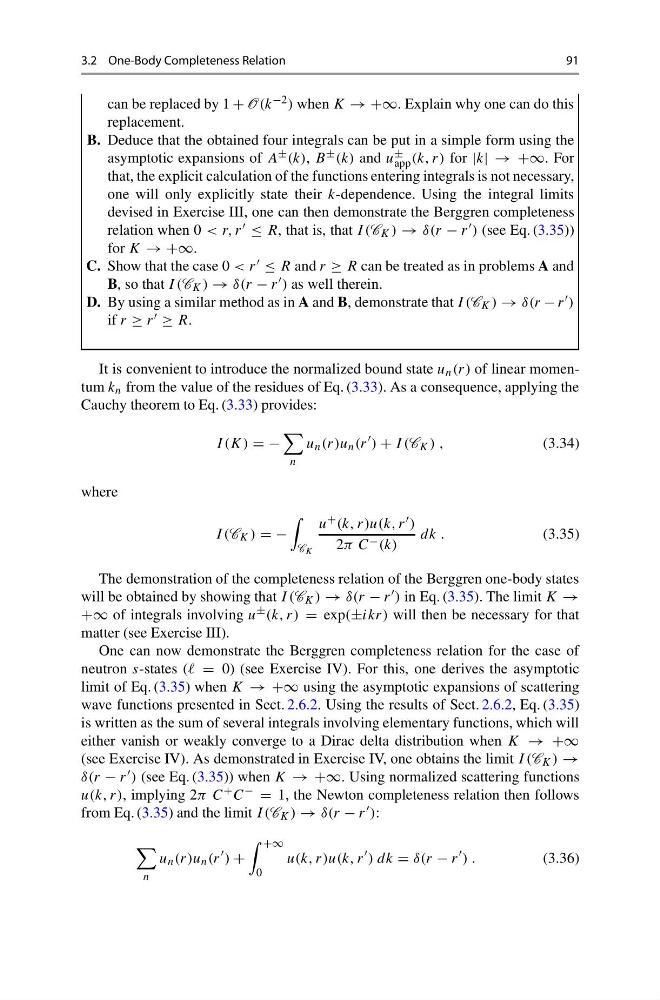
It is convenient to introduce the normalized bound state u n (r) of linear momentum k n from the value of the residues of Eq. (3.33). As a consequence, applying the
Cauchy theorem to Eq. (3.33) provides:
I (K) = −
n
u n (r)u n (r
) + I (C K ) ,
(3.34)
where
I (C K ) = −
C K
u + (k, r)u(k, r )
2π C − (k)
dk .
(3.35)
The demonstration of the completeness relation of the Berggren one-body states
will be obtained by showing that I (C K ) → δ(r − r ) in Eq. (3.35). The limit K →
+∞ of integrals involving u ± (k, r) = exp(±ikr) will then be necessary for that
matter (see Exercise III).
One can now demonstrate the Berggren completeness relation for the case of
neutron s-states ( = 0) (see Exercise IV). For this, one derives the asymptotic
limit of Eq. (3.35) when K → +∞ using the asymptotic expansions of scattering
wave functions presented in Sect. 2.6.2. Using the results of Sect. 2.6.2, Eq. (3.35)
is written as the sum of several integrals involving elementary functions, which will
either vanish or weakly converge to a Dirac delta distribution when K → +∞
(see Exercise IV). As demonstrated in Exercise IV, one obtains the limit I (C K ) →
δ(r − r ) (see Eq. (3.35)) when K → +∞. Using normalized scattering functions
u(k, r), implying 2π C + C − = 1, the Newton completeness relation then follows
from Eq. (3.35) and the limit I (C K ) → δ(r − r ):
n
u n (r)u n (r
) +
+∞
0
u(k, r)u(k, r
) dk = δ(r − r
) .
(3.36)
91
can be replaced by 1 + O(k −2 ) when K → +∞. Explain why one can do this
replacement.
B. Deduce that the obtained four integrals can be put in a simple form using the
asymptotic expansions of A ± (k), B ± (k) and u ±
app (k, r) for |k| → +∞. For
that, the explicit calculation of the functions entering integrals is not necessary,
one will only explicitly state their k-dependence. Using the integral limits
devised in Exercise III, one can then demonstrate the Berggren completeness
relation when 0 < r, r ≤ R, that is, that I (C K ) → δ(r − r ) (see Eq. (3.35))
for K → +∞.
C. Show that the case 0 < r ≤ R and r ≥ R can be treated as in problems A and
B, so that I (C K ) → δ(r − r ) as well therein.
D. By using a similar method as in A and B, demonstrate that I (C K ) → δ(r − r )
if r ≥ r ≥ R.
It is convenient to introduce the normalized bound state u n (r) of linear momentum k n from the value of the residues of Eq. (3.33). As a consequence, applying the
Cauchy theorem to Eq. (3.33) provides:
I (K) = −
n
u n (r)u n (r
) + I (C K ) ,
(3.34)
where
I (C K ) = −
C K
u + (k, r)u(k, r )
2π C − (k)
dk .
(3.35)
The demonstration of the completeness relation of the Berggren one-body states
will be obtained by showing that I (C K ) → δ(r − r ) in Eq. (3.35). The limit K →
+∞ of integrals involving u ± (k, r) = exp(±ikr) will then be necessary for that
matter (see Exercise III).
One can now demonstrate the Berggren completeness relation for the case of
neutron s-states ( = 0) (see Exercise IV). For this, one derives the asymptotic
limit of Eq. (3.35) when K → +∞ using the asymptotic expansions of scattering
wave functions presented in Sect. 2.6.2. Using the results of Sect. 2.6.2, Eq. (3.35)
is written as the sum of several integrals involving elementary functions, which will
either vanish or weakly converge to a Dirac delta distribution when K → +∞
(see Exercise IV). As demonstrated in Exercise IV, one obtains the limit I (C K ) →
δ(r − r ) (see Eq. (3.35)) when K → +∞. Using normalized scattering functions
u(k, r), implying 2π C + C − = 1, the Newton completeness relation then follows
from Eq. (3.35) and the limit I (C K ) → δ(r − r ):
n
u n (r)u n (r
) +
+∞
0
u(k, r)u(k, r
) dk = δ(r − r
) .
(3.36)