

3.2 One-Body Completeness Relation
89
potential, so that this case can be treated within the neutron = 0 case. The general
case of potentials possessing a centrifugal and/or a Coulomb part in the asymptotic
region will then be recovered by taking the limit R s → +∞, with R s the screening
radius after which the potential vanishes. The completeness of the Coulomb wave
functions will play a prominent role in the treatment of the essential singularity in
the complex momentum plane at k = 0, arising when R s → +∞.
3.2.1 One-Body Completeness Relation for = 0 Neutrons
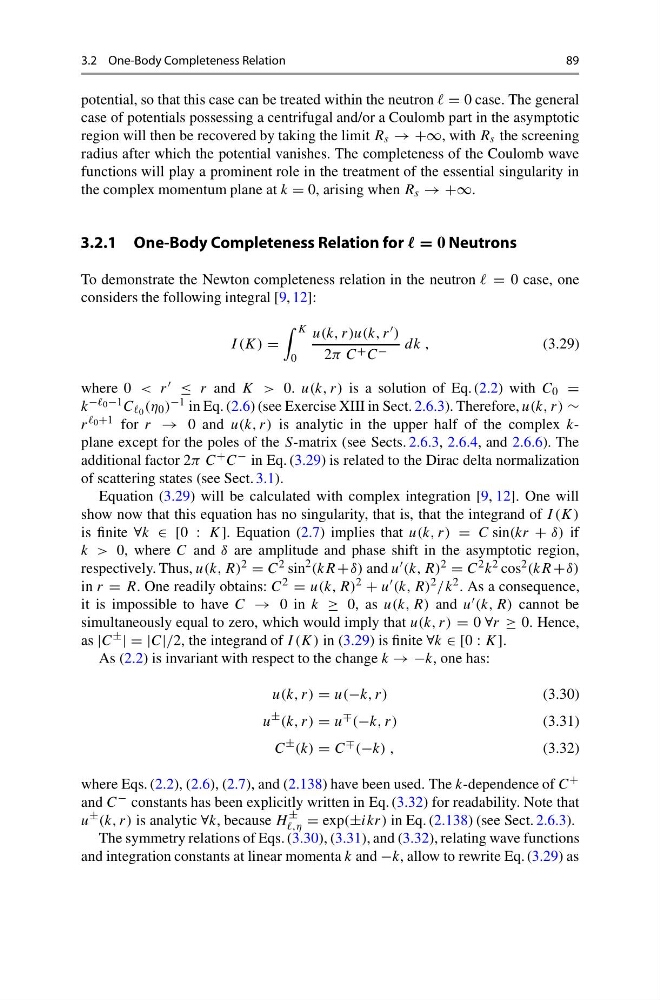
To demonstrate the Newton completeness relation in the neutron = 0 case, one
considers the following integral [9, 12]:
I (K) =
K
0
u(k, r)u(k, r )
2π C + C − dk ,
(3.29)
where 0 < r ≤ r and K > 0. u(k, r) is a solution of Eq. (2.2) with C 0 =
k − 0 −1 C 0 (η 0 ) −1 in Eq. (2.6) (see Exercise XIII in Sect. 2.6.3). Therefore, u(k, r) ∼
r 0 +1 for r → 0 and u(k, r) is analytic in the upper half of the complex kplane except for the poles of the S-matrix (see Sects. 2.6.3, 2.6.4, and 2.6.6). The
additional factor 2π C + C − in Eq. (3.29) is related to the Dirac delta normalization
of scattering states (see Sect. 3.1).
Equation (3.29) will be calculated with complex integration [9, 12]. One will
show now that this equation has no singularity, that is, that the integrand of I (K)
is finite ∀k ∈ [0 : K]. Equation (2.7) implies that u(k, r) = C sin(kr + δ) if
k > 0, where C and δ are amplitude and phase shift in the asymptotic region,
respectively. Thus, u(k, R) 2 = C 2 sin
2 (kR +δ) and u (k, R) 2 = C 2 k 2 cos 2 (kR +δ)
in r = R. One readily obtains: C 2 = u(k, R) 2 + u (k, R) 2 /k 2 . As a consequence,
it is impossible to have C → 0 in k ≥ 0, as u(k, R) and u (k, R) cannot be
simultaneously equal to zero, which would imply that u(k, r) = 0 ∀r ≥ 0. Hence,
as |C ± | = |C|/2, the integrand of I (K) in (3.29) is finite ∀k ∈ [0 : K].
As (2.2) is invariant with respect to the change k → −k, one has:
u(k, r) = u(−k, r)
(3.30)
u
± (k, r) = u
∓ (−k, r)
(3.31)
C
± (k) = C
∓ (−k) ,
(3.32)
where Eqs. (2.2), (2.6), (2.7), and (2.138) have been used. The k-dependence of C +
and C − constants has been explicitly written in Eq. (3.32) for readability. Note that
u ± (k, r) is analytic ∀k, because H
±
,η = exp(±ikr) in Eq. (2.138) (see Sect. 2.6.3).
The symmetry relations of Eqs. (3.30), (3.31), and (3.32), relating wave functions
and integration constants at linear momenta k and −k, allow to rewrite Eq. (3.29) as
89
potential, so that this case can be treated within the neutron = 0 case. The general
case of potentials possessing a centrifugal and/or a Coulomb part in the asymptotic
region will then be recovered by taking the limit R s → +∞, with R s the screening
radius after which the potential vanishes. The completeness of the Coulomb wave
functions will play a prominent role in the treatment of the essential singularity in
the complex momentum plane at k = 0, arising when R s → +∞.
3.2.1 One-Body Completeness Relation for = 0 Neutrons
To demonstrate the Newton completeness relation in the neutron = 0 case, one
considers the following integral [9, 12]:
I (K) =
K
0
u(k, r)u(k, r )
2π C + C − dk ,
(3.29)
where 0 < r ≤ r and K > 0. u(k, r) is a solution of Eq. (2.2) with C 0 =
k − 0 −1 C 0 (η 0 ) −1 in Eq. (2.6) (see Exercise XIII in Sect. 2.6.3). Therefore, u(k, r) ∼
r 0 +1 for r → 0 and u(k, r) is analytic in the upper half of the complex kplane except for the poles of the S-matrix (see Sects. 2.6.3, 2.6.4, and 2.6.6). The
additional factor 2π C + C − in Eq. (3.29) is related to the Dirac delta normalization
of scattering states (see Sect. 3.1).
Equation (3.29) will be calculated with complex integration [9, 12]. One will
show now that this equation has no singularity, that is, that the integrand of I (K)
is finite ∀k ∈ [0 : K]. Equation (2.7) implies that u(k, r) = C sin(kr + δ) if
k > 0, where C and δ are amplitude and phase shift in the asymptotic region,
respectively. Thus, u(k, R) 2 = C 2 sin
2 (kR +δ) and u (k, R) 2 = C 2 k 2 cos 2 (kR +δ)
in r = R. One readily obtains: C 2 = u(k, R) 2 + u (k, R) 2 /k 2 . As a consequence,
it is impossible to have C → 0 in k ≥ 0, as u(k, R) and u (k, R) cannot be
simultaneously equal to zero, which would imply that u(k, r) = 0 ∀r ≥ 0. Hence,
as |C ± | = |C|/2, the integrand of I (K) in (3.29) is finite ∀k ∈ [0 : K].
As (2.2) is invariant with respect to the change k → −k, one has:
u(k, r) = u(−k, r)
(3.30)
u
± (k, r) = u
∓ (−k, r)
(3.31)
C
± (k) = C
∓ (−k) ,
(3.32)
where Eqs. (2.2), (2.6), (2.7), and (2.138) have been used. The k-dependence of C +
and C − constants has been explicitly written in Eq. (3.32) for readability. Note that
u ± (k, r) is analytic ∀k, because H
±
,η = exp(±ikr) in Eq. (2.138) (see Sect. 2.6.3).
The symmetry relations of Eqs. (3.30), (3.31), and (3.32), relating wave functions
and integration constants at linear momenta k and −k, allow to rewrite Eq. (3.29) as