

3.1 Normalization of Gamow Functions
87
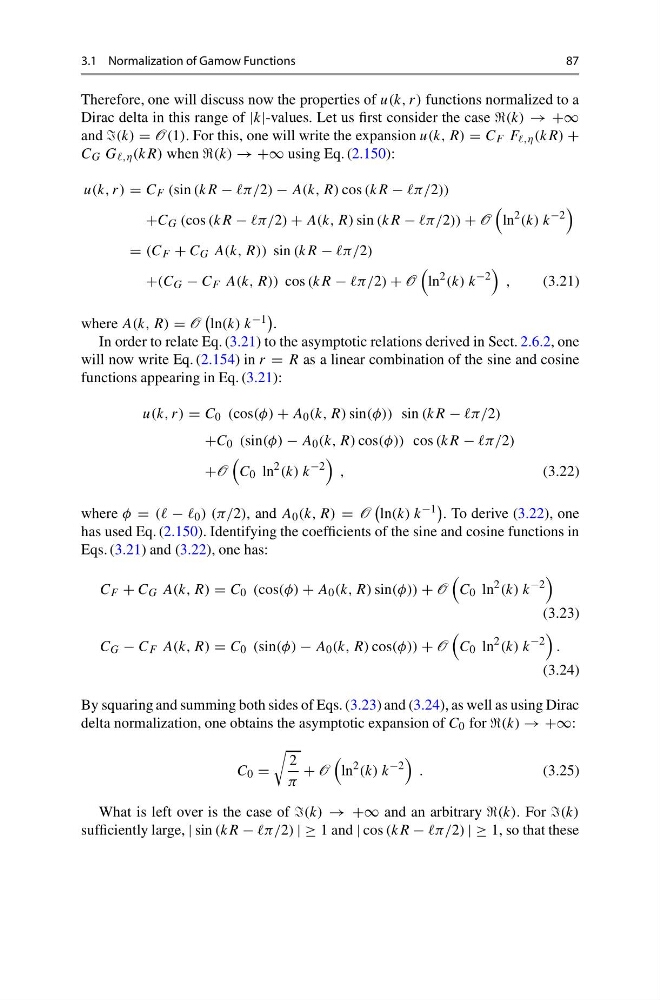
Therefore, one will discuss now the properties of u(k, r) functions normalized to a
Dirac delta in this range of |k|-values. Let us first consider the case (k) → +∞
and (k) = O(1). For this, one will write the expansion u(k, R) = C F F ,η (kR) +
C G G ,η (kR) when (k) → +∞ using Eq. (2.150):
u(k, r) = C F (sin (kR − − A(k, R) cos (kR −
+C G (cos (kR − π/2) + A(k, R) sin (kR − + O
ln
2 (k) k
−2
= (C F + C G A(k, R)) sin (kR −
+(C G − C F A(k, R)) cos (kR − + O
ln
2 (k) k
−2
,
(3.21)
where A(k, R) = O
ln(k) k −1
.
In order to relate Eq. (3.21) to the asymptotic relations derived in Sect. 2.6.2, one
will now write Eq. (2.154) in r = R as a linear combination of the sine and cosine
functions appearing in Eq. (3.21):
u(k, r) = C 0 (cos(φ) + A 0 (k, R) sin(φ)) sin (kR − π/2)
+C 0 (sin(φ) − A 0 (k, R) cos(φ)) cos (kR −
+O
C 0 ln
2 (k) k
−2
,
(3.22)
where φ = (( − 0 ) (π/2), and A 0 (k, R) = O
ln(k) k −1
. To derive (3.22), one
has used Eq. (2.150). Identifying the coefficients of the sine and cosine functions in
Eqs. (3.21) and (3.22), one has:
C F + C G A(k, R) = C 0 (cos(φ) + A 0 (k, R) sin(φ)) + O
C 0 ln
2 (k) k
−2
(3.23)
C G − C F A(k, R) = C 0 (sin(φ) − A 0 (k, R) cos(φ)) + O
C 0 ln
2 (k) k
−2
.
(3.24)
By squaring and summing both sides of Eqs. (3.23) and (3.24), as well as using Dirac
delta normalization, one obtains the asymptotic expansion of C 0 for (k) → +∞:
C 0 =
2
π
+ O
ln
2 (k) k
−2
.
(3.25)
What is left over is the case of (k) → +∞ and an arbitrary (k). For (k)
sufficiently large, | sin (kR − π/2) | ≥ 1 and | cos (kR − π/2) | ≥ 1, so that these
87
Therefore, one will discuss now the properties of u(k, r) functions normalized to a
Dirac delta in this range of |k|-values. Let us first consider the case (k) → +∞
and (k) = O(1). For this, one will write the expansion u(k, R) = C F F ,η (kR) +
C G G ,η (kR) when (k) → +∞ using Eq. (2.150):
u(k, r) = C F (sin (kR − − A(k, R) cos (kR −
+C G (cos (kR − π/2) + A(k, R) sin (kR − + O
ln
2 (k) k
−2
= (C F + C G A(k, R)) sin (kR −
+(C G − C F A(k, R)) cos (kR − + O
ln
2 (k) k
−2
,
(3.21)
where A(k, R) = O
ln(k) k −1
.
In order to relate Eq. (3.21) to the asymptotic relations derived in Sect. 2.6.2, one
will now write Eq. (2.154) in r = R as a linear combination of the sine and cosine
functions appearing in Eq. (3.21):
u(k, r) = C 0 (cos(φ) + A 0 (k, R) sin(φ)) sin (kR − π/2)
+C 0 (sin(φ) − A 0 (k, R) cos(φ)) cos (kR −
+O
C 0 ln
2 (k) k
−2
,
(3.22)
where φ = (( − 0 ) (π/2), and A 0 (k, R) = O
ln(k) k −1
. To derive (3.22), one
has used Eq. (2.150). Identifying the coefficients of the sine and cosine functions in
Eqs. (3.21) and (3.22), one has:
C F + C G A(k, R) = C 0 (cos(φ) + A 0 (k, R) sin(φ)) + O
C 0 ln
2 (k) k
−2
(3.23)
C G − C F A(k, R) = C 0 (sin(φ) − A 0 (k, R) cos(φ)) + O
C 0 ln
2 (k) k
−2
.
(3.24)
By squaring and summing both sides of Eqs. (3.23) and (3.24), as well as using Dirac
delta normalization, one obtains the asymptotic expansion of C 0 for (k) → +∞:
C 0 =
2
π
+ O
ln
2 (k) k
−2
.
(3.25)
What is left over is the case of (k) → +∞ and an arbitrary (k). For (k)
sufficiently large, | sin (kR − π/2) | ≥ 1 and | cos (kR − π/2) | ≥ 1, so that these