

82
3 Single Molecule Non-cleavable Multiply Active Antibacterials
3.3.3 Established and Potential Single Molecule Triple
Action or Interaction Agents
One established example here is kanglemycin A, which is a naturally occurring
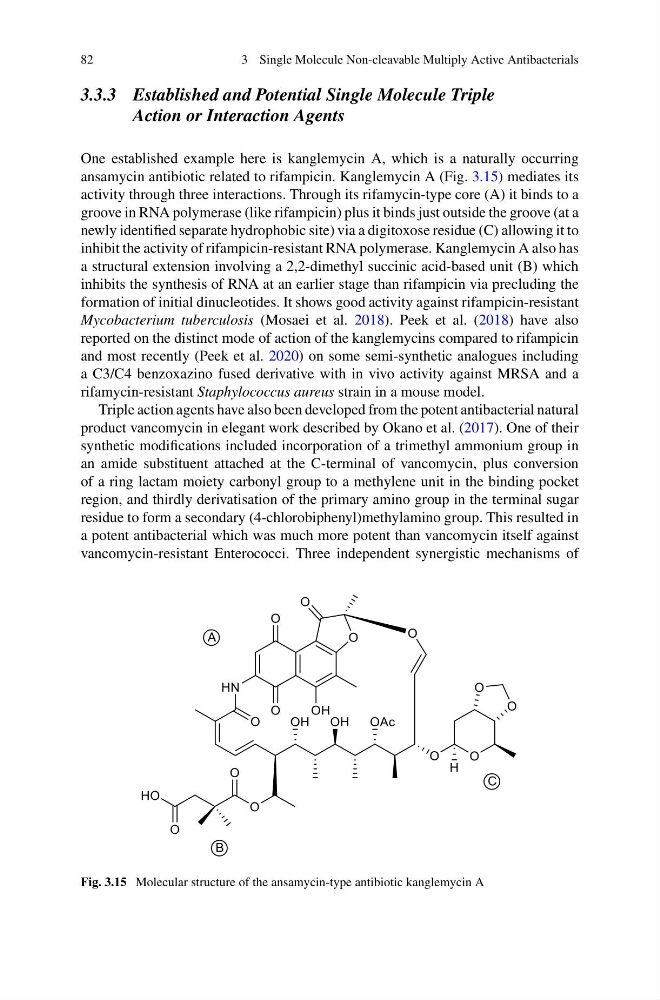
ansamycin antibiotic related to rifampicin. Kanglemycin A (Fig. 3.15) mediates its
activity through three interactions. Through its rifamycin-type core (A) it binds to a
groove in RNA polymerase (like rifampicin) plus it binds just outside the groove (at a
newly identified separate hydrophobic site) via a digitoxose residue (C) allowing it to
inhibit the activity of rifampicin-resistant RNA polymerase. Kanglemycin A also has
a structural extension involving a 2,2-dimethyl succinic acid-based unit (B) which
inhibits the synthesis of RNA at an earlier stage than rifampicin via precluding the
formation of initial dinucleotides. It shows good activity against rifampicin-resistant
Mycobacterium tuberculosis (Mosaei et al. 2018). Peek et al. (2018) have also
reported on the distinct mode of action of the kanglemycins compared to rifampicin
and most recently (Peek et al. 2020) on some semi-synthetic analogues including
a C3/C4 benzoxazino fused derivative with in vivo activity against MRSA and a
rifamycin-resistant Staphylococcus aureus strain in a mouse model.
Triple action agents have also been developed from the potent antibacterial natural
product vancomycin in elegant work described by Okano et al. (2017). One of their
synthetic modifications included incorporation of a trimethyl ammonium group in
an amide substituent attached at the C-terminal of vancomycin, plus conversion
of a ring lactam moiety carbonyl group to a methylene unit in the binding pocket
region, and thirdly derivatisation of the primary amino group in the terminal sugar
residue to form a secondary (4-chlorobiphenyl)methylamino group. This resulted in
a potent antibacterial which was much more potent than vancomycin itself against
vancomycin-resistant Enterococci. Three independent synergistic mechanisms of
Fig. 3.15 Molecular structure of the ansamycin-type antibiotic kanglemycin A
3 Single Molecule Non-cleavable Multiply Active Antibacterials
3.3.3 Established and Potential Single Molecule Triple
Action or Interaction Agents
One established example here is kanglemycin A, which is a naturally occurring
ansamycin antibiotic related to rifampicin. Kanglemycin A (Fig. 3.15) mediates its
activity through three interactions. Through its rifamycin-type core (A) it binds to a
groove in RNA polymerase (like rifampicin) plus it binds just outside the groove (at a
newly identified separate hydrophobic site) via a digitoxose residue (C) allowing it to
inhibit the activity of rifampicin-resistant RNA polymerase. Kanglemycin A also has
a structural extension involving a 2,2-dimethyl succinic acid-based unit (B) which
inhibits the synthesis of RNA at an earlier stage than rifampicin via precluding the
formation of initial dinucleotides. It shows good activity against rifampicin-resistant
Mycobacterium tuberculosis (Mosaei et al. 2018). Peek et al. (2018) have also
reported on the distinct mode of action of the kanglemycins compared to rifampicin
and most recently (Peek et al. 2020) on some semi-synthetic analogues including
a C3/C4 benzoxazino fused derivative with in vivo activity against MRSA and a
rifamycin-resistant Staphylococcus aureus strain in a mouse model.
Triple action agents have also been developed from the potent antibacterial natural
product vancomycin in elegant work described by Okano et al. (2017). One of their
synthetic modifications included incorporation of a trimethyl ammonium group in
an amide substituent attached at the C-terminal of vancomycin, plus conversion
of a ring lactam moiety carbonyl group to a methylene unit in the binding pocket
region, and thirdly derivatisation of the primary amino group in the terminal sugar
residue to form a secondary (4-chlorobiphenyl)methylamino group. This resulted in
a potent antibacterial which was much more potent than vancomycin itself against
vancomycin-resistant Enterococci. Three independent synergistic mechanisms of
Fig. 3.15 Molecular structure of the ansamycin-type antibiotic kanglemycin A