

80
3 Single Molecule Non-cleavable Multiply Active Antibacterials
protopine, a modified isoquinoline derivative with some antibacterial activity, where
the nitrogen lone pair is suitably positioned to interact with the carbonyl group carbon
across the medium-sized ring in an n to π* orbital mixing. High level DFT calculations confirm this interaction (Griffith and Bremner unpublished results). This interaction then constrains the conformation of the 10-membered ring to more closely
match that in the protoberberine type alkaloid coptisine (two fused 6-membered
rings). Coptisine is very closely related to berberine with a second methylenedioxy
group present in place of the two methoxy substituents in berberine and it also has
antibacterial activity.
In this example, above berberine was the starting point for the exploratory thought
experiments, and proceeding from that point to the tetrahydroprotoberberine and
then allocryptopine or protopine structural types. Calculations were largely based
on protopine related to the berberine-type alkaloid coptisine as the rotational flexibility of the two methoxy groups in allocryptopine complicate the computations.
These compounds themselves have weak and variable antibacterial activities but low
cytotoxicities (Cheng et al. 2014).
There are many other possibilities for quasi-ring formation which might result in
energetically favoured conformations with the overall bent shape of the berberine type
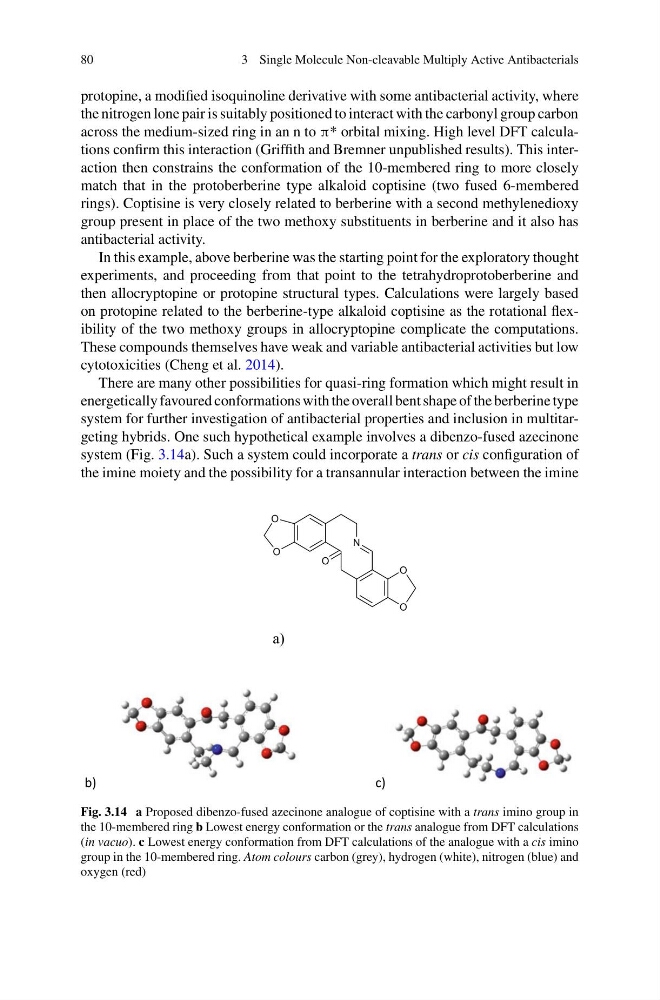
system for further investigation of antibacterial properties and inclusion in multitargeting hybrids. One such hypothetical example involves a dibenzo-fused azecinone
system (Fig. 3.14a). Such a system could incorporate a trans or cis configuration of
the imine moiety and the possibility for a transannular interaction between the imine
Fig. 3.14 a Proposed dibenzo-fused azecinone analogue of coptisine with a trans imino group in
the 10-membered ring b Lowest energy conformation or the trans analogue from DFT calculations
(in vacuo). c Lowest energy conformation from DFT calculations of the analogue with a cis imino
group in the 10-membered ring. Atom colours carbon (grey), hydrogen (white), nitrogen (blue) and
oxygen (red)
3 Single Molecule Non-cleavable Multiply Active Antibacterials
protopine, a modified isoquinoline derivative with some antibacterial activity, where
the nitrogen lone pair is suitably positioned to interact with the carbonyl group carbon
across the medium-sized ring in an n to π* orbital mixing. High level DFT calculations confirm this interaction (Griffith and Bremner unpublished results). This interaction then constrains the conformation of the 10-membered ring to more closely
match that in the protoberberine type alkaloid coptisine (two fused 6-membered
rings). Coptisine is very closely related to berberine with a second methylenedioxy
group present in place of the two methoxy substituents in berberine and it also has
antibacterial activity.
In this example, above berberine was the starting point for the exploratory thought
experiments, and proceeding from that point to the tetrahydroprotoberberine and
then allocryptopine or protopine structural types. Calculations were largely based
on protopine related to the berberine-type alkaloid coptisine as the rotational flexibility of the two methoxy groups in allocryptopine complicate the computations.
These compounds themselves have weak and variable antibacterial activities but low
cytotoxicities (Cheng et al. 2014).
There are many other possibilities for quasi-ring formation which might result in
energetically favoured conformations with the overall bent shape of the berberine type
system for further investigation of antibacterial properties and inclusion in multitargeting hybrids. One such hypothetical example involves a dibenzo-fused azecinone
system (Fig. 3.14a). Such a system could incorporate a trans or cis configuration of
the imine moiety and the possibility for a transannular interaction between the imine
Fig. 3.14 a Proposed dibenzo-fused azecinone analogue of coptisine with a trans imino group in
the 10-membered ring b Lowest energy conformation or the trans analogue from DFT calculations
(in vacuo). c Lowest energy conformation from DFT calculations of the analogue with a cis imino
group in the 10-membered ring. Atom colours carbon (grey), hydrogen (white), nitrogen (blue) and
oxygen (red)