

3.1 Introduction to General Design Considerations
55
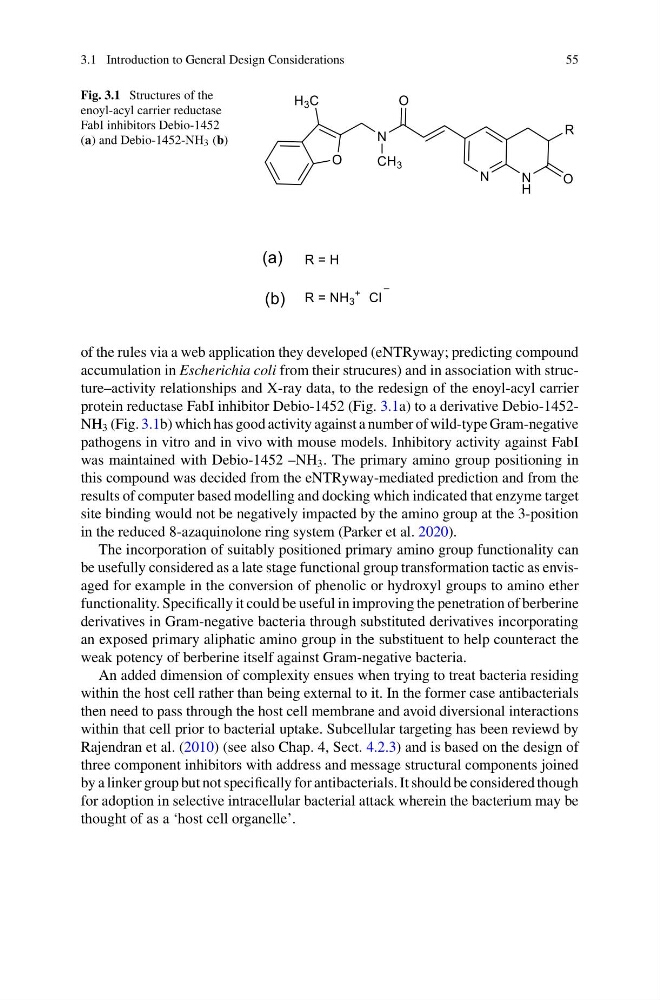
Fig. 3.1 Structures of the
enoyl-acyl carrier reductase
FabI inhibitors Debio-1452
(a) and Debio-1452-NH 3 (b)
of the rules via a web application they developed (eNTRyway; predicting compound
accumulation in Escherichia coli from their strucures) and in association with structure–activity relationships and X-ray data, to the redesign of the enoyl-acyl carrier
protein reductase FabI inhibitor Debio-1452 (Fig. 3.1a) to a derivative Debio-1452NH 3 (Fig. 3.1b) which has good activity against a number of wild-type Gram-negative
pathogens in vitro and in vivo with mouse models. Inhibitory activity against FabI
was maintained with Debio-1452 –NH 3 . The primary amino group positioning in
this compound was decided from the eNTRyway-mediated prediction and from the
results of computer based modelling and docking which indicated that enzyme target
site binding would not be negatively impacted by the amino group at the 3-position
in the reduced 8-azaquinolone ring system (Parker et al. 2020).
The incorporation of suitably positioned primary amino group functionality can
be usefully considered as a late stage functional group transformation tactic as envisaged for example in the conversion of phenolic or hydroxyl groups to amino ether
functionality. Specifically it could be useful in improving the penetration of berberine
derivatives in Gram-negative bacteria through substituted derivatives incorporating
an exposed primary aliphatic amino group in the substituent to help counteract the
weak potency of berberine itself against Gram-negative bacteria.
An added dimension of complexity ensues when trying to treat bacteria residing
within the host cell rather than being external to it. In the former case antibacterials
then need to pass through the host cell membrane and avoid diversional interactions
within that cell prior to bacterial uptake. Subcellular targeting has been reviewd by
Rajendran et al. (2010) (see also Chap. 4, Sect. 4.2.3) and is based on the design of
three component inhibitors with address and message structural components joined
by a linker group but not specifically for antibacterials. It should be considered though
for adoption in selective intracellular bacterial attack wherein the bacterium may be
thought of as a ‘host cell organelle’.
55
Fig. 3.1 Structures of the
enoyl-acyl carrier reductase
FabI inhibitors Debio-1452
(a) and Debio-1452-NH 3 (b)
of the rules via a web application they developed (eNTRyway; predicting compound
accumulation in Escherichia coli from their strucures) and in association with structure–activity relationships and X-ray data, to the redesign of the enoyl-acyl carrier
protein reductase FabI inhibitor Debio-1452 (Fig. 3.1a) to a derivative Debio-1452NH 3 (Fig. 3.1b) which has good activity against a number of wild-type Gram-negative
pathogens in vitro and in vivo with mouse models. Inhibitory activity against FabI
was maintained with Debio-1452 –NH 3 . The primary amino group positioning in
this compound was decided from the eNTRyway-mediated prediction and from the
results of computer based modelling and docking which indicated that enzyme target
site binding would not be negatively impacted by the amino group at the 3-position
in the reduced 8-azaquinolone ring system (Parker et al. 2020).
The incorporation of suitably positioned primary amino group functionality can
be usefully considered as a late stage functional group transformation tactic as envisaged for example in the conversion of phenolic or hydroxyl groups to amino ether
functionality. Specifically it could be useful in improving the penetration of berberine
derivatives in Gram-negative bacteria through substituted derivatives incorporating
an exposed primary aliphatic amino group in the substituent to help counteract the
weak potency of berberine itself against Gram-negative bacteria.
An added dimension of complexity ensues when trying to treat bacteria residing
within the host cell rather than being external to it. In the former case antibacterials
then need to pass through the host cell membrane and avoid diversional interactions
within that cell prior to bacterial uptake. Subcellular targeting has been reviewd by
Rajendran et al. (2010) (see also Chap. 4, Sect. 4.2.3) and is based on the design of
three component inhibitors with address and message structural components joined
by a linker group but not specifically for antibacterials. It should be considered though
for adoption in selective intracellular bacterial attack wherein the bacterium may be
thought of as a ‘host cell organelle’.