

5.5 DNA and RNA Level Modulation
179
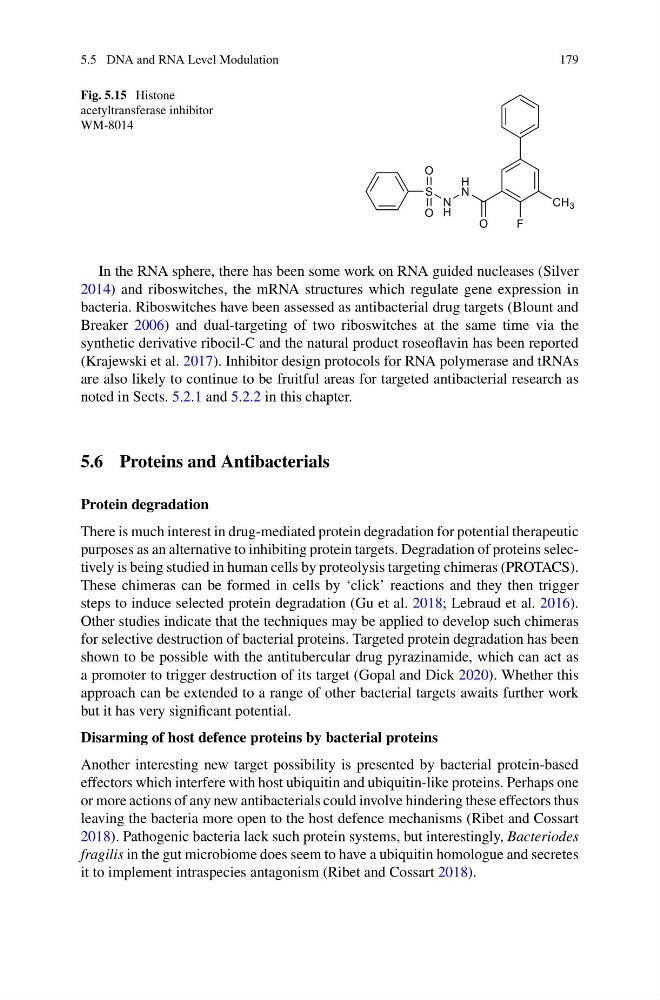
Fig. 5.15 Histone
acetyltransferase inhibitor
WM-8014
In the RNA sphere, there has been some work on RNA guided nucleases (Silver
2014) and riboswitches, the mRNA structures which regulate gene expression in
bacteria. Riboswitches have been assessed as antibacterial drug targets (Blount and
Breaker 2006) and dual-targeting of two riboswitches at the same time via the
synthetic derivative ribocil-C and the natural product roseoflavin has been reported
(Krajewski et al. 2017). Inhibitor design protocols for RNA polymerase and tRNAs
are also likely to continue to be fruitful areas for targeted antibacterial research as
noted in Sects. 5.2.1 and 5.2.2 in this chapter.
5.6 Proteins and Antibacterials
Protein degradation
There is much interest in drug-mediated protein degradation for potential therapeutic
purposes as an alternative to inhibiting protein targets. Degradation of proteins selectively is being studied in human cells by proteolysis targeting chimeras (PROTACS).
These chimeras can be formed in cells by ‘click’ reactions and they then trigger
steps to induce selected protein degradation (Gu et al. 2018; Lebraud et al. 2016).
Other studies indicate that the techniques may be applied to develop such chimeras
for selective destruction of bacterial proteins. Targeted protein degradation has been
shown to be possible with the antitubercular drug pyrazinamide, which can act as
a promoter to trigger destruction of its target (Gopal and Dick 2020). Whether this
approach can be extended to a range of other bacterial targets awaits further work
but it has very significant potential.
Disarming of host defence proteins by bacterial proteins
Another interesting new target possibility is presented by bacterial protein-based
effectors which interfere with host ubiquitin and ubiquitin-like proteins. Perhaps one
or more actions of any new antibacterials could involve hindering these effectors thus
leaving the bacteria more open to the host defence mechanisms (Ribet and Cossart
2018). Pathogenic bacteria lack such protein systems, but interestingly, Bacteriodes
fragilis in the gut microbiome does seem to have a ubiquitin homologue and secretes
it to implement intraspecies antagonism (Ribet and Cossart 2018).
179
Fig. 5.15 Histone
acetyltransferase inhibitor
WM-8014
In the RNA sphere, there has been some work on RNA guided nucleases (Silver
2014) and riboswitches, the mRNA structures which regulate gene expression in
bacteria. Riboswitches have been assessed as antibacterial drug targets (Blount and
Breaker 2006) and dual-targeting of two riboswitches at the same time via the
synthetic derivative ribocil-C and the natural product roseoflavin has been reported
(Krajewski et al. 2017). Inhibitor design protocols for RNA polymerase and tRNAs
are also likely to continue to be fruitful areas for targeted antibacterial research as
noted in Sects. 5.2.1 and 5.2.2 in this chapter.
5.6 Proteins and Antibacterials
Protein degradation
There is much interest in drug-mediated protein degradation for potential therapeutic
purposes as an alternative to inhibiting protein targets. Degradation of proteins selectively is being studied in human cells by proteolysis targeting chimeras (PROTACS).
These chimeras can be formed in cells by ‘click’ reactions and they then trigger
steps to induce selected protein degradation (Gu et al. 2018; Lebraud et al. 2016).
Other studies indicate that the techniques may be applied to develop such chimeras
for selective destruction of bacterial proteins. Targeted protein degradation has been
shown to be possible with the antitubercular drug pyrazinamide, which can act as
a promoter to trigger destruction of its target (Gopal and Dick 2020). Whether this
approach can be extended to a range of other bacterial targets awaits further work
but it has very significant potential.
Disarming of host defence proteins by bacterial proteins
Another interesting new target possibility is presented by bacterial protein-based
effectors which interfere with host ubiquitin and ubiquitin-like proteins. Perhaps one
or more actions of any new antibacterials could involve hindering these effectors thus
leaving the bacteria more open to the host defence mechanisms (Ribet and Cossart
2018). Pathogenic bacteria lack such protein systems, but interestingly, Bacteriodes
fragilis in the gut microbiome does seem to have a ubiquitin homologue and secretes
it to implement intraspecies antagonism (Ribet and Cossart 2018).