

4.3 Release Mechanisms and Prodrug Design
145
The process involves ring opening via the attack of the Ser 67 residue in the lactamase (for example OXA-10) on the cyclic urea carbonyl with cleavage of the C–
N(OSO 2 OH) bond in the urea moiety, followed by intramolecular N-acylation to
reform avibactam and the free serine residue. Such mechanistic knowledge could
be used to design in structural features to allow release of another antibacterial
after the enzyme-mediated ring opening, perhaps via an intramolecular nucleophilic
displacement process. However such designs do not appear to have been reported in
the literature as yet.
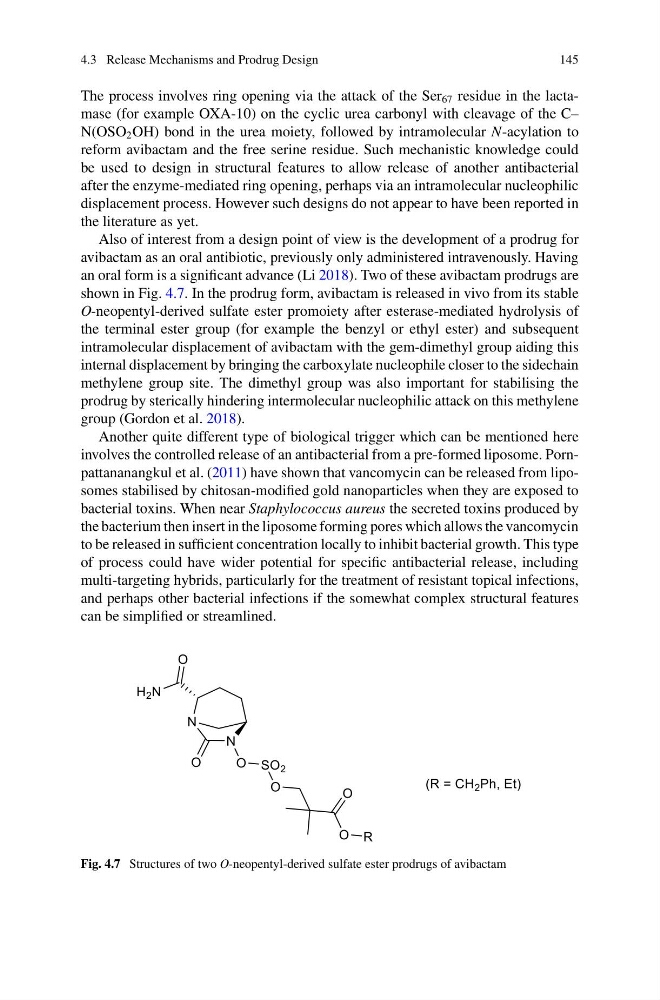
Also of interest from a design point of view is the development of a prodrug for
avibactam as an oral antibiotic, previously only administered intravenously. Having
an oral form is a significant advance (Li 2018). Two of these avibactam prodrugs are
shown in Fig. 4.7. In the prodrug form, avibactam is released in vivo from its stable
O-neopentyl-derived sulfate ester promoiety after esterase-mediated hydrolysis of
the terminal ester group (for example the benzyl or ethyl ester) and subsequent
intramolecular displacement of avibactam with the gem-dimethyl group aiding this
internal displacement by bringing the carboxylate nucleophile closer to the sidechain
methylene group site. The dimethyl group was also important for stabilising the
prodrug by sterically hindering intermolecular nucleophilic attack on this methylene
group (Gordon et al. 2018).
Another quite different type of biological trigger which can be mentioned here
involves the controlled release of an antibacterial from a pre-formed liposome. Pornpattananangkul et al. (2011) have shown that vancomycin can be released from liposomes stabilised by chitosan-modified gold nanoparticles when they are exposed to
bacterial toxins. When near Staphylococcus aureus the secreted toxins produced by
the bacterium then insert in the liposome forming pores which allows the vancomycin
to be released in sufficient concentration locally to inhibit bacterial growth. This type
of process could have wider potential for specific antibacterial release, including
multi-targeting hybrids, particularly for the treatment of resistant topical infections,
and perhaps other bacterial infections if the somewhat complex structural features
can be simplified or streamlined.
Fig. 4.7 Structures of two O-neopentyl-derived sulfate ester prodrugs of avibactam
145
The process involves ring opening via the attack of the Ser 67 residue in the lactamase (for example OXA-10) on the cyclic urea carbonyl with cleavage of the C–
N(OSO 2 OH) bond in the urea moiety, followed by intramolecular N-acylation to
reform avibactam and the free serine residue. Such mechanistic knowledge could
be used to design in structural features to allow release of another antibacterial
after the enzyme-mediated ring opening, perhaps via an intramolecular nucleophilic
displacement process. However such designs do not appear to have been reported in
the literature as yet.
Also of interest from a design point of view is the development of a prodrug for
avibactam as an oral antibiotic, previously only administered intravenously. Having
an oral form is a significant advance (Li 2018). Two of these avibactam prodrugs are
shown in Fig. 4.7. In the prodrug form, avibactam is released in vivo from its stable
O-neopentyl-derived sulfate ester promoiety after esterase-mediated hydrolysis of
the terminal ester group (for example the benzyl or ethyl ester) and subsequent
intramolecular displacement of avibactam with the gem-dimethyl group aiding this
internal displacement by bringing the carboxylate nucleophile closer to the sidechain
methylene group site. The dimethyl group was also important for stabilising the
prodrug by sterically hindering intermolecular nucleophilic attack on this methylene
group (Gordon et al. 2018).
Another quite different type of biological trigger which can be mentioned here
involves the controlled release of an antibacterial from a pre-formed liposome. Pornpattananangkul et al. (2011) have shown that vancomycin can be released from liposomes stabilised by chitosan-modified gold nanoparticles when they are exposed to
bacterial toxins. When near Staphylococcus aureus the secreted toxins produced by
the bacterium then insert in the liposome forming pores which allows the vancomycin
to be released in sufficient concentration locally to inhibit bacterial growth. This type
of process could have wider potential for specific antibacterial release, including
multi-targeting hybrids, particularly for the treatment of resistant topical infections,
and perhaps other bacterial infections if the somewhat complex structural features
can be simplified or streamlined.
Fig. 4.7 Structures of two O-neopentyl-derived sulfate ester prodrugs of avibactam