

142
4 Design Principles and Development of Prodrugs for Multiply …
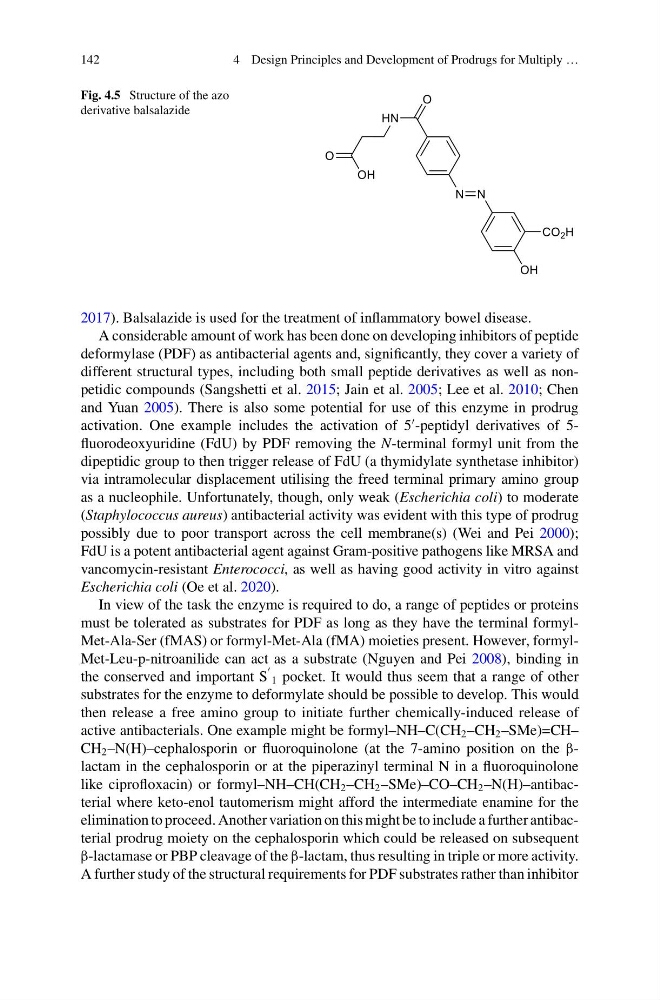
Fig. 4.5 Structure of the azo
derivative balsalazide
2017). Balsalazide is used for the treatment of inflammatory bowel disease.
A considerable amount of work has been done on developing inhibitors of peptide
deformylase (PDF) as antibacterial agents and, significantly, they cover a variety of
different structural types, including both small peptide derivatives as well as nonpetidic compounds (Sangshetti et al. 2015; Jain et al. 2005; Lee et al. 2010; Chen
and Yuan 2005). There is also some potential for use of this enzyme in prodrug
activation. One example includes the activation of 5
-peptidyl derivatives of 5fluorodeoxyuridine (FdU) by PDF removing the N-terminal formyl unit from the
dipeptidic group to then trigger release of FdU (a thymidylate synthetase inhibitor)
via intramolecular displacement utilising the freed terminal primary amino group
as a nucleophile. Unfortunately, though, only weak (Escherichia coli) to moderate
(Staphylococcus aureus) antibacterial activity was evident with this type of prodrug
possibly due to poor transport across the cell membrane(s) (Wei and Pei 2000);
FdU is a potent antibacterial agent against Gram-positive pathogens like MRSA and
vancomycin-resistant Enterococci, as well as having good activity in vitro against
Escherichia coli (Oe et al. 2020).
In view of the task the enzyme is required to do, a range of peptides or proteins
must be tolerated as substrates for PDF as long as they have the terminal formylMet-Ala-Ser (fMAS) or formyl-Met-Ala (fMA) moieties present. However, formylMet-Leu-p-nitroanilide can act as a substrate (Nguyen and Pei 2008), binding in
the conserved and important S
1 pocket. It would thus seem that a range of other
substrates for the enzyme to deformylate should be possible to develop. This would
then release a free amino group to initiate further chemically-induced release of
active antibacterials. One example might be formyl–NH–C(CH 2 –CH 2 –SMe)=CH–
CH 2 –N(H)–cephalosporin or fluoroquinolone (at the 7-amino position on the βlactam in the cephalosporin or at the piperazinyl terminal N in a fluoroquinolone
like ciprofloxacin) or formyl–NH–CH(CH 2 –CH 2 –SMe)–CO–CH 2 –N(H)–antibacterial where keto-enol tautomerism might afford the intermediate enamine for the
elimination to proceed. Another variation on this might be to include a further antibacterial prodrug moiety on the cephalosporin which could be released on subsequent
β-lactamase or PBP cleavage of the β-lactam, thus resulting in triple or more activity.
A further study of the structural requirements for PDF substrates rather than inhibitor
4 Design Principles and Development of Prodrugs for Multiply …
Fig. 4.5 Structure of the azo
derivative balsalazide
2017). Balsalazide is used for the treatment of inflammatory bowel disease.
A considerable amount of work has been done on developing inhibitors of peptide
deformylase (PDF) as antibacterial agents and, significantly, they cover a variety of
different structural types, including both small peptide derivatives as well as nonpetidic compounds (Sangshetti et al. 2015; Jain et al. 2005; Lee et al. 2010; Chen
and Yuan 2005). There is also some potential for use of this enzyme in prodrug
activation. One example includes the activation of 5
-peptidyl derivatives of 5fluorodeoxyuridine (FdU) by PDF removing the N-terminal formyl unit from the
dipeptidic group to then trigger release of FdU (a thymidylate synthetase inhibitor)
via intramolecular displacement utilising the freed terminal primary amino group
as a nucleophile. Unfortunately, though, only weak (Escherichia coli) to moderate
(Staphylococcus aureus) antibacterial activity was evident with this type of prodrug
possibly due to poor transport across the cell membrane(s) (Wei and Pei 2000);
FdU is a potent antibacterial agent against Gram-positive pathogens like MRSA and
vancomycin-resistant Enterococci, as well as having good activity in vitro against
Escherichia coli (Oe et al. 2020).
In view of the task the enzyme is required to do, a range of peptides or proteins
must be tolerated as substrates for PDF as long as they have the terminal formylMet-Ala-Ser (fMAS) or formyl-Met-Ala (fMA) moieties present. However, formylMet-Leu-p-nitroanilide can act as a substrate (Nguyen and Pei 2008), binding in
the conserved and important S
1 pocket. It would thus seem that a range of other
substrates for the enzyme to deformylate should be possible to develop. This would
then release a free amino group to initiate further chemically-induced release of
active antibacterials. One example might be formyl–NH–C(CH 2 –CH 2 –SMe)=CH–
CH 2 –N(H)–cephalosporin or fluoroquinolone (at the 7-amino position on the βlactam in the cephalosporin or at the piperazinyl terminal N in a fluoroquinolone
like ciprofloxacin) or formyl–NH–CH(CH 2 –CH 2 –SMe)–CO–CH 2 –N(H)–antibacterial where keto-enol tautomerism might afford the intermediate enamine for the
elimination to proceed. Another variation on this might be to include a further antibacterial prodrug moiety on the cephalosporin which could be released on subsequent
β-lactamase or PBP cleavage of the β-lactam, thus resulting in triple or more activity.
A further study of the structural requirements for PDF substrates rather than inhibitor