

4.2 Introduction to Prodrugs for Triple or Higher Action …
137
versions of this construct with an aryl ether substituting a monobactam at the 4position and utilizing lactamase- or PBP- induced ring opening triggering the reaction
cascade to release one or two antibacterials plus the reactive para-quinone methide
unit. The quinone methide (either attached to the enzyme or released) may then
interact with a number of other bacterial targets as a Michael acceptor and a number
of known Gram-positive antibacterials incorporate this functional assembly within
their structures, for example the nortriterpene quinone methide celastrol (Moujir
et al. 2014) and the novel antibacterial p-quinone methide elansolid A3 (Jansen et al.
2011) isolated from the bacterium Chitinophaga sancti.
In terms of future design within this general type there are many possibilities.
For example, molecule (II) above in Scheme 4.1 (Sect. 4.2.2 cleavable type ii) might
include a feature in the linking group to A which was susceptible to cleavage by
a later trigger to give A
and the antibacterial ciprofloxacin as B
. Also a sulfonate
ester could be part of the leaving group and release sulfur dioxide as well as another
antibacterial with a phenolic group. In addition, –(CH 2 ) n NH 2 could be incorporated
to aid Gram-negative penetration as well as then possibly assisting with release
of the active enzyme by intramolecular lactam formation i.e. chemically assisted
re-activation.
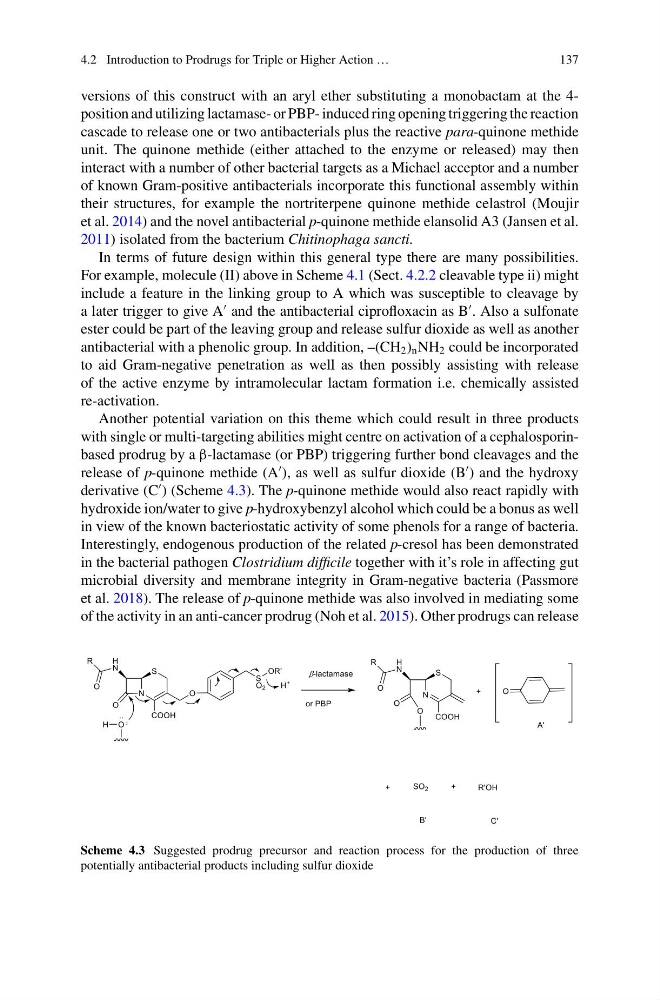
Another potential variation on this theme which could result in three products
with single or multi-targeting abilities might centre on activation of a cephalosporinbased prodrug by a β-lactamase (or PBP) triggering further bond cleavages and the
release of p-quinone methide (A
), as well as sulfur dioxide (B
) and the hydroxy
derivative (C
) (Scheme 4.3). The p-quinone methide would also react rapidly with
hydroxide ion/water to give p-hydroxybenzyl alcohol which could be a bonus as well
in view of the known bacteriostatic activity of some phenols for a range of bacteria.
Interestingly, endogenous production of the related p-cresol has been demonstrated
in the bacterial pathogen Clostridium difficile together with it’s role in affecting gut
microbial diversity and membrane integrity in Gram-negative bacteria (Passmore
et al. 2018). The release of p-quinone methide was also involved in mediating some
of the activity in an anti-cancer prodrug (Noh et al. 2015). Other prodrugs can release
Scheme 4.3 Suggested prodrug precursor and reaction process for the production of three
potentially antibacterial products including sulfur dioxide
137
versions of this construct with an aryl ether substituting a monobactam at the 4position and utilizing lactamase- or PBP- induced ring opening triggering the reaction
cascade to release one or two antibacterials plus the reactive para-quinone methide
unit. The quinone methide (either attached to the enzyme or released) may then
interact with a number of other bacterial targets as a Michael acceptor and a number
of known Gram-positive antibacterials incorporate this functional assembly within
their structures, for example the nortriterpene quinone methide celastrol (Moujir
et al. 2014) and the novel antibacterial p-quinone methide elansolid A3 (Jansen et al.
2011) isolated from the bacterium Chitinophaga sancti.
In terms of future design within this general type there are many possibilities.
For example, molecule (II) above in Scheme 4.1 (Sect. 4.2.2 cleavable type ii) might
include a feature in the linking group to A which was susceptible to cleavage by
a later trigger to give A
and the antibacterial ciprofloxacin as B
. Also a sulfonate
ester could be part of the leaving group and release sulfur dioxide as well as another
antibacterial with a phenolic group. In addition, –(CH 2 ) n NH 2 could be incorporated
to aid Gram-negative penetration as well as then possibly assisting with release
of the active enzyme by intramolecular lactam formation i.e. chemically assisted
re-activation.
Another potential variation on this theme which could result in three products
with single or multi-targeting abilities might centre on activation of a cephalosporinbased prodrug by a β-lactamase (or PBP) triggering further bond cleavages and the
release of p-quinone methide (A
), as well as sulfur dioxide (B
) and the hydroxy
derivative (C
) (Scheme 4.3). The p-quinone methide would also react rapidly with
hydroxide ion/water to give p-hydroxybenzyl alcohol which could be a bonus as well
in view of the known bacteriostatic activity of some phenols for a range of bacteria.
Interestingly, endogenous production of the related p-cresol has been demonstrated
in the bacterial pathogen Clostridium difficile together with it’s role in affecting gut
microbial diversity and membrane integrity in Gram-negative bacteria (Passmore
et al. 2018). The release of p-quinone methide was also involved in mediating some
of the activity in an anti-cancer prodrug (Noh et al. 2015). Other prodrugs can release
Scheme 4.3 Suggested prodrug precursor and reaction process for the production of three
potentially antibacterial products including sulfur dioxide