

130
4 Design Principles and Development of Prodrugs for Multiply …
In the cleavable type i design manifold, a range of other structural variants are
possible apart from those already discussed if A and B are incorporated in different
structures, for example ligand–metal ion complexes where the metal ion might be A
and one of the ligands having a recognition element B. Such complexes may then
be activated through target-ligand binding. Rutledge and co-workers are working
towards an interesting realisation of one aspect of this target binding activation
approach with the design concept of target-activated metal complexes as a magic
bullet type antibacterial therapy. They are developing a metal ion-cyclam complex
to which is attached another ligand with an N-atom also complexed to the metal
ion in the inactive state. When this pendant ligand binds to its biological target
this reveals the active metal ion in the cyclam or other complex which can then
exert other biological activity in situ (Spain et al. 2018). The biological target does
not necessarily have to be an enzyme but it could be. Initial studies indicate good
anti-TB activity with prototype compounds with a cyclam metal-complexing core
and different pendant groups. Such compounds are radically different from other
antibacterials and incorporate structural features and components with potential for
multi-activity expression. Mode of action studies are being pursued. This work also
uses a Zebra fish model for assessment of in vivo activity (Mycobacterium marinarum) and there are possibilities for the extension of this model to other bacterial
pathogens (Yu et al. 2016; Spain et al. 2018).
If A and B are incorporated in monocyclic or bicyclic type systems then on
activation through A---B cleavage could give active single molecules with say A
and
B
exposed in a linked structure able to express multiple binding properties through
the exposed groups. Many possibilities present themselves with these cyclic type i
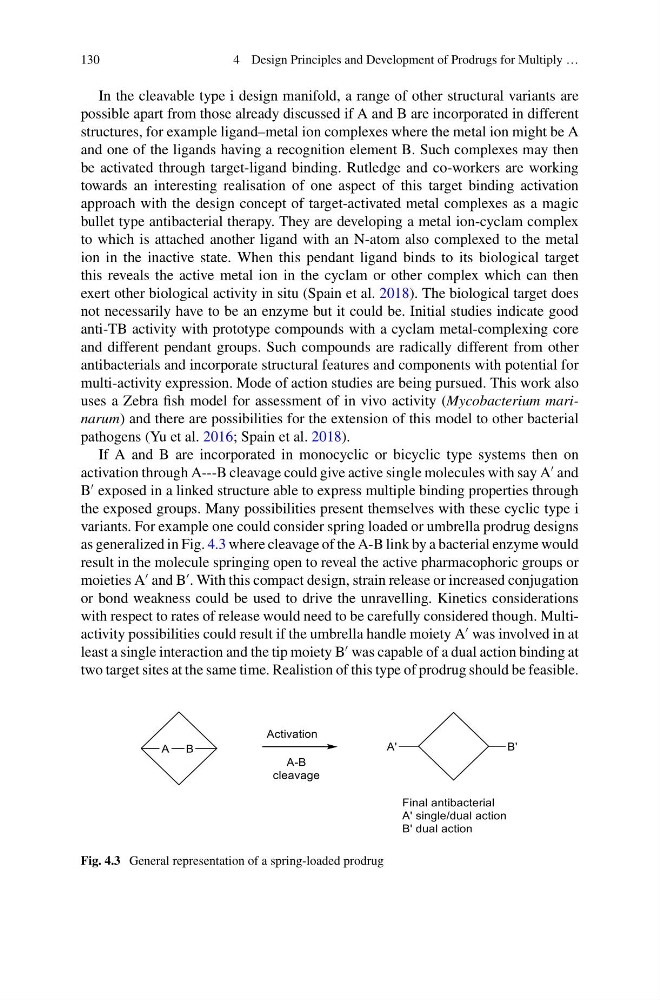
variants. For example one could consider spring loaded or umbrella prodrug designs
as generalized in Fig. 4.3 where cleavage of the A-B link by a bacterial enzyme would
result in the molecule springing open to reveal the active pharmacophoric groups or
moieties A
and B
. With this compact design, strain release or increased conjugation
or bond weakness could be used to drive the unravelling. Kinetics considerations
with respect to rates of release would need to be carefully considered though. Multiactivity possibilities could result if the umbrella handle moiety A
was involved in at
least a single interaction and the tip moiety B
was capable of a dual action binding at
two target sites at the same time. Realistion of this type of prodrug should be feasible.
Fig. 4.3 General representation of a spring-loaded prodrug
4 Design Principles and Development of Prodrugs for Multiply …
In the cleavable type i design manifold, a range of other structural variants are
possible apart from those already discussed if A and B are incorporated in different
structures, for example ligand–metal ion complexes where the metal ion might be A
and one of the ligands having a recognition element B. Such complexes may then
be activated through target-ligand binding. Rutledge and co-workers are working
towards an interesting realisation of one aspect of this target binding activation
approach with the design concept of target-activated metal complexes as a magic
bullet type antibacterial therapy. They are developing a metal ion-cyclam complex
to which is attached another ligand with an N-atom also complexed to the metal
ion in the inactive state. When this pendant ligand binds to its biological target
this reveals the active metal ion in the cyclam or other complex which can then
exert other biological activity in situ (Spain et al. 2018). The biological target does
not necessarily have to be an enzyme but it could be. Initial studies indicate good
anti-TB activity with prototype compounds with a cyclam metal-complexing core
and different pendant groups. Such compounds are radically different from other
antibacterials and incorporate structural features and components with potential for
multi-activity expression. Mode of action studies are being pursued. This work also
uses a Zebra fish model for assessment of in vivo activity (Mycobacterium marinarum) and there are possibilities for the extension of this model to other bacterial
pathogens (Yu et al. 2016; Spain et al. 2018).
If A and B are incorporated in monocyclic or bicyclic type systems then on
activation through A---B cleavage could give active single molecules with say A
and
B
exposed in a linked structure able to express multiple binding properties through
the exposed groups. Many possibilities present themselves with these cyclic type i
variants. For example one could consider spring loaded or umbrella prodrug designs
as generalized in Fig. 4.3 where cleavage of the A-B link by a bacterial enzyme would
result in the molecule springing open to reveal the active pharmacophoric groups or
moieties A
and B
. With this compact design, strain release or increased conjugation
or bond weakness could be used to drive the unravelling. Kinetics considerations
with respect to rates of release would need to be carefully considered though. Multiactivity possibilities could result if the umbrella handle moiety A
was involved in at
least a single interaction and the tip moiety B
was capable of a dual action binding at
two target sites at the same time. Realistion of this type of prodrug should be feasible.
Fig. 4.3 General representation of a spring-loaded prodrug