

resource-saving of over 50%. Also, the acceleration mode of the Digital Twin
offered a significant reduction in development time.
4.2.1 Experimental Setup
To realise a smooth transfer of the control strategies between the “twins”, the Digital
Twin and the small scale STR were connected to the identical process control system
WinErs [20], in which also the controllers were implemented (see Fig. 5).
Since both, the real STR and the Digital Twin were connected to the identical
PCS, the control strategies could be quickly and variably applied and transferred to
the real and simulated process. Both the PCS and the control strategies (RQ feedback
and OLFO) were realised in separate coupled WinErs projects, which leads to high
compatibility.
4.2.2 Development of Respiratory Quotient (RQ) Feedback Control
for the Cultivation of S. cerevisiae
The RQ feedback control strategy is an established soft sensor control strategy used
for fed-batch cultivations of S. cerevisiae [68]. To ensure optimal growth of
S. cerevisiae the RQ should be kept close to a value of 1.0. For the determination
of the RQ value, the composition of the exhaust gas from the reactor during the
cultivation is measured using a gas analyser (SIDOR, Sick). The RQ value can be
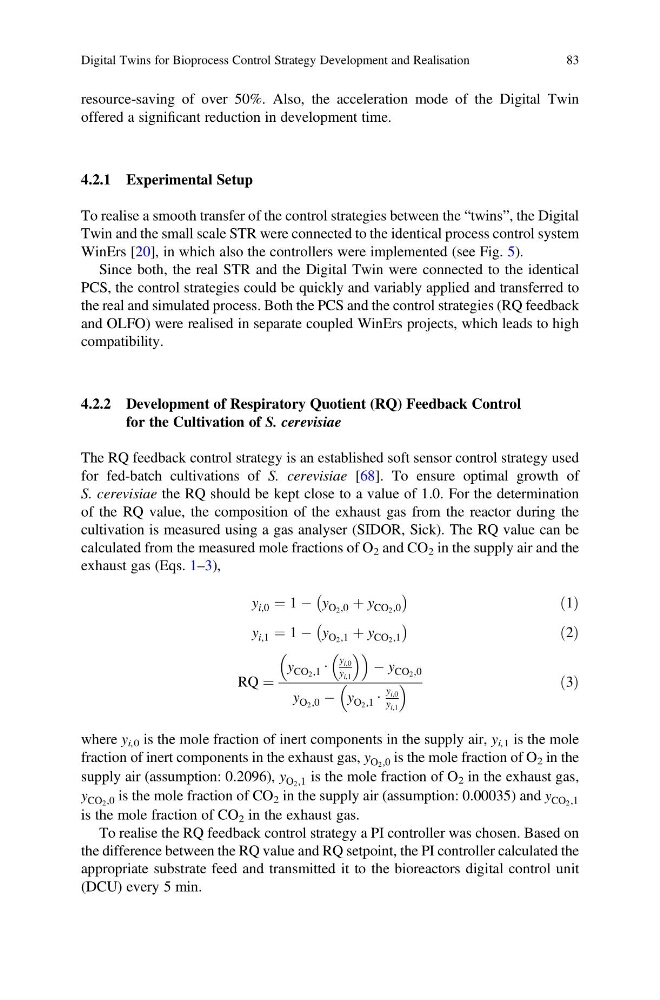
calculated from the measured mole fractions of O 2 and CO 2 in the supply air and the
exhaust gas (Eqs. 1–3),
y i,0 ¼ 1 À y O 2 ,0 þ y CO 2 ,0
À
Á
ð1Þ
y i,1 ¼ 1 À y O 2 ,1 þ y CO 2 ,1
À
Á
ð2Þ
RQ ¼
y CO 2 ,1 ∙
y i,0
y i,1
À y CO 2 ,0
y O 2 ,0 À y O 2 ,1 ∙
y i,0
y i,1
ð3Þ
where y i,0 is the mole fraction of inert components in the supply air, y i,1 is the mole
fraction of inert components in the exhaust gas, y O 2 ,0 is the mole fraction of O 2 in the
supply air (assumption: 0.2096), y O 2 ,1 is the mole fraction of O 2 in the exhaust gas,
y CO 2 ,0 is the mole fraction of CO 2 in the supply air (assumption: 0.00035) and y CO 2 ,1
is the mole fraction of CO 2 in the exhaust gas.
To realise the RQ feedback control strategy a PI controller was chosen. Based on
the difference between the RQ value and RQ setpoint, the PI controller calculated the
appropriate substrate feed and transmitted it to the bioreactors digital control unit
(DCU) every 5 min.
Digital Twins for Bioprocess Control Strategy Development and Realisation
83
offered a significant reduction in development time.
4.2.1 Experimental Setup
To realise a smooth transfer of the control strategies between the “twins”, the Digital
Twin and the small scale STR were connected to the identical process control system
WinErs [20], in which also the controllers were implemented (see Fig. 5).
Since both, the real STR and the Digital Twin were connected to the identical
PCS, the control strategies could be quickly and variably applied and transferred to
the real and simulated process. Both the PCS and the control strategies (RQ feedback
and OLFO) were realised in separate coupled WinErs projects, which leads to high
compatibility.
4.2.2 Development of Respiratory Quotient (RQ) Feedback Control
for the Cultivation of S. cerevisiae
The RQ feedback control strategy is an established soft sensor control strategy used
for fed-batch cultivations of S. cerevisiae [68]. To ensure optimal growth of
S. cerevisiae the RQ should be kept close to a value of 1.0. For the determination
of the RQ value, the composition of the exhaust gas from the reactor during the
cultivation is measured using a gas analyser (SIDOR, Sick). The RQ value can be
calculated from the measured mole fractions of O 2 and CO 2 in the supply air and the
exhaust gas (Eqs. 1–3),
y i,0 ¼ 1 À y O 2 ,0 þ y CO 2 ,0
À
Á
ð1Þ
y i,1 ¼ 1 À y O 2 ,1 þ y CO 2 ,1
À
Á
ð2Þ
RQ ¼
y CO 2 ,1 ∙
y i,0
y i,1
À y CO 2 ,0
y O 2 ,0 À y O 2 ,1 ∙
y i,0
y i,1
ð3Þ
where y i,0 is the mole fraction of inert components in the supply air, y i,1 is the mole
fraction of inert components in the exhaust gas, y O 2 ,0 is the mole fraction of O 2 in the
supply air (assumption: 0.2096), y O 2 ,1 is the mole fraction of O 2 in the exhaust gas,
y CO 2 ,0 is the mole fraction of CO 2 in the supply air (assumption: 0.00035) and y CO 2 ,1
is the mole fraction of CO 2 in the exhaust gas.
To realise the RQ feedback control strategy a PI controller was chosen. Based on
the difference between the RQ value and RQ setpoint, the PI controller calculated the
appropriate substrate feed and transmitted it to the bioreactors digital control unit
(DCU) every 5 min.
Digital Twins for Bioprocess Control Strategy Development and Realisation
83