

Abstract New innovative Digital Twins can represent complex bioprocesses,
including the biological, physico-chemical, and chemical reaction kinetics, as well
as the mechanical and physical characteristics of the reactors and the involved
peripherals. Digital Twins are an ideal tool for the rapid and cost-effective development, realisation and optimisation of control and automation strategies. They may be
utilised for the development and implementation of conventional controllers
(e.g. temperature, dissolved oxygen, etc.), as well as for advanced control strategies
(e.g. control of substrate or metabolite concentrations, multivariable controls), and
the development of complete bioprocess control. This chapter describes the requirements Digital Twins must fulfil to be used for bioprocess control strategy development, and implementation and gives an overview of research projects where Digital
Twins or “early-stage” Digital Twins were used in this context. Furthermore,
applications of Digital Twins for the academic education of future control and
bioprocess engineers as well as for the training of future bioreactor operators will
be described. Finally, a case study is presented, in which an “early-stage” Digital
Twin was applied for the development of control strategies of the fed-batch cultivation of Saccharomyces cerevisiae.
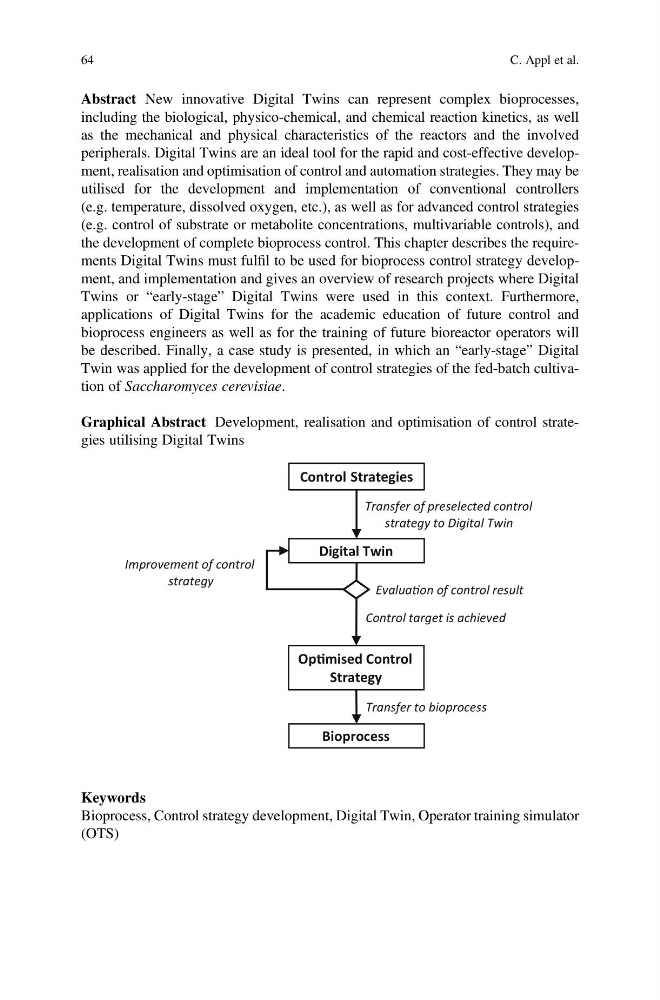
Graphical Abstract Development, realisation and optimisation of control strategies utilising Digital Twins
Digital Twin
Bioprocess
EvaluaƟon of control result
Transfer to bioprocess
OpƟmised Control
Strategy
Control Strategies
Control target is achieved
Improvement of control
strategy
Transfer of preselected control
strategy to Digital Twin
Keywords
Bioprocess, Control strategy development, Digital Twin, Operator training simulator
(OTS)
64
C. Appl et al.
including the biological, physico-chemical, and chemical reaction kinetics, as well
as the mechanical and physical characteristics of the reactors and the involved
peripherals. Digital Twins are an ideal tool for the rapid and cost-effective development, realisation and optimisation of control and automation strategies. They may be
utilised for the development and implementation of conventional controllers
(e.g. temperature, dissolved oxygen, etc.), as well as for advanced control strategies
(e.g. control of substrate or metabolite concentrations, multivariable controls), and
the development of complete bioprocess control. This chapter describes the requirements Digital Twins must fulfil to be used for bioprocess control strategy development, and implementation and gives an overview of research projects where Digital
Twins or “early-stage” Digital Twins were used in this context. Furthermore,
applications of Digital Twins for the academic education of future control and
bioprocess engineers as well as for the training of future bioreactor operators will
be described. Finally, a case study is presented, in which an “early-stage” Digital
Twin was applied for the development of control strategies of the fed-batch cultivation of Saccharomyces cerevisiae.
Graphical Abstract Development, realisation and optimisation of control strategies utilising Digital Twins
Digital Twin
Bioprocess
EvaluaƟon of control result
Transfer to bioprocess
OpƟmised Control
Strategy
Control Strategies
Control target is achieved
Improvement of control
strategy
Transfer of preselected control
strategy to Digital Twin
Keywords
Bioprocess, Control strategy development, Digital Twin, Operator training simulator
(OTS)
64
C. Appl et al.