

the design still provides some information regarding the influence of the other factors
on the response [41]. However, in bioprocesses the number of factors is significantly
larger than the observations. Therefore, domain knowledge as used in mDoE is
needed, captured on models as additional constraints to the system.
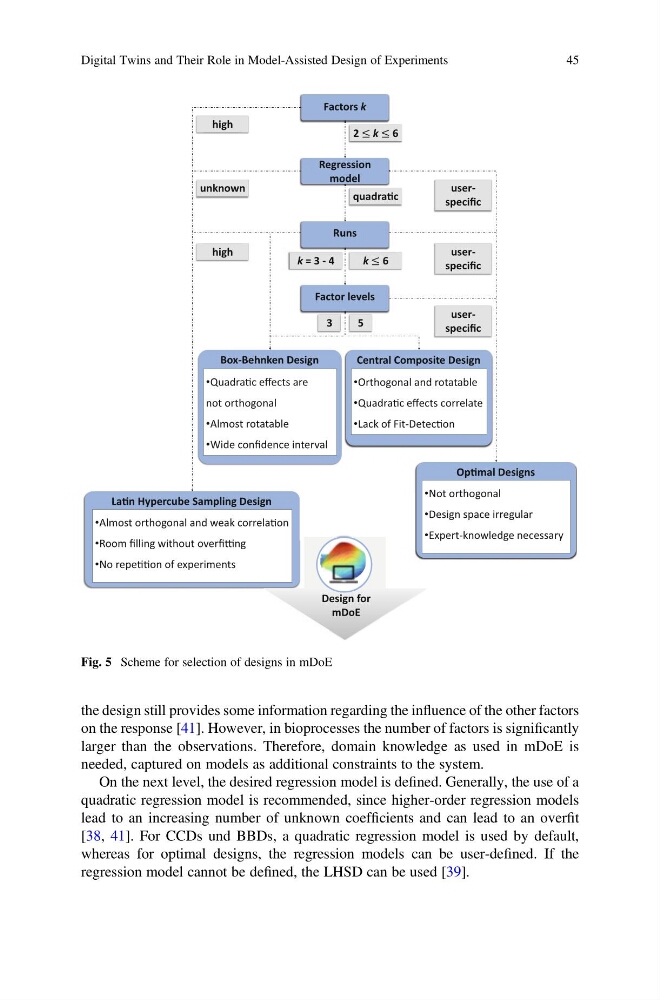
On the next level, the desired regression model is defined. Generally, the use of a
quadratic regression model is recommended, since higher-order regression models
lead to an increasing number of unknown coefficients and can lead to an overfit
[38, 41]. For CCDs und BBDs, a quadratic regression model is used by default,
whereas for optimal designs, the regression models can be user-defined. If the
regression model cannot be defined, the LHSD can be used [39].
quadraƟc
userspecific
5
3
userspecific
userspecific
2 k 6
high
high
k = 3 - 4
k 6
unknown
LaƟn Hypercube Sampling Design
•Almost orthogonal and weak correlaƟon
•Room filling without overfiƫng
•No repeƟƟon of experiments
Box-Behnken Design
•QuadraƟc effects are
not orthogonal
•Almost rotatable
•Wide confidence interval
Central Composite Design
•Orthogonal and rotatable
•QuadraƟc effects correlate
•Lack of Fit-DetecƟon
OpƟmal Designs
•Not orthogonal
•Design space irregular
•Expert-knowledge necessary
Factors k
Regression
model
Runs
Factor levels
Design for
mDoE
Fig. 5 Scheme for selection of designs in mDoE
Digital Twins and Their Role in Model-Assisted Design of Experiments
45
on the response [41]. However, in bioprocesses the number of factors is significantly
larger than the observations. Therefore, domain knowledge as used in mDoE is
needed, captured on models as additional constraints to the system.
On the next level, the desired regression model is defined. Generally, the use of a
quadratic regression model is recommended, since higher-order regression models
lead to an increasing number of unknown coefficients and can lead to an overfit
[38, 41]. For CCDs und BBDs, a quadratic regression model is used by default,
whereas for optimal designs, the regression models can be user-defined. If the
regression model cannot be defined, the LHSD can be used [39].
quadraƟc
userspecific
5
3
userspecific
userspecific
2 k 6
high
high
k = 3 - 4
k 6
unknown
LaƟn Hypercube Sampling Design
•Almost orthogonal and weak correlaƟon
•Room filling without overfiƫng
•No repeƟƟon of experiments
Box-Behnken Design
•QuadraƟc effects are
not orthogonal
•Almost rotatable
•Wide confidence interval
Central Composite Design
•Orthogonal and rotatable
•QuadraƟc effects correlate
•Lack of Fit-DetecƟon
OpƟmal Designs
•Not orthogonal
•Design space irregular
•Expert-knowledge necessary
Factors k
Regression
model
Runs
Factor levels
Design for
mDoE
Fig. 5 Scheme for selection of designs in mDoE
Digital Twins and Their Role in Model-Assisted Design of Experiments
45