

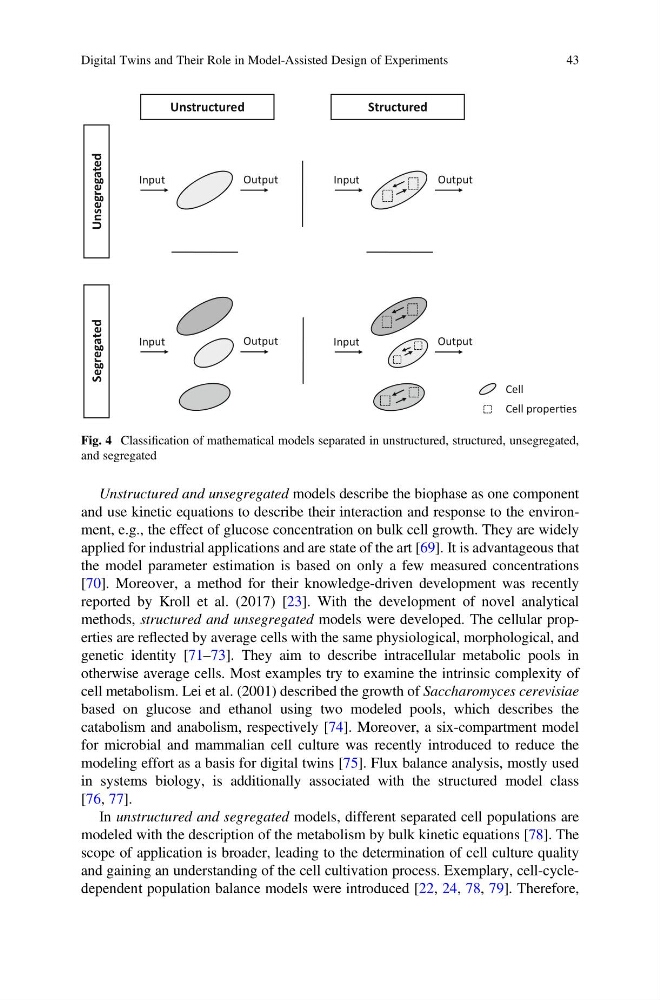
Unstructured and unsegregated models describe the biophase as one component
and use kinetic equations to describe their interaction and response to the environment, e.g., the effect of glucose concentration on bulk cell growth. They are widely
applied for industrial applications and are state of the art [69]. It is advantageous that
the model parameter estimation is based on only a few measured concentrations
[70]. Moreover, a method for their knowledge-driven development was recently
reported by Kroll et al. (2017) [23]. With the development of novel analytical
methods, structured and unsegregated models were developed. The cellular properties are reflected by average cells with the same physiological, morphological, and
genetic identity [71–73]. They aim to describe intracellular metabolic pools in
otherwise average cells. Most examples try to examine the intrinsic complexity of
cell metabolism. Lei et al. (2001) described the growth of Saccharomyces cerevisiae
based on glucose and ethanol using two modeled pools, which describes the
catabolism and anabolism, respectively [74]. Moreover, a six-compartment model
for microbial and mammalian cell culture was recently introduced to reduce the
modeling effort as a basis for digital twins [75]. Flux balance analysis, mostly used
in systems biology, is additionally associated with the structured model class
[76, 77].
In unstructured and segregated models, different separated cell populations are
modeled with the description of the metabolism by bulk kinetic equations [78]. The
scope of application is broader, leading to the determination of cell culture quality
and gaining an understanding of the cell cultivation process. Exemplary, cell-cycledependent population balance models were introduced [22, 24, 78, 79]. Therefore,
Unstructured
Structured
d
e
t
a
g
e
r
g
e
s
n
U
Input
Output
Input
Output
Input
Output
Input
Output
Cell
Cell properƟes
Segregated
Fig. 4 Classification of mathematical models separated in unstructured, structured, unsegregated,
and segregated
Digital Twins and Their Role in Model-Assisted Design of Experiments
43
and use kinetic equations to describe their interaction and response to the environment, e.g., the effect of glucose concentration on bulk cell growth. They are widely
applied for industrial applications and are state of the art [69]. It is advantageous that
the model parameter estimation is based on only a few measured concentrations
[70]. Moreover, a method for their knowledge-driven development was recently
reported by Kroll et al. (2017) [23]. With the development of novel analytical
methods, structured and unsegregated models were developed. The cellular properties are reflected by average cells with the same physiological, morphological, and
genetic identity [71–73]. They aim to describe intracellular metabolic pools in
otherwise average cells. Most examples try to examine the intrinsic complexity of
cell metabolism. Lei et al. (2001) described the growth of Saccharomyces cerevisiae
based on glucose and ethanol using two modeled pools, which describes the
catabolism and anabolism, respectively [74]. Moreover, a six-compartment model
for microbial and mammalian cell culture was recently introduced to reduce the
modeling effort as a basis for digital twins [75]. Flux balance analysis, mostly used
in systems biology, is additionally associated with the structured model class
[76, 77].
In unstructured and segregated models, different separated cell populations are
modeled with the description of the metabolism by bulk kinetic equations [78]. The
scope of application is broader, leading to the determination of cell culture quality
and gaining an understanding of the cell cultivation process. Exemplary, cell-cycledependent population balance models were introduced [22, 24, 78, 79]. Therefore,
Unstructured
Structured
d
e
t
a
g
e
r
g
e
s
n
U
Input
Output
Input
Output
Input
Output
Input
Output
Cell
Cell properƟes
Segregated
Fig. 4 Classification of mathematical models separated in unstructured, structured, unsegregated,
and segregated
Digital Twins and Their Role in Model-Assisted Design of Experiments
43