

2.3 Examples and Challenges of Conventional DoE
In this part, challenges of conventional DoE are discussed focusing on specific
studies. A number of possible applications of screening and optimization designs
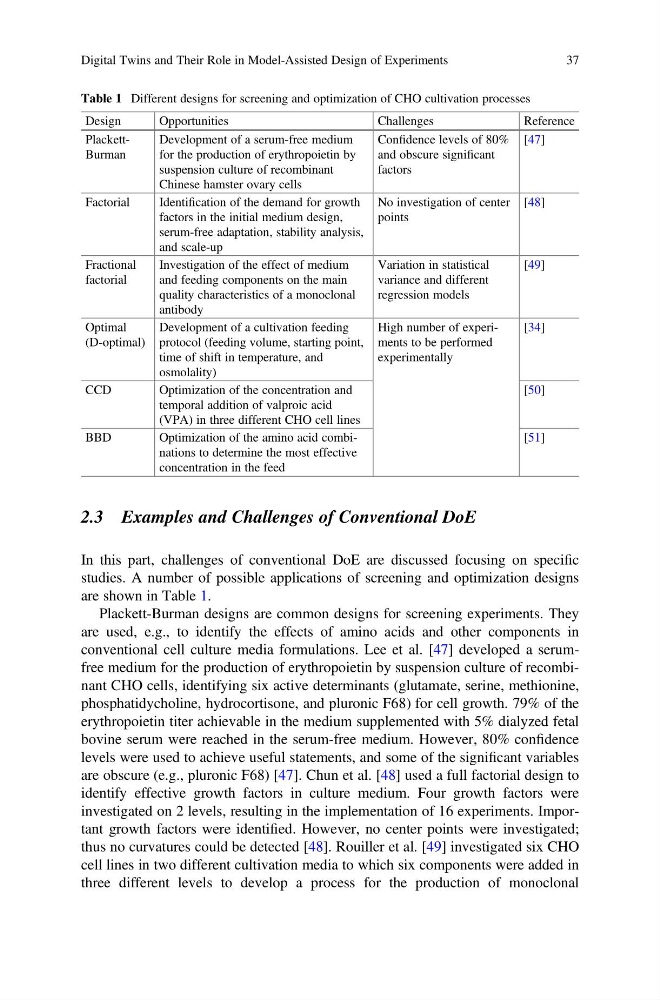
are shown in Table 1.
Plackett-Burman designs are common designs for screening experiments. They
are used, e.g., to identify the effects of amino acids and other components in
conventional cell culture media formulations. Lee et al. [47] developed a serumfree medium for the production of erythropoietin by suspension culture of recombinant CHO cells, identifying six active determinants (glutamate, serine, methionine,
phosphatidycholine, hydrocortisone, and pluronic F68) for cell growth. 79% of the
erythropoietin titer achievable in the medium supplemented with 5% dialyzed fetal
bovine serum were reached in the serum-free medium. However, 80% confidence
levels were used to achieve useful statements, and some of the significant variables
are obscure (e.g., pluronic F68) [47]. Chun et al. [48] used a full factorial design to
identify effective growth factors in culture medium. Four growth factors were
investigated on 2 levels, resulting in the implementation of 16 experiments. Important growth factors were identified. However, no center points were investigated;
thus no curvatures could be detected [48]. Rouiller et al. [49] investigated six CHO
cell lines in two different cultivation media to which six components were added in
three different levels to develop a process for the production of monoclonal
Table 1 Different designs for screening and optimization of CHO cultivation processes
Design
Opportunities
Challenges
Reference
PlackettBurman
Development of a serum-free medium
for the production of erythropoietin by
suspension culture of recombinant
Chinese hamster ovary cells
Confidence levels of 80%
and obscure significant
factors
[47]
Factorial
Identification of the demand for growth
factors in the initial medium design,
serum-free adaptation, stability analysis,
and scale-up
No investigation of center
points
[48]
Fractional
factorial
Investigation of the effect of medium
and feeding components on the main
quality characteristics of a monoclonal
antibody
Variation in statistical
variance and different
regression models
[49]
Optimal
(D-optimal)
Development of a cultivation feeding
protocol (feeding volume, starting point,
time of shift in temperature, and
osmolality)
High number of experiments to be performed
experimentally
[34]
CCD
Optimization of the concentration and
temporal addition of valproic acid
(VPA) in three different CHO cell lines
[50]
BBD
Optimization of the amino acid combinations to determine the most effective
concentration in the feed
[51]
Digital Twins and Their Role in Model-Assisted Design of Experiments
37
In this part, challenges of conventional DoE are discussed focusing on specific
studies. A number of possible applications of screening and optimization designs
are shown in Table 1.
Plackett-Burman designs are common designs for screening experiments. They
are used, e.g., to identify the effects of amino acids and other components in
conventional cell culture media formulations. Lee et al. [47] developed a serumfree medium for the production of erythropoietin by suspension culture of recombinant CHO cells, identifying six active determinants (glutamate, serine, methionine,
phosphatidycholine, hydrocortisone, and pluronic F68) for cell growth. 79% of the
erythropoietin titer achievable in the medium supplemented with 5% dialyzed fetal
bovine serum were reached in the serum-free medium. However, 80% confidence
levels were used to achieve useful statements, and some of the significant variables
are obscure (e.g., pluronic F68) [47]. Chun et al. [48] used a full factorial design to
identify effective growth factors in culture medium. Four growth factors were
investigated on 2 levels, resulting in the implementation of 16 experiments. Important growth factors were identified. However, no center points were investigated;
thus no curvatures could be detected [48]. Rouiller et al. [49] investigated six CHO
cell lines in two different cultivation media to which six components were added in
three different levels to develop a process for the production of monoclonal
Table 1 Different designs for screening and optimization of CHO cultivation processes
Design
Opportunities
Challenges
Reference
PlackettBurman
Development of a serum-free medium
for the production of erythropoietin by
suspension culture of recombinant
Chinese hamster ovary cells
Confidence levels of 80%
and obscure significant
factors
[47]
Factorial
Identification of the demand for growth
factors in the initial medium design,
serum-free adaptation, stability analysis,
and scale-up
No investigation of center
points
[48]
Fractional
factorial
Investigation of the effect of medium
and feeding components on the main
quality characteristics of a monoclonal
antibody
Variation in statistical
variance and different
regression models
[49]
Optimal
(D-optimal)
Development of a cultivation feeding
protocol (feeding volume, starting point,
time of shift in temperature, and
osmolality)
High number of experiments to be performed
experimentally
[34]
CCD
Optimization of the concentration and
temporal addition of valproic acid
(VPA) in three different CHO cell lines
[50]
BBD
Optimization of the amino acid combinations to determine the most effective
concentration in the feed
[51]
Digital Twins and Their Role in Model-Assisted Design of Experiments
37