

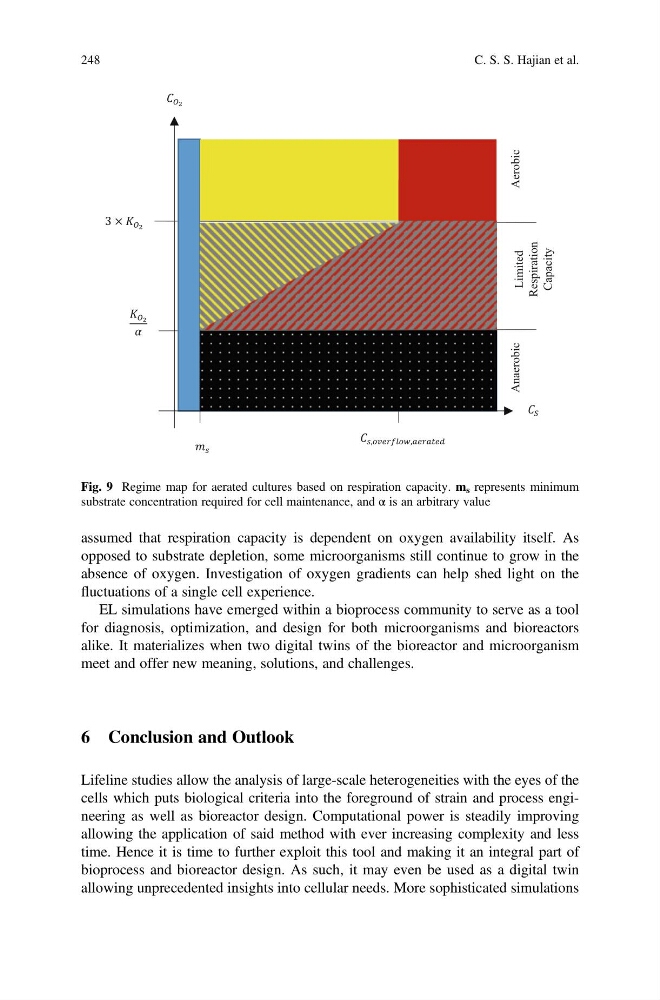
assumed that respiration capacity is dependent on oxygen availability itself. As
opposed to substrate depletion, some microorganisms still continue to grow in the
absence of oxygen. Investigation of oxygen gradients can help shed light on the
fluctuations of a single cell experience.
EL simulations have emerged within a bioprocess community to serve as a tool
for diagnosis, optimization, and design for both microorganisms and bioreactors
alike. It materializes when two digital twins of the bioreactor and microorganism
meet and offer new meaning, solutions, and challenges.
6 Conclusion and Outlook
Lifeline studies allow the analysis of large-scale heterogeneities with the eyes of the
cells which puts biological criteria into the foreground of strain and process engineering as well as bioreactor design. Computational power is steadily improving
allowing the application of said method with ever increasing complexity and less
time. Hence it is time to further exploit this tool and making it an integral part of
bioprocess and bioreactor design. As such, it may even be used as a digital twin
allowing unprecedented insights into cellular needs. More sophisticated simulations
Limited
Respiration
Capacity
Anaerobic
Aerobic
3 ×
,
,
Fig. 9 Regime map for aerated cultures based on respiration capacity. m s represents minimum
substrate concentration required for cell maintenance, and α is an arbitrary value
248
C. S. S. Hajian et al.
opposed to substrate depletion, some microorganisms still continue to grow in the
absence of oxygen. Investigation of oxygen gradients can help shed light on the
fluctuations of a single cell experience.
EL simulations have emerged within a bioprocess community to serve as a tool
for diagnosis, optimization, and design for both microorganisms and bioreactors
alike. It materializes when two digital twins of the bioreactor and microorganism
meet and offer new meaning, solutions, and challenges.
6 Conclusion and Outlook
Lifeline studies allow the analysis of large-scale heterogeneities with the eyes of the
cells which puts biological criteria into the foreground of strain and process engineering as well as bioreactor design. Computational power is steadily improving
allowing the application of said method with ever increasing complexity and less
time. Hence it is time to further exploit this tool and making it an integral part of
bioprocess and bioreactor design. As such, it may even be used as a digital twin
allowing unprecedented insights into cellular needs. More sophisticated simulations
Limited
Respiration
Capacity
Anaerobic
Aerobic
3 ×
,
,
Fig. 9 Regime map for aerated cultures based on respiration capacity. m s represents minimum
substrate concentration required for cell maintenance, and α is an arbitrary value
248
C. S. S. Hajian et al.