

achievable in industrial reactors easily if at all, namely, substrate and product
gradients; high-shear regions are among the most interesting factors that can be
reproduced adequately with help of a digital twin. In this chapter basic principles of
this method will be introduced, and later on some practical aspects of particle
tracking technique will be illustrated. In the final section, some of the advantages
and challenges associated with this method will be discussed.
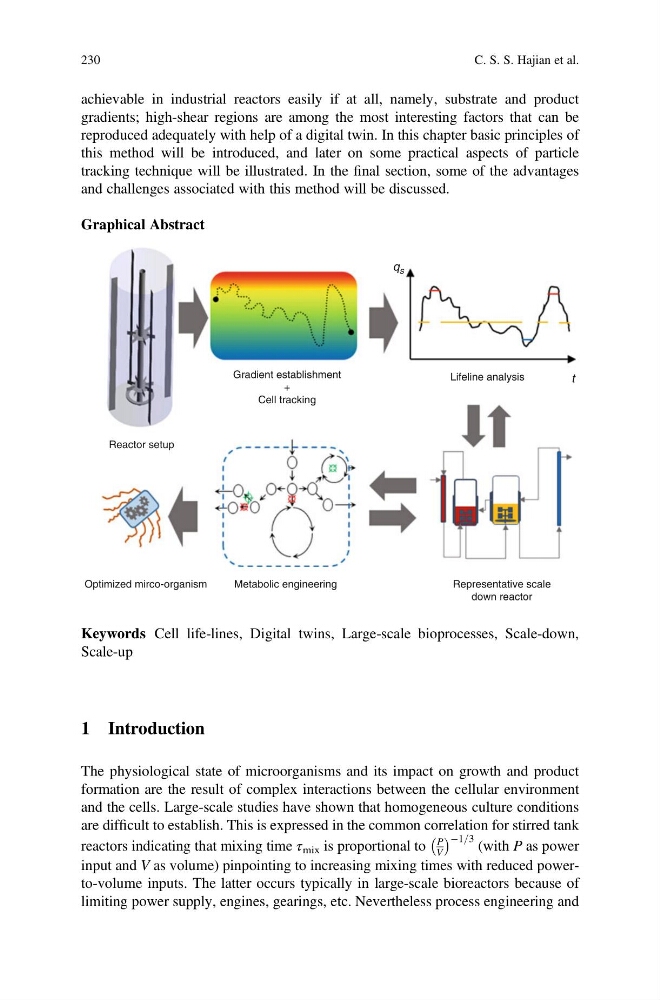
Graphical Abstract
Gradient establishment
+
Cell tracking
Lifeline analysis
t
Reactor setup
Optimized mirco-organism
Metabolic engineering
Representative scale
down reactor
q s
Keywords Cell life-lines, Digital twins, Large-scale bioprocesses, Scale-down,
Scale-up
1 Introduction
The physiological state of microorganisms and its impact on growth and product
formation are the result of complex interactions between the cellular environment
and the cells. Large-scale studies have shown that homogeneous culture conditions
are difficult to establish. This is expressed in the common correlation for stirred tank
reactors indicating that mixing time τ mix is proportional to
P
V
À Á À1=3 (with P as power
input and V as volume) pinpointing to increasing mixing times with reduced powerto-volume inputs. The latter occurs typically in large-scale bioreactors because of
limiting power supply, engines, gearings, etc. Nevertheless process engineering and
230
C. S. S. Hajian et al.
gradients; high-shear regions are among the most interesting factors that can be
reproduced adequately with help of a digital twin. In this chapter basic principles of
this method will be introduced, and later on some practical aspects of particle
tracking technique will be illustrated. In the final section, some of the advantages
and challenges associated with this method will be discussed.
Graphical Abstract
Gradient establishment
+
Cell tracking
Lifeline analysis
t
Reactor setup
Optimized mirco-organism
Metabolic engineering
Representative scale
down reactor
q s
Keywords Cell life-lines, Digital twins, Large-scale bioprocesses, Scale-down,
Scale-up
1 Introduction
The physiological state of microorganisms and its impact on growth and product
formation are the result of complex interactions between the cellular environment
and the cells. Large-scale studies have shown that homogeneous culture conditions
are difficult to establish. This is expressed in the common correlation for stirred tank
reactors indicating that mixing time τ mix is proportional to
P
V
À Á À1=3 (with P as power
input and V as volume) pinpointing to increasing mixing times with reduced powerto-volume inputs. The latter occurs typically in large-scale bioreactors because of
limiting power supply, engines, gearings, etc. Nevertheless process engineering and
230
C. S. S. Hajian et al.