

3.1 Modelling Approaches
The prediction of the fluid flow is based on solving mass, momentum, and energy
conservation equations. This concept includes balances of accumulation, net inflow
from convection and diffusion, and volumetric production within an infinitesimally
small volume element. For most of the bioprocesses performed in the biotech
industry, isothermal conditions (i.e., T % const.) can be assumed. As a result, the
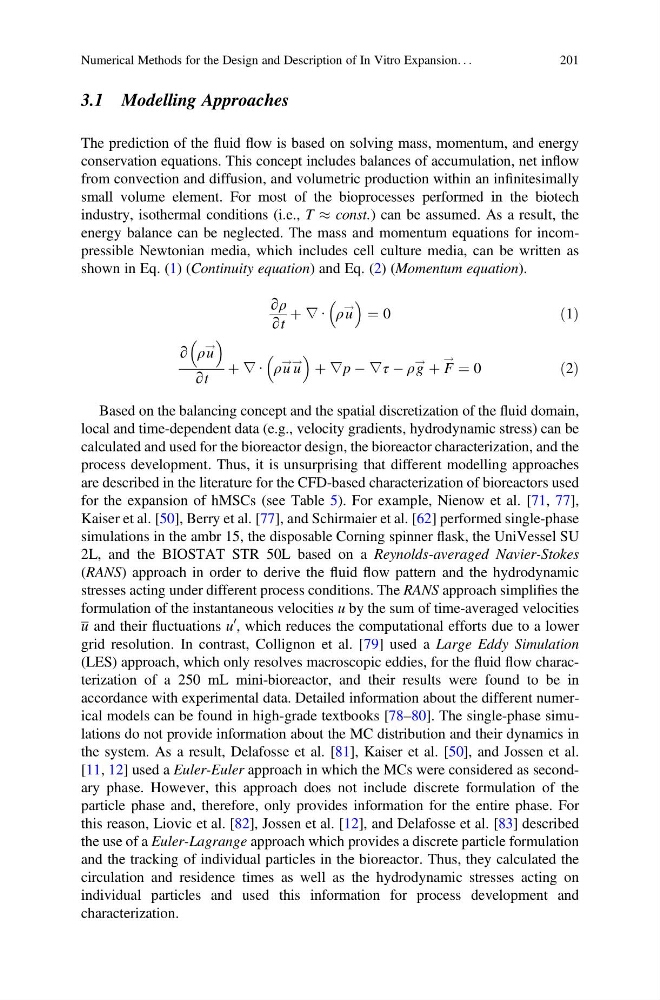
energy balance can be neglected. The mass and momentum equations for incompressible Newtonian media, which includes cell culture media, can be written as
shown in Eq. (1) (Continuity equation) and Eq. (2) (Momentum equation).
∂ρ
∂t
þ ∇ ∙ ρ u
!
¼ 0
ð1Þ
∂ ρ u
!
∂t
þ ∇ ∙ ρ u
! u
!
þ ∇p À ∇τ À ρg
! þ F
! ¼ 0
ð2Þ
Based on the balancing concept and the spatial discretization of the fluid domain,
local and time-dependent data (e.g., velocity gradients, hydrodynamic stress) can be
calculated and used for the bioreactor design, the bioreactor characterization, and the
process development. Thus, it is unsurprising that different modelling approaches
are described in the literature for the CFD-based characterization of bioreactors used
for the expansion of hMSCs (see Table 5). For example, Nienow et al. [71, 77],
Kaiser et al. [50], Berry et al. [77], and Schirmaier et al. [62] performed single-phase
simulations in the ambr 15, the disposable Corning spinner flask, the UniVessel SU
2L, and the BIOSTAT STR 50L based on a Reynolds-averaged Navier-Stokes
(RANS) approach in order to derive the fluid flow pattern and the hydrodynamic
stresses acting under different process conditions. The RANS approach simplifies the
formulation of the instantaneous velocities u by the sum of time-averaged velocities
u and their fluctuations u
0
, which reduces the computational efforts due to a lower
grid resolution. In contrast, Collignon et al. [79] used a Large Eddy Simulation
(LES) approach, which only resolves macroscopic eddies, for the fluid flow characterization of a 250 mL mini-bioreactor, and their results were found to be in
accordance with experimental data. Detailed information about the different numerical models can be found in high-grade textbooks [78–80]. The single-phase simulations do not provide information about the MC distribution and their dynamics in
the system. As a result, Delafosse et al. [81], Kaiser et al. [50], and Jossen et al.
[11, 12] used a Euler-Euler approach in which the MCs were considered as secondary phase. However, this approach does not include discrete formulation of the
particle phase and, therefore, only provides information for the entire phase. For
this reason, Liovic et al. [82], Jossen et al. [12], and Delafosse et al. [83] described
the use of a Euler-Lagrange approach which provides a discrete particle formulation
and the tracking of individual particles in the bioreactor. Thus, they calculated the
circulation and residence times as well as the hydrodynamic stresses acting on
individual particles and used this information for process development and
characterization.
Numerical Methods for the Design and Description of In Vitro Expansion. . .
201
The prediction of the fluid flow is based on solving mass, momentum, and energy
conservation equations. This concept includes balances of accumulation, net inflow
from convection and diffusion, and volumetric production within an infinitesimally
small volume element. For most of the bioprocesses performed in the biotech
industry, isothermal conditions (i.e., T % const.) can be assumed. As a result, the
energy balance can be neglected. The mass and momentum equations for incompressible Newtonian media, which includes cell culture media, can be written as
shown in Eq. (1) (Continuity equation) and Eq. (2) (Momentum equation).
∂ρ
∂t
þ ∇ ∙ ρ u
!
¼ 0
ð1Þ
∂ ρ u
!
∂t
þ ∇ ∙ ρ u
! u
!
þ ∇p À ∇τ À ρg
! þ F
! ¼ 0
ð2Þ
Based on the balancing concept and the spatial discretization of the fluid domain,
local and time-dependent data (e.g., velocity gradients, hydrodynamic stress) can be
calculated and used for the bioreactor design, the bioreactor characterization, and the
process development. Thus, it is unsurprising that different modelling approaches
are described in the literature for the CFD-based characterization of bioreactors used
for the expansion of hMSCs (see Table 5). For example, Nienow et al. [71, 77],
Kaiser et al. [50], Berry et al. [77], and Schirmaier et al. [62] performed single-phase
simulations in the ambr 15, the disposable Corning spinner flask, the UniVessel SU
2L, and the BIOSTAT STR 50L based on a Reynolds-averaged Navier-Stokes
(RANS) approach in order to derive the fluid flow pattern and the hydrodynamic
stresses acting under different process conditions. The RANS approach simplifies the
formulation of the instantaneous velocities u by the sum of time-averaged velocities
u and their fluctuations u
0
, which reduces the computational efforts due to a lower
grid resolution. In contrast, Collignon et al. [79] used a Large Eddy Simulation
(LES) approach, which only resolves macroscopic eddies, for the fluid flow characterization of a 250 mL mini-bioreactor, and their results were found to be in
accordance with experimental data. Detailed information about the different numerical models can be found in high-grade textbooks [78–80]. The single-phase simulations do not provide information about the MC distribution and their dynamics in
the system. As a result, Delafosse et al. [81], Kaiser et al. [50], and Jossen et al.
[11, 12] used a Euler-Euler approach in which the MCs were considered as secondary phase. However, this approach does not include discrete formulation of the
particle phase and, therefore, only provides information for the entire phase. For
this reason, Liovic et al. [82], Jossen et al. [12], and Delafosse et al. [83] described
the use of a Euler-Lagrange approach which provides a discrete particle formulation
and the tracking of individual particles in the bioreactor. Thus, they calculated the
circulation and residence times as well as the hydrodynamic stresses acting on
individual particles and used this information for process development and
characterization.
Numerical Methods for the Design and Description of In Vitro Expansion. . .
201