

per cultivation is significantly increased. Maximum cell densities have been reported
in the literature in the range of 0.4 to 4.2 Â 10
5 cells/cm
2 for hMSCs expanded in 5and 10-layer multi-tray systems with serum-containing and serum-free cell culture
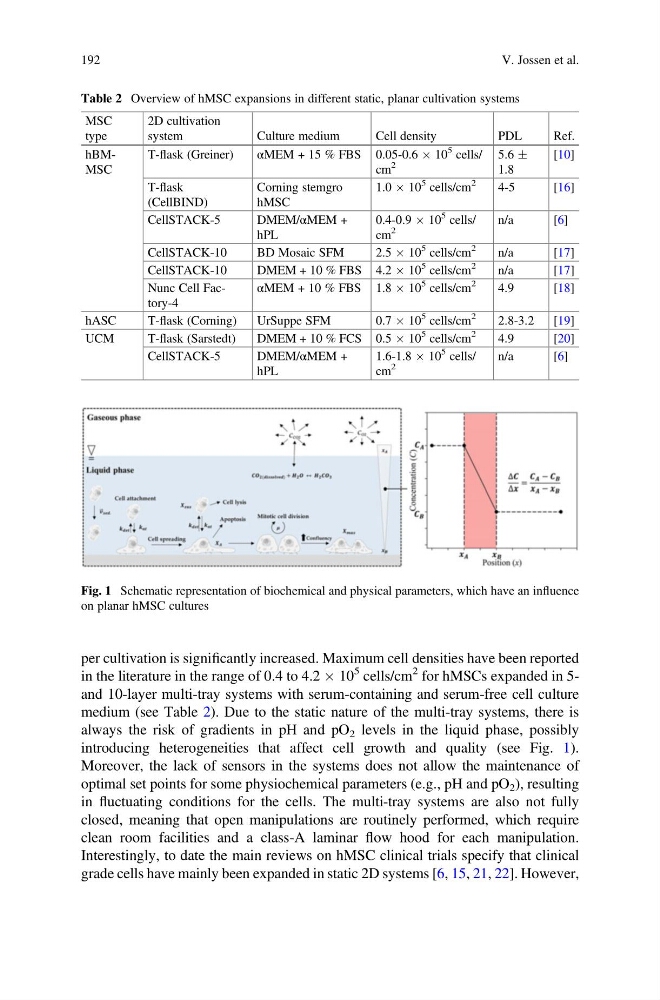
medium (see Table 2). Due to the static nature of the multi-tray systems, there is
always the risk of gradients in pH and pO 2 levels in the liquid phase, possibly
introducing heterogeneities that affect cell growth and quality (see Fig. 1).
Moreover, the lack of sensors in the systems does not allow the maintenance of
optimal set points for some physiochemical parameters (e.g., pH and pO 2 ), resulting
in fluctuating conditions for the cells. The multi-tray systems are also not fully
closed, meaning that open manipulations are routinely performed, which require
clean room facilities and a class-A laminar flow hood for each manipulation.
Interestingly, to date the main reviews on hMSC clinical trials specify that clinical
grade cells have mainly been expanded in static 2D systems [6, 15, 21, 22]. However,
Table 2 Overview of hMSC expansions in different static, planar cultivation systems
MSC
type
2D cultivation
system
Culture medium
Cell density
PDL
Ref.
hBMMSC
T-flask (Greiner)
αMEM + 15 % FBS 0.05-0.6 Â 10
5 cells/
cm
2
5.6 Æ
1.8
[10]
T-flask
(CellBIND)
Corning stemgro
hMSC
1.0 Â 10
5 cells/cm
2
4-5
[16]
CellSTACK-5
DMEM/αMEM +
hPL
0.4-0.9 Â 10
5 cells/
cm
2
n/a
[6]
CellSTACK-10
BD Mosaic SFM
2.5 Â 10
5 cells/cm
2
n/a
[17]
CellSTACK-10
DMEM + 10 % FBS 4.2 Â 10
5 cells/cm
2
n/a
[17]
Nunc Cell Factory-4
αMEM + 10 % FBS 1.8 Â 10
5 cells/cm
2
4.9
[18]
hASC
T-flask (Corning)
UrSuppe SFM
0.7 Â 10
5 cells/cm
2
2.8-3.2
[19]
UCM
T-flask (Sarstedt)
DMEM + 10 % FCS 0.5 Â 10
5 cells/cm
2
4.9
[20]
CellSTACK-5
DMEM/αMEM +
hPL
1.6-1.8 Â 10
5 cells/
cm
2
n/a
[6]
Fig. 1 Schematic representation of biochemical and physical parameters, which have an influence
on planar hMSC cultures
192
V. Jossen et al.
in the literature in the range of 0.4 to 4.2 Â 10
5 cells/cm
2 for hMSCs expanded in 5and 10-layer multi-tray systems with serum-containing and serum-free cell culture
medium (see Table 2). Due to the static nature of the multi-tray systems, there is
always the risk of gradients in pH and pO 2 levels in the liquid phase, possibly
introducing heterogeneities that affect cell growth and quality (see Fig. 1).
Moreover, the lack of sensors in the systems does not allow the maintenance of
optimal set points for some physiochemical parameters (e.g., pH and pO 2 ), resulting
in fluctuating conditions for the cells. The multi-tray systems are also not fully
closed, meaning that open manipulations are routinely performed, which require
clean room facilities and a class-A laminar flow hood for each manipulation.
Interestingly, to date the main reviews on hMSC clinical trials specify that clinical
grade cells have mainly been expanded in static 2D systems [6, 15, 21, 22]. However,
Table 2 Overview of hMSC expansions in different static, planar cultivation systems
MSC
type
2D cultivation
system
Culture medium
Cell density
PDL
Ref.
hBMMSC
T-flask (Greiner)
αMEM + 15 % FBS 0.05-0.6 Â 10
5 cells/
cm
2
5.6 Æ
1.8
[10]
T-flask
(CellBIND)
Corning stemgro
hMSC
1.0 Â 10
5 cells/cm
2
4-5
[16]
CellSTACK-5
DMEM/αMEM +
hPL
0.4-0.9 Â 10
5 cells/
cm
2
n/a
[6]
CellSTACK-10
BD Mosaic SFM
2.5 Â 10
5 cells/cm
2
n/a
[17]
CellSTACK-10
DMEM + 10 % FBS 4.2 Â 10
5 cells/cm
2
n/a
[17]
Nunc Cell Factory-4
αMEM + 10 % FBS 1.8 Â 10
5 cells/cm
2
4.9
[18]
hASC
T-flask (Corning)
UrSuppe SFM
0.7 Â 10
5 cells/cm
2
2.8-3.2
[19]
UCM
T-flask (Sarstedt)
DMEM + 10 % FCS 0.5 Â 10
5 cells/cm
2
4.9
[20]
CellSTACK-5
DMEM/αMEM +
hPL
1.6-1.8 Â 10
5 cells/
cm
2
n/a
[6]
Fig. 1 Schematic representation of biochemical and physical parameters, which have an influence
on planar hMSC cultures
192
V. Jossen et al.